What is open innovation?
Open innovation involves a high degree of trust and belief among collaborating partners (Lam et al. 2021; Ogink et al. 2023). This notion suggests that companies benefit from the knowledge and capabilities of a wide array of stakeholders, including of their human resources, as well of external participants (Lippolis et al. 2023; Luan and Wang 2024). Practitioners may avail themselves of expert individuals and organizations who are not members of staff in their organization. Hence, they could collaborate with other businesses, enterprises, and startups as well as with institutions like universities to achieve their organizations’ objectives (Cappellaro et al. 2019). Various commentators noted that stakeholder engagement could lead to win-win outcomes for all parties involved in open innovation partnerships (Camilleri et al. 2023; Diriker et al. 2023; Kim et al. 2024). Very often, they confirmed that when practitioners worked in tandem with external stakeholders’ practitioners, they were in a better position to improve their operational performance, in terms of incremental and radical innovations, as opposed to when they were on their own (Radicic and Alkaraan 2024).
Several researchers indicated that businesses could increase their competitive advantage and enhance their research and development (R&D) capabilities when they forge collaborative agreements with consultants, disruptive startups, agile companies, reliable suppliers, and excellent universities with cutting-edge facilities as well as with their talented researchers (Beck et al. 2023; Chen 2018). This is in stark contrast with secretive, closed-innovation mentalities characterized when organizations withhold knowledge and ideas generated by their own intellectual capital and internal resources (Barbic et al. 2021; Yoshino et al. 2023). In this case, firms are very careful not to leak insider information to external stakeholders.
Elements of open innovation
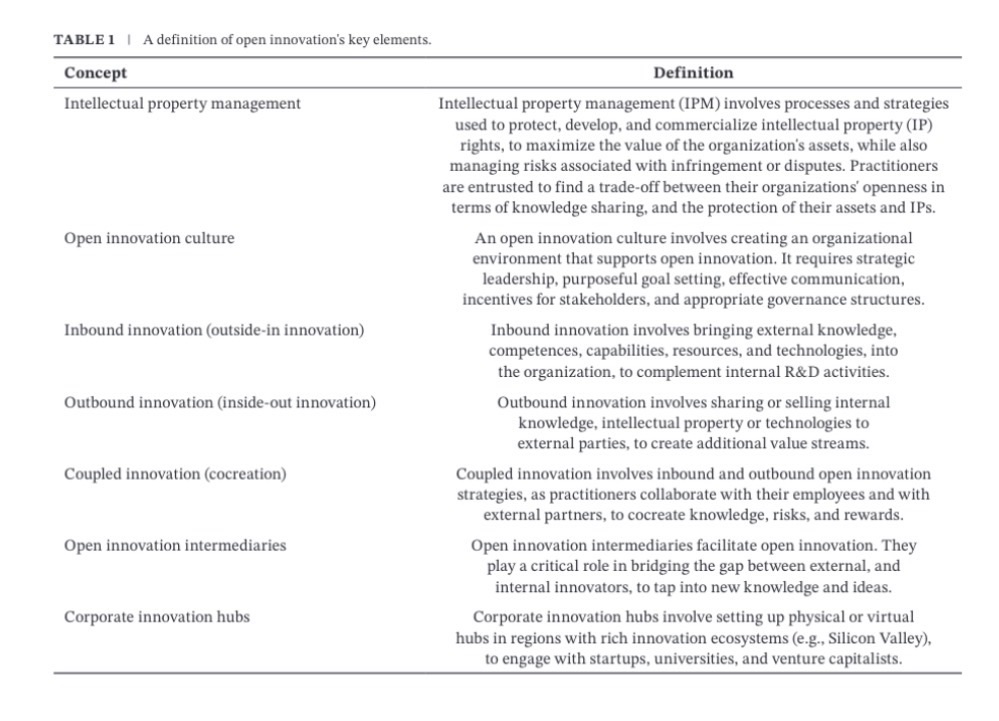
Generally, open innovation ecosystems comprise (i) intellectual property management (Ahlfänger et al. 2022; Fu et al. 2022; Greco et al. 2022; Grimaldi et al. 2021; Jesus et al. 2024; Naveed et al. 2020; Oke 2023), (ii) open innovation culture and governance (Avnimelech and Amit 2024; Lippolis et al. 2023), (iii) inbound innovation (outside-in innovation) (Barjak and Heimsch 2023; Cappellaro et al. 2019; Pilav-Velic and Jahic 2022), (iv) outbound innovation (inside-out innovation) (de Andrés-Sánchez et al. 2022; Remneland Wikhamn and Styhre 2019), (v) coupled innovation (cocreation) (Cammarano et al. 2022), (vi) open innovation intermediaries (Caloffi et al. 2023), and (vii) corporate innovation hubs (Amann et al. 2022; Corvello et al. 2023). Practitioners may avail themselves of open innovation systems to access diverse ideas, resources, and capabilities from their own human resources’ talent pool, and more importantly, from knowledgeable external sources. Table 1 sheds light on the most popular open innovation concepts and provides their definitions.
Suggested citation: Camilleri, M. A. (2025). Cocreating value through open circular innovation strategies: a results‐driven work plan and future research avenues. Business Strategy and the Environment, 34(4), 4561-4580.
 Substantia Mea
You must be logged in to post a comment.