📣[Call for papers] on AI-enabled accommodation platforms and destination governance!
Accommodation platforms may no longer be simply considered as places where travellers book a room, bearing in mind that algorithms rank properties; AI recommends destinations; dynamic pricing affects perceived value; reviews and generated content influence destination images; AND platforms redirect tourist flows across cities and neighbourhoods.
I am pleased to invite submissions to our Special Issue in the Journal of Destination Marketing & Management [CS 13.5; IF 8]:
“Digital Transformation and AI-Enabled Accommodation Platforms: Implications for Destination Marketing, Governance and Development”.
My colleagues and I welcome theoretically grounded, empirically robust research that examines how AI, algorithms and accommodation platforms are reconfiguring destination ecosystems.
🔎 Plausible research areas include: • Generative AI and destination marketing • AI-powered recommendation systems • Algorithmic visibility and destination branding • Dynamic pricing and demand forecasting • Reviews, ratings and AI-generated content • Hotels versus P2P accommodation platforms • Overtourism, undertourism and spatial redistribution • Platform power, regulation and destination governance • Sustainable and inclusive destination development
💡 Here are a few questions worth investigating: 🔴 What if AI decides which destinations tourists see and visit? 🔴 Who controls destination visibility in the age of AI? 🔴 Who shapes a destination’s image today: marketers, travellers or algorithms? 🔴 Could algorithms determine which destinations become more competitive? 🔴 When AI recommends where to stay, does it also influence where we travel? 🔴 Are booking platforms just selling rooms, or are they transforming destinations? 🔴 What happens to destination governance when platforms manage data and direct tourist demand?
📅 Submissions open: 1 October 2026 ⏳ Deadline: 31st August 2028
We particularly encourage mixed-method, longitudinal and multi-level empirical research.
Prof. Camilleri is supported by internationally recognised experts in services marketing and management, comprising Prof. Levent Altinay, Editor of The Services Industries Journal; Prof. Sang M. Lee, Editor of Service Business and Prof. Cheng Lu (Charles) Wang, Editor of the Journal of Research in Interactive Marketing.
The full text of the Call for Papers is presented below. It provides background to the special issue. It outlines the theoretical perspectives that prospective contributors may adopt. It highlights illustrative research topics and also includes the submission guidelines for authors.
Introduction
Generative Artificial Intelligence (GenAI) and Agentic Artificial Intelligence (Agentic AI) are transforming how services are designed, delivered, experienced and led. While GenAI refers to systems, such as large language models (LLMs), that produce content in response to human prompts; Agentic AI technologies may be considered as active agents that can implement tasks (rather than merely functioning as passive generators) (Acharya et al., 2025). The latter can monitor situations, allocate resources, initiate and manage processes as well as co-ordinate multiple activities (Gonzalez et al., 2026). Hence, Agentic AI algorithms and their governance affect service outcomes.
Generative AI capabilities often constitute the communicative and cognitive foundations of Agentic AI. In other words, many Agentic AI systems rely on GenAI models to reason, communicate and interact. Together, these AI technologies challenge conventional assumptions about agency, control, responsibility and value creation in service environments (Ferraro et al., 2024; Wirtz & Stock-Homburg, 2025). Unlike earlier forms of automation and analytics, these AI systems can engage in social interactions, reason in a contextual manner and may dynamically adapt to changing situations. As such, they raise profound theoretical questions about anthropomorphism, social presence, trust, autonomy, creativity, emotion, accountability, responsibility and moral agency (Banh & Strobel, 2023; Ng et al., 2026; Sun et al., 2026).
These capabilities indicate that Generative and Agentic AI represent more than incremental advances in automated technologies. They introduce different forms of interaction and agency that cannot be fully explained by utility-driven adoption frameworks (Camilleri, 2024).
Consequently, there is a growing need for theory-driven and conceptually rigorous research that explains how, why and under what conditions Generative and Agentic AI are deployed, adapted, governed, or even resisted in service environments.
This special issue seeks to advance services marketing research by encouraging scholars to utilise, extend, integrate or critically evaluate existing theories to investigate user engagement with Generative and Agentic AI across diverse service settings. In this light, the guest editorial team particularly welcomes submissions that move beyond descriptive accounts. Prospective contributions are expected to offer strong theoretical explanations of AI acceptance and usage in services.
Theoretical perspectives
The editors of this special issue particularly welcome submissions that explicitly draw upon, refine or combine well-established theories that have been influential in service and technology research, including (but not limited to) the following ones (as discussed in Camilleri & Troise, 2023):
Anthropomorphism theory (e.g., human-likeness, emotional attachment and/or moral attributions to AI).
Affordance theory (perceived action possibilities enabled or constrained by GenAI and/or Agentic AI interfaces).
Assemblage theory (AI as part of dynamic socio-technical service systems).
Behavioural reasoning theory (reasons for and against AI use in service encounters).
Cognitive fit theory (task–AI alignment and decision quality).
Commitment–consistency theory (habit formation and sustained AI use).
Communication accommodation theory (linguistic and stylistic adaptation in human–AI interaction).
Contingency theory (contextual conditions that can have an impact on AI effectiveness).
Diffusion of innovations theory (organisational and market-level adoption trajectories).
Expectancy and expectation-violation theories (surprise, delight, discomfort or distrust in AI services).
Flow theory in computer-mediated environments (engagement, creativity and immersion).
Functionalist theory of emotion (affective responses to AI-enabled services).
Human–computer interaction / human–machine communication theories.
Information systems success model (service quality, satisfaction and net benefits of AI).
Politeness theory (face-management and social norms in AI communication).
Self-determination theory (autonomy, competence and relatedness in AI use).
Situational theories of problem-solving and publics.
Social cognitive theory (learning AI use through observation and social influence).
Social presence and social response theories.
Structural role theory (AI as role-performing service actors).
Technology acceptance model (TAM) and unified theory of acceptance and use of technology (UTAUT).
Theory of conversation.
Theory of planned behaviour (TPB) and its related theory of reasoned action (TRA).
Trust–commitment theory.
Uses and gratifications theory.
Submissions that integrate multiple perspectives, compare existing conceptual frameworks and develop new theoretical models specific to GenAI and Agentic AI in services are especially encouraged for this special issue.
Illustrative research questions may include (but are not limited to): How and to what extent do customers and employees anthropomorphise Generative versus Agentic AI in service encounters? Which GenAI and Agentic AI affordances drive value co-creation, trust, reliance or resistance in services? How do emotional cues, social presence and politeness strategies influence engagement with AI-driven service agents? Under what contingencies does AI adoption enhance or undermine service quality, relationships and well-being? How do expectations and expectation violation aspects influence satisfaction and continued use of AI-enabled services? How do organisations implement Agentic AI within broader service systems? What ethical, relational, psychological and accountability tensions emerge from sustained human–AI interactions, particularly when AI acts autonomously?
The special issue welcomes conceptual, qualitative, quantitative, experimental or mixed-methods approaches, provided that the contributing authors demonstrate strong theoretical grounding and relevance to the underlying objectives of this journal.
List of topic areas
Theoretical perspectives on Generative and Agentic AI adoption in service environments.
Comparative or multi-theoretical frameworks for studying human-AI interaction in services.
Anthropomorphism, social presence and human-AI relationships.
Perceived affordances, interface design and service experiences.
Emotions, expectations and psychological responses to AI.
Adoption, acceptance and continued use of AI in services.
Trust, ethics, accountability and relational governance.
AI as a service actor within socio-technical systems.
Contextual and contingency-based perspectives.
Value co-creation, value co-destruction and service outcomes.
Organisational, strategic and policy implications of Generative and Agentic AI in services.
Submissions Information
Submissions are made using ScholarOne Manuscripts. Registration and access are available here.
Author guidelines must be strictly followed which are available online.
Authors should select (from the drop-down menu) the special issue title at the appropriate step in the submission process, i.e. in response to ““Please select the issue you are submitting to”.
Submitted articles must not have been previously published, nor should they be under consideration for publication anywhere else, while under review for this journal.
Key deadlines
Opening date for manuscripts submissions: 23 June 2026
Closing date for manuscripts submission: 26 February 2027
In January 2026, Professor Camilleri launched another call for papers for a special issue focused on ethical AI. The latter one, entitled: ‘Ethical implications of artificial intelligence (AI) and automation in service industries’, will be published by The Service Industries Journal. In this case, the deadline for submission will be on 31 January 2027.
Artificial intelligence (AI) and automation technologies are transforming service industries, including finance, healthcare, hospitality, retail, education, public services and digital platforms. While algorithmic decision-making systems, service robots, chatbots, predictive analytics and automated workflows offer enhanced efficiencies, personalization possibilities and scalability potential, these technologies are also raising profound ethical concerns related to their modus operandi and explainability of their outputs (Camilleri, 2024; Hu & Min, 2023).
As AI-driven service systems increasingly mediate interactions between organisations and their stakeholders; ethical failures and bias have the potential to reinforce existing social inequalities, undermine their trustworthiness, service quality, organisational legitimacy and broader societal well-being (Camilleri et al., 2024). Moreover, opaque “black-box” models reduce transparency and could erode user trust in these machine learning technologies (Kordzadeh & Ghasemaghaei, 2022). Unclear accountability structures may obscure responsibility for service failures or might facilitate unintended harmful outcomes (Novelli et al., 2024). These challenges are particularly evidenced in service contexts where human–AI interactions are frequent, relational and consequential.
Such concerns are clearly illustrated in healthcare services (Procter et al., 2023), where AI-driven diagnostic and triage systems are increasingly used to support clinical decision-making. When these technologies rely on biased or unrepresentative training data, they may systematically underdiagnose or misclassify specific demographic groups. Given the high-stakes and the relational nature of healthcare encounters, limited transparency and explainability can significantly diminish patient trust while raising serious ethical and accountability concerns.
Similar issues arise in financial and insurance services (Oke & Cavus, 2025), where automated credit scoring, loan approval and underwriting systems directly influence individuals’ financial inclusion and long-term economic prospects. Algorithmic opacity makes it difficult for customers to understand, question or contest adverse decisions. Therefore, biased models may perpetuate or amplify socioeconomic inequalities. Such an outcome is particularly problematic in service relationships characterised by long-term dependency and trust.
Ethical challenges are also conspicuous in customer service and frontline interactions (Han et al., 2023), where chatbots and virtual assistants handle large volumes of customer inquiries across retail, telecommunications and travel services (Lv et al., 2022). Although these systems offer efficiency and scalability benefits, there are instances where they fail to recognise emotional distress, cultural differences, or exceptional circumstances. Excessive automation can therefore undermine relational service quality, especially when customers are unable to escalate complex or sensitive issues to human agents (Yang et al., 2022).
In public service contexts, governments are progressively deploying AI systems (Willems et al., 2023) to allocate welfare benefits, determine assess eligibility and detect fraud. In such settings, automated decisions can have profound implications for the citizens’ livelihoods and their inclusion in cohesive societies Ethical concerns become particularly acute when accountability is diffused between public agencies and technology providers, as well as when affected individuals lack meaningful mechanisms for appeal, explanation or redress.
Likewise, platform-based and gig economy services are increasingly relying on algorithmic management systems to assign tasks, evaluate performance and to compute remunerations (Kadolkar et al., 2025). These systems often operate as “black boxes,” leaving workers uncertain about how ratings, penalties or income calculations are determined. The resulting lack of transparency and of clear accountability structures can weaken trust, exacerbate power asymmetries and could intensify worker vulnerability within ongoing service relationships.
Notwithstanding, more human resource management and recruitment specialists are adopting AI-enabled tools for résumé screening and to assess their candidates’ credentials (Soleimani et al., 2025). Possible bias embedded within these systems may disadvantage certain social groups. Their limited transparency can prevent applicants from understanding how hiring decisions are made. Such practices raise important ethical questions concerning fairness, informed consent and procedural justice within professional service contexts.
This special issue seeks to advance novel insights into the above ethical implications of AI and automation in services industries. The guest editors look forward to receiving original, interdisciplinary contributions that critically examine how ethical principles can be embedded into the design, governance, implementation and evaluation of AI-enabled service systems.
Aims and scope
The special issue aims to:
· Deepen understanding of ethical risks and dilemmas associated with AI and automation in service industries.
· Explore mechanisms for bias detection, mitigation and governance in service algorithms.
· Examine transparency, explainability and accountability in AI-enabled service encounters.
· Advance responsible, human-centered and sustainable approaches to AI-driven service innovation.
Both conceptual, theoretical and empirical contributions are welcome, including qualitative, quantitative, mixed-methods, experimental, design science as well as critical and/or reflexive approaches.
Indicative themes and topics
Submissions may address, but are not limited to, the following topics:
· Algorithmic bias and discrimination in service delivery;
· Ethical design of AI-enabled service systems;
· Transparency and explainability in automated service decisions;
· Accountability and responsibility in human–AI service interactions;
· AI ethics governance, regulation, and standards in service industries;
· Trust, legitimacy and customer perceptions of AI-driven services;
· Ethical implications of service robots and conversational agents;
· Human oversight and hybrid human–AI service models;
· Data privacy, surveillance and consent in digital service platforms;
· Fairness and inclusion in AI-based personalisation and targeting;
· Responsible AI and ESG considerations in service organisations;
· Cross-cultural and institutional perspectives on AI ethics in services;
· Ethical failures, service recovery and crisis communication involving AI;
· Methodological advances for studying ethics in AI-enabled services.
References
Camilleri, M. A., Zhong, L., Rosenbaum, M. S. & Wirtz, J. (2024). Ethical considerations of service organizations in the information age. The Service Industries Journal, 44(9-10), 634-660.
Camilleri, M. A. (2024). Artificial intelligence governance: Ethical considerations and implications for social responsibility. Expert Systems, 41(7), e13406.
Hu, Y., & Min, H. K. (2023). The dark side of artificial intelligence in service: The “watching-eye” effect and privacy concerns. International Journal of Hospitality Management, 110, 103437.
Kadolkar, I., Kepes, S., & Subramony, M. (2025). Algorithmic management in the gig economy: A systematic review and research integration. Journal of Organizational Behavior, 46(7), 1057-1080.
Kordzadeh, N., & Ghasemaghaei, M. (2022). Algorithmic bias: review, synthesis, and future research directions. European Journal of Information Systems, 31(3), 388-409.
Lv, X., Yang, Y., Qin, D., Cao, X., & Xu, H. (2022). Artificial intelligence service recovery: The role of empathic response in hospitality customers’ continuous usage intention. Computers in Human Behavior, 126, 106993.
Novelli, C., Taddeo, M., & Floridi, L. (2024). Accountability in artificial intelligence: What it is and how it works. AI & Society, 39(4), 1871-1882.
Procter, R., Tolmie, P., & Rouncefield, M. (2023). Holding AI to account: challenges for the delivery of trustworthy AI in healthcare. ACM Transactions on Computer-Human Interaction, 30(2), 1-34.
Soleimani, M., Intezari, A., Arrowsmith, J., Pauleen, D. J., & Taskin, N. (2025). Reducing AI bias in recruitment and selection: an integrative grounded approach. The International Journal of Human Resource Management, 1-36.
Willems, J., Schmid, M. J., Vanderelst, D., Vogel, D., & Ebinger, F. (2023). AI-driven public services and the privacy paradox: do citizens really care about their privacy?. Public Management Review, 25(11), 2116-2134.
Yang, Y., Liu, Y., Lv, X., Ai, J., & Li, Y. (2022). Anthropomorphism and customers’ willingness to use artificial intelligence service agents. Journal of Hospitality Marketing & Management, 31(1), 1-23.
Submission Instructions
Submission guidelines
Manuscripts should be prepared according to The Service Industries Journal’s author guidelines and submitted via the journal’s online submission system. During submission, authors should select the special issue title:
“Ethical implications of artificial intelligence (AI) and automation in service industries: Addressing algorithmic bias, opacity and unclear accountability mechanisms”.
All submissions will undergo a double-blind peer review process in accordance with the journal’s standards and policies of Taylor & Francis.
Important dates
Full paper submission deadline: 31st January 2027
First round of reviews: 31st March 2027
Revised manuscript submission: 31st May 2027
Final acceptance: 31st August 2027
Expected publication: 30th November 2027
Contact Information: For informal enquiries regarding the fit of manuscripts or the scope of the special issue, please contact the Leading Guest Editor via Mark.A.Camilleri@um.edu.mt.
This empirical study provides a snapshot of the online users’ perceptions about Chat Generative Pre-Trained Transformer (ChatGPT)’s responses to verbal queries, and sheds light on their dispositions to avail themselves from ChatGPT’s natural language processing.
It explores their performance expectations about their usefulness and their effort expectations related to the ease of use of these information technologies and investigates whether they are affected by colleagues or by other social influences to use such dialogue systems. Moreover, it examines their insights about the content quality, source trustworthiness as well as on the interactivity features of these text-generative AI models.
Generally, the results suggest that the research participants felt that these algorithms are easy to use. The findings indicate that they consider them to be useful too, specifically when the information they generate is trustworthy and dependable.
The respondents suggest that they are concerned about the quality and accuracy of the content that is featured in the AI chatbots’ answers. This contingent issue can have a negative effect on the use of the information that is created by online dialogue systems.
OpenAI’s ChatGPT is a case in point. Its app is freely available in many countries, via desktop and mobile technologies including iOS and Android. The company admits that its GPT-3.5 outputs may be inaccurate, untruthful, and misleading at times. It clarifies that its algorithm is not connected to the internet, and that it can occasionally produce incorrect answers (OpenAI, 2023a). It posits that GPT-3.5 has limited knowledge of the world and events after 2021 and may also occasionally produce harmful instructions or biased content.
OpenAI recommends checking whether its chatbot’s responses are accurate or not, and to let them know when and if it answers in an incorrect manner, by using their “Thumbs Down” button. They even declare that their ChatGPT’s Help Center can occasionally make up facts or “hallucinate” outputs (OpenAI, 2023a, OpenAI, 2023b).
OpenAI reports that its top notch ChatGPT Plus subscribers can access safer and more useful responses. In this case, users can avail themselves from a number of beta plugins and resources that can offer a wide range of capabilities including text-to-speech applications as well as web browsing features through Bing.
Yet again, OpenAI (2023b) indicates that its GPT-4 still has many known limitations that the company is working to address, such as “social biases and adversarial prompts” (at the time of writing this article). Evidently, works are still in progress at OpenAI.
The company needs to resolve these serious issues, considering that its Content Policy and Terms clearly stipulate that OpenAI’s consumers are the owners of the output that is created by ChatGPT. Hence, ChatGPT’s users have the right to reprint, sell, and merchandise the content that is generated for them through OpenAI’s platforms, regardless of whether the output (its response) was provided via a free or a paid plan.
Various commentators are increasingly raising awareness about the corporate digital responsibilities of those involved in the research, development and maintenance of such dialogue systems. A number of stakeholders, particularly the regulatory ones, are concerned on possible risks and perils arising from AI algorithms including interactive chatbots.
In many cases, they are warning that disruptive chatbots could disseminate misinformation, foster prejudice, bias and discrimination, raise privacy concerns, and could lead to the loss of jobs. Arguably, one has to bear in mind that, in many cases, many governments are outpaced by the proliferation of technological innovations (as their development happens before the enactment of legislation).
As a result, they tend to be reactive in the implementation of substantive regulatory interventions. This research reported that the development of ChatGPT has resulted in mixed reactions among different stakeholders in society, especially during the first months after its official launch.
At the moment, there are just a few jurisdictions that have formalized policies and governance frameworks that are meant to protect and safeguard individuals and entities from possible risks and dangers of AI technologies (Camilleri, 2023). Of course, voluntary principles and guidelines are a step in the right direction. However, policy makers are expected by various stakeholders to step-up their commitment by introducing quasi-regulations and legislation.
Currently, a number of technology conglomerates including Microsoft-backed OpenAI, Apple and IBM, among others, anticipated the governments’ regulations by joining forces in a non-profit organization entitled, “Partnership for AI” that aims to advance safe, responsible AI, that is rooted in open innovation.
In addition, IBM has also teamed up with Meta and other companies, startups, universities, research and government organizations, as well as non-profit foundations to form an “AI Alliance”, that is intended to foster innovations across all aspects of AI technology, applications and governance.
Suggested citation: Camilleri, M. A. (2024). Factors affecting performance expectancy and intentions to use ChatGPT: Using SmartPLS to advance an information technology acceptance framework. Technological Forecasting and Social Change, 201, https://doi.org/10.1016/j.techfore.2024.123247
Featuring an excerpt and a few snippets from one of my latest articles related to Generative Artificial Intelligence (AI).
Suggested Citation: Camilleri, M.A. (2024). Factors affecting performance expectancy and intentions to use ChatGPT: Using SmartPLS to advance an information technology acceptance framework, Technological Forecasting and Social Change, https://doi.org/10.1016/j.techfore.2024.123247
The introduction
Artificial intelligence (AI) chatbots utilize algorithms that are trained to process and analyze vast amounts of data by using techniques ranging from rule-based approaches to statistical models and deep learning, to generate natural text, to respond to online users, based on the input they received (OECD, 2023). For instance, Open AI‘s Chat Generative Pre-Trained Transformer (ChatGPT) is one of the most popular AI-powered chatbots. The company claims that ChatGPT “is designed to assist with a wide range of tasks, from answering questions to generating text in various styles and formats” (OpenAI, 2023a). OpenAI clarifies that its GPT-3.5, is a free-to-use language model that was optimized for dialogue by using Reinforcement Learning with Human Feedback (RLHF) – a method that relies on human demonstrations and preference comparisons to guide the model toward desired behaviors. Its models are trained on vast amounts of data including conversations that were created by humans (such content is accessed through the Internet). The responses it provides appear to be as human-like as possible (Jiang et al., 2023).
GPT-3.5’s database was last updated in September 2021. However, GPT-4.0 version comes with a paid plan that is more creative than GPT-3.5, could accept images as inputs, can generate captions, classifications and analyses (Qureshi et al., 2023). Its developers assert that GPT-4.0 can create better content including extended conversations, as well as document search and analysis (Takefuji, 2023). Recently, its proponents noted that ChatGPT can be utilized for academic purposes, including research. It can extract and paraphrase information, translate text, grade tests, and/or it may be used for conversation purposes (MIT, 2023). Various stakeholders in education noted that this LLM tool may be able to provide quick and easy answers to questions.
However, earlier this year, several higher educational institutions issued statements that warned students against using ChatGPT for academic purposes. In a similar vein, a number of schools banned ChatGPT from their networks and devices (Rudolph et al., 2023). Evidently, policy makers were concerned that this text generating AI system could disseminate misinformation and even promote plagiarism. Some commentators argue that it can affect the students’ critical-thinking and problem-solving abilities. Such skill sets are essential aspects for their academic and lifelong successes (Liebrenz et al., 2023; Thorp, 2023). Nevertheless, a number of jurisdictions are reversing their decisions that impede students from using this technology (Reuters, 2023). In many cases, educational leaders are realizing that their students could benefit from this innovation, if they are properly taught how to adopt it as a tool for their learning journey.
Academic colleagues are increasingly raising awareness on different uses of AI dialogue systems like service chatbots and/or virtual assistants (Baabdullah et al., 2022; Balakrishnan et al., 2022; Brachten et al., 2021; Hari et al., 2022; Li et al., 2021; Lou et al., 2022; Malodia et al., 2021; Sharma et al., 2022). Some of them are evaluating their strengths and weaknesses, including of OpenAI’s ChatGPT (Farrokhnia et al., 2023; Kasneci et al., 2023). Very often, they argue that there may be instances where the chatbots’ prompts are not completely accurate and/or may not fully address the questions that are asked to them (Gill et al., 2024). This may be due to different reasons. For example, GPT-3.5’s responses are based on the data that were uploaded before a knowledge cut-off date (i.e. September 2021). This can have a negative effect on the quality of its replies, as the algorithm is not up to date with the latest developments. Although, at the moment, there is a knowledge gap and a few grey areas on the use of AI chatbots that use natural language processing to create humanlike conversational dialogue, currently, there are still a few contributions that have critically evaluated their pros and cons, and even less studies have investigated the factors affecting the individuals’ engagement levels with ChatGPT.
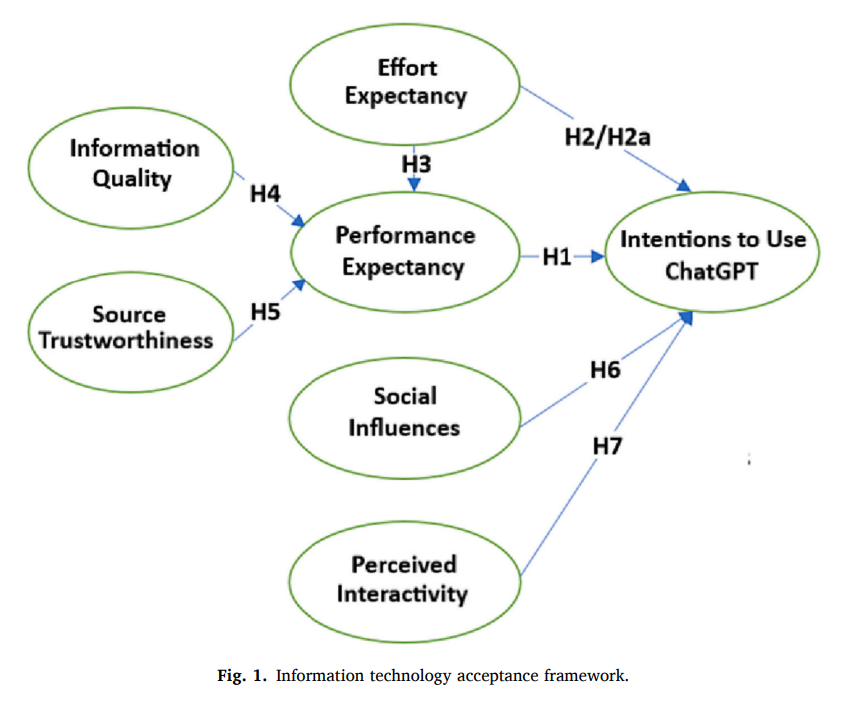
This empirical research builds on theoretical underpinnings related to information technologyadoption in order to examine the online users’ perceptions and intentions to use AI Chatbots. Specifically, it integrates a perceived interactivity construct (Baabdullah et al., 2022; McMillan and Hwang, 2002) with information quality and source trustworthiness measures (Leong et al., 2021; Sussman and Siegal, 2003) from the Information Adoption Model (IAM) with performance expectancy, effort expectancy and social influences constructs (Venkatesh et al., 2003; Venkatesh et al., 2012) from the Unified Theory of Acceptance and Use of Technology (UTAUT1/UTAUT2) to determine which factors are influencing the individuals’ intentions to use AI text generation systems like ChatGPT. This study’s focused research questions are:
RQ1
How and to what extent are information quality and source trustworthiness influencing the online users’ performance expectancy from ChatGPT?
RQ2
How and to what extent are their perceptions about ChatGPT’s interactivity, performance expectancy, effort expectancy, as well as their social influences affecting their intentions to continue using their large language models?
RQ3
How and to what degree is the performance expectancy construct mediating effort expectancy – intentions to use these interactive AI technologies?
This study hypothesizes that information quality and source trustworthiness are significant antecedents of performance expectancy. It presumes that this latter construct, together with effort expectancy, social influences as well as perceived interactivity affect the online users’ acceptance and usage of generative pre-trained AI chatbots like GPT-3.5 or GPT-4.
Notwithstanding, for the time being, there is still scant research that is focused on AI-powered LLM, like ChatGPT, that are capable of generating human-like text that is based on previous contexts and drawn from past conversations. This timely study raises awareness on the individuals’ perceptions about the utilitarian value of such interactive technologies, in an academic (higher educational) context. It clearly identifies the factors that are influencing the individuals’ intentions to continue using them, in the future.
From the literature review
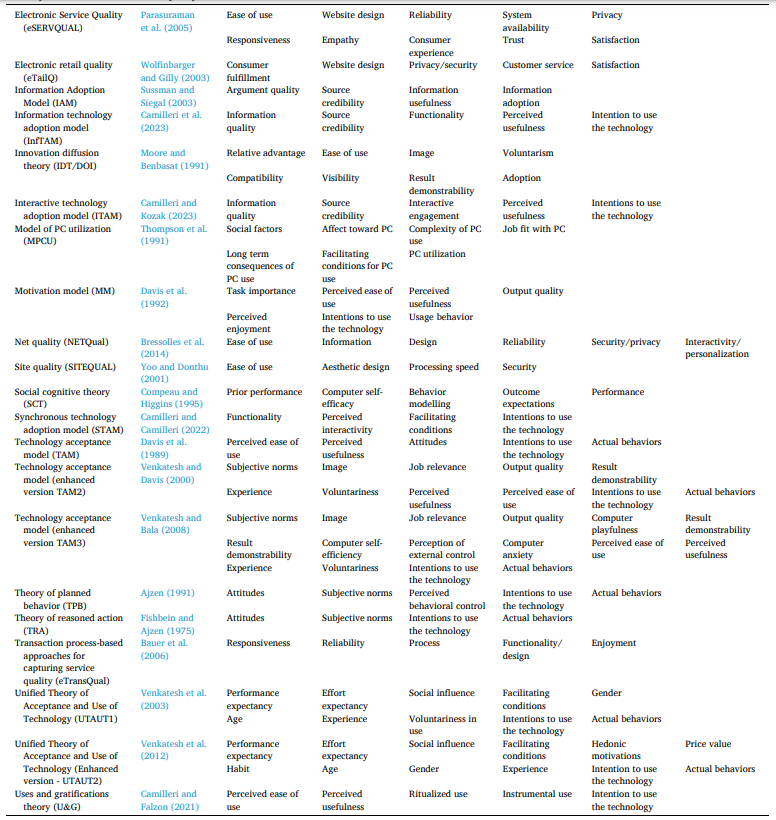
Table 1 features a summary of the most popular theoretical frameworks that sought to identify the antecedents and the extent to which they may affect the individuals’ intentions to use information technologies.
Table 1. A non-exhaustive list of theoretical frameworks focused on (information) technology adoption behaviors
Figure 1. features the conceptual framework that investigates information technology adoption factors. It represents a visual illustration of the hypotheses of this study. In sum, this empirical research presumes that information quality and source trustworthiness (from Information Adoption Model) precede performance expectancy. The latter construct together with effort expectancy, social influences (from Unified Theory of Acceptance and Use of Technology) as well as the perceived interactivity construct, are significant antecedents of the individuals’ intentions to use ChatGPT.
The survey instrument
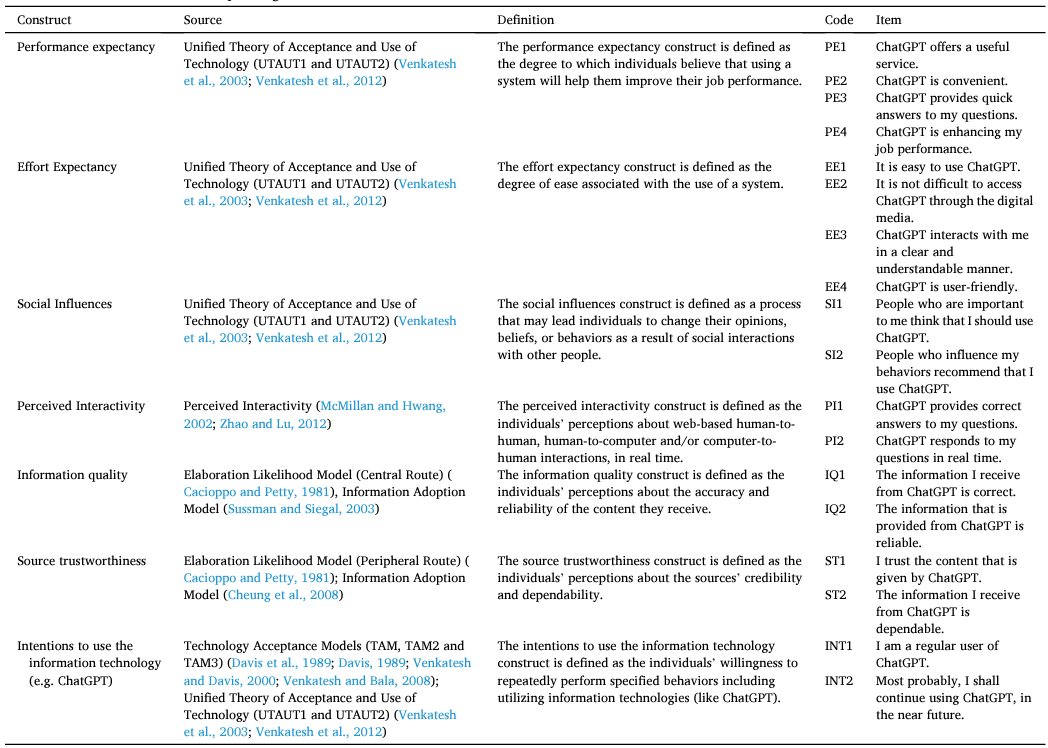
The respondents were instructed to answer all survey questions that were presented to them about information quality, source trustworthiness, performance expectancy, effort expectancy, social influences, perceived interactivity and on their behavioral intentions to continue using this technology (otherwise, they could not submit the questionnaire). Table 2 features the list of measures as well as their corresponding items that were utilized in this study. It also provides a definition of the constructs used in the proposed information technology acceptance framework.
Table 2. The list of measures and the corresponding items used in this research.
Theoretical implications
This research sought to explore the factors that are affecting the individuals’ intentions to use ChatGPT. It examined the online users’ effort and performance expectancy, social influences as well as their perceptions about the information quality, source trustworthiness and interactivity of generative text AI chatbots. The empirical investigation hypothesized that performance expectancy, effort expectancy and social influences from Venkatesh et al.’s (2003) UTAUT together with a perceived interactivity construct (McMillan and Hwang, 2002) were significant antecedents of their intentions to revisit ChatGPT’s website and/or to use its app. Moreover, it presumed that information quality and source trustworthiness measures from Sussman and Siegal’s (2003) IAM were found to be the precursors of performance expectancy.
The results from this study report that source trustworthiness-performance expectancy is the most significant path in this research model. They confirm that online users indicated that they believed that there is a connection between the source’s trustworthiness in terms of its dependability, and the degree to which they believe that using such an AI generative system will help them improve their job performance. Similar effects were also evidenced in previous IAM theoretical frameworks (Kang and Namkung, 2019; Onofrei et al., 2022), as well as in a number of studies related to TAM (Assaker, 2020; Chen and Aklikokou, 2020; Shahzad et al., 2018) and/or to UTAUT/UTAUT2 (Lallmahomed et al., 2017).
In addition, this research also reports that the users’ peceptions about information quality significantly affects their performance expectancy/expectancies from ChatGPT. Yet, in this case, this link was weaker than the former, thus implying that the respondents’ perceptions about the usefulness of this text generative technology were clearly influenced by the peripheral cues of communication (Cacioppo and Petty, 1981; Shi et al., 2018; Sussman and Siegal, 2003; Tien et al., 2019).
Very often, academic colleagues noted that individuals would probably rely on the information that is presented to them, if they perceive that the sources and/or their content are trustworthy (Bingham et al., 2019; John and De’Villiers, 2020; Winter, 2020). Frequently, they indicated that source trustworthiness would likely affect their beliefs about the usefulness of information technologies, as they enable them to enhance their performance. Conversely, some commentators argued that there may be users that could be skeptical and wary about using new technologies, especially if they are unfamiliar with them (Shankar et al., 2021). They noted that such individuals may be concerned about the reliability and trustworthiness of the latest technologies.
The findings suggest that the individuals’ perceptions about the interactivity of ChatGPT are a precursor of their intentions to use it. This link is also highly significant. Therefore, the online users were somehow appreciating this information technology’s responsiveness to their prompts (in terms of its computer-human communications). Evidently, ChatGPT’s interactivity attributes are having an impact on the individuals’ readiness to engage with it, and to seek answers to their questions. Similar results were reported in other studies that analyzed how the interactivity and anthropomorphic features of dialogue systems like live support chatbots, or virtual assistants can influence the online users’ willingness to continue utilizing them in the future (Baabdullah et al., 2022; Balakrishnan et al., 2022; Brachten et al., 2021; Liew et al., 2017).
There are a number of academic contributions that sought to explore how, why, where and when individuals are lured by interactive communication technologies (e.g. Hari et al., 2022; Li et al., 2021; Lou et al., 2022). Generally, these researchers posited that users are habituated with information systems that are programed to engage with them in a dynamic and responsive manner. Very often they indicated that many individuals are favorably disposed to use dialogue systems that are capable of providing them with instant feedback and personalized content. Several colleagues suggest that positive user experiences as well as high satisfaction levels and enjoyment, could enhance their connection with information technologies, and will probably motivate them to continue using them in the future (Ashfaq et al., 2020; Camilleri and Falzon, 2021; Huang and Chueh, 2021; Wolfinbarger and Gilly, 2003).
Another important finding from this research is that the individuals’ social influences (from family, friends or colleagues) are affecting their interactions with ChatGPT. Again, this causal path is also very significant. Similar results were also reported in UTAUT/UTAUT2 studies that are focused on the link between social influences and its link with intentional behaviors to use technologies (Gursoy et al., 2019; Patil et al., 2020). In addition, TPB/TRA researchers found that subjective norms also predict behavioral intentions (Driediger and Bhatiasevi, 2019; Sohn and Kwon, 2020). This is in stark contract with other studies that reported that there was no significant relationship between social influences/subjective norms and behavioral intentions (Ho et al., 2020; Kamble et al., 2019).
Interestingly, the results report that there are highly significant effects between effort expectancy (i.e. ease of use of the generative AI technology) and performance expectancy (i.e. its perceived usefulness). Many scholars posit that perceived ease of use is a significant driver of perceived usefulness of technology (Bressolles et al., 2014; Davis, 1989; Davis et al., 1989; Kamble et al., 2019; Yoo and Donthu, 2001). Furthermore, there are significant causal paths between performance expectancy-intentions to use ChatGPT and even between effort expectancy-intentions to use ChatGPT, albeit to a lesser extent. Yet, this research indicates that performance expectancy partially mediates effort expectancy-intentions to use ChatGPT. In this case, this link is highly significant.
In sum, this contribution validates key information technology measures, specifically, performance expectancy, effort expectancy, social influences and behavioral intentions from UTAUT/UTAUT2, as well as information quality and source trustworthiness from ELM/IAM and integrates them with a perceived interactivity factor. It builds on previous theoretical underpinnings. Yet, it differentiates itself from previous studies. To date, there are no other empirical investigations that have combined the same constructs that are presented in this article. Notwithstanding, this research puts forward a robust Information Technology Acceptance Framework. The results confirm the reliability and validity of the measures. They clearly outline the relative strength and significance of the causal paths that are predicting the individuals’ intentions to use ChatGPT.
Managerial implications
This empirical study provides a snapshot on the online users’ perceptions about ChatGPT’s responses to verbal queries, and sheds light on their dispositions to avail themselves from its natural language processing. It explores their performance expectations about their usefulness and their effort expectations related to the ease of use of these information technologies and investigates whether they are affected by colleagues or by other social influences to use such dialogue systems. Moreover, it examines their insights about the content quality, source trustworthiness as well as on the interactivity features of these text- generative AI models.
Generally, the results suggest that the research participants felt thatthese algorithms are easy to use. The findings indicate that they consider them to be useful too, specifically when the information they generate is trustworthy and dependable. The respondents suggest that they are concerned about the quality and accuracy of the content that is featured in the AI chatbots’ answers. This contingent issue can have a negative effect on the use of the information that is created by online dialogue systems.
OpenAI’s ChatGPT is a case in point. Its app is freely available in many countries, via desktop and mobile technologies including iOS and Android. The company admits that its GPT-3.5 outputs may be inaccurate, untruthful, and misleading at times. It clarifies that its algorithm is not connected to the internet, and that it can occasionally produce incorrect answers (OpenAI, 2023a). It posits that GPT-3.5 has limited knowledge of the world and events after 2021 and may also occasionally produce harmful instructions or biased content. OpenAI recommends checking whether its chatbot’s responses are accurate or not, and to let them know when and if it answers in an incorrect manner, by using their “Thumbs Down” button. They even declare that their ChatGPT’s Help Center can occasionally make up facts or “hallucinate” outputs (OpenAI, 2023a,b).
OpenAI reports that its top notch ChatGPT Plus subscribers can access safer and more useful responses. In this case, users can avail themselves from a number of beta plugins and resources that can offer a wide range of capabilities including text-to-speech applications as well as web browsing features through Bing. Yet again, OpenAI (2023b) indicates that its GPT-4 still has many known limitations that the company is working to address, such as “social biases and adversarial prompts” (at the time of writing this article). Evidently, works are still in progress at OpenAI. The company needs to resolve these serious issues, considering that its Content Policy and Terms clearly stipulate that OpenAI’s consumers are the owners of the output that is created by ChatGPT. Hence, ChatGPT’s users have the right to reprint, sell, and merchandise the content that is generated for them through OpenAI’s platforms, regardless of whether the output (its response) was provided via a free or a paid plan.
Various commentators are increasingly raising awareness about the corporate digital responsibilities of those involved in the research, development and maintenance of such dialogue systems. A number of stakeholders, particularly the regulatory ones, are concerned on possible risks and perils arising from AI algorithms including interactive chatbots. In many cases, they are warning that disruptive chatbots could disseminate misinformation,foster prejudice, bias and discrimination, raise privacy concerns, and could lead to the loss of jobs. Arguably, one has to bear in mind that, in many cases, many governments are outpaced by the proliferation of technological innovations (as their development happens before the enactment of legislation). As a result, they tend to be reactive in the implementation of substantive regulatory interventions. This research reported that the development of ChatGPT has resulted in mixed reactions among different stakeholders in society, especially during the first months after its official launch. At the moment, there are just a few jurisdictions that have formalized policies and governance frameworks that are meant to protect and safeguard individuals and entities from possible risks and dangers of AI technologies (Camilleri, 2023). Of course, voluntary principles and guidelines are a step in the right direction. However, policy makers are expected by various stakeholders to step-up their commitment by introducing quasi-regulations and legislation.
Currently, a number of technology conglomerates including Microsoft-backed OpenAI, Apple and IBM, among others, anticipated the governments’ regulations by joining forces in a non-profit organization entitled, “Partnership for AI” that aims to advance safe, responsible AI, that is rooted in open innovation. In addition, IBM has also teamed up with Meta and other companies, startups, universities, research and government organizations, as well as non-profit foundations to form an “AI Alliance”, that is intended to foster innovations across all aspects of AI technology, applications and governance.





You must be logged in to post a comment.