I am delighted to share that I have further consolidated my international standing in Business and Management, as well as in Sport, Leisure and Tourism as second subfield.
I have once again been recognised among the world’s top 2% of scientists in the Stanford University–Elsevier rankings. The 2026 update, is based on citation data up to 2025. It highlights recent research impact.
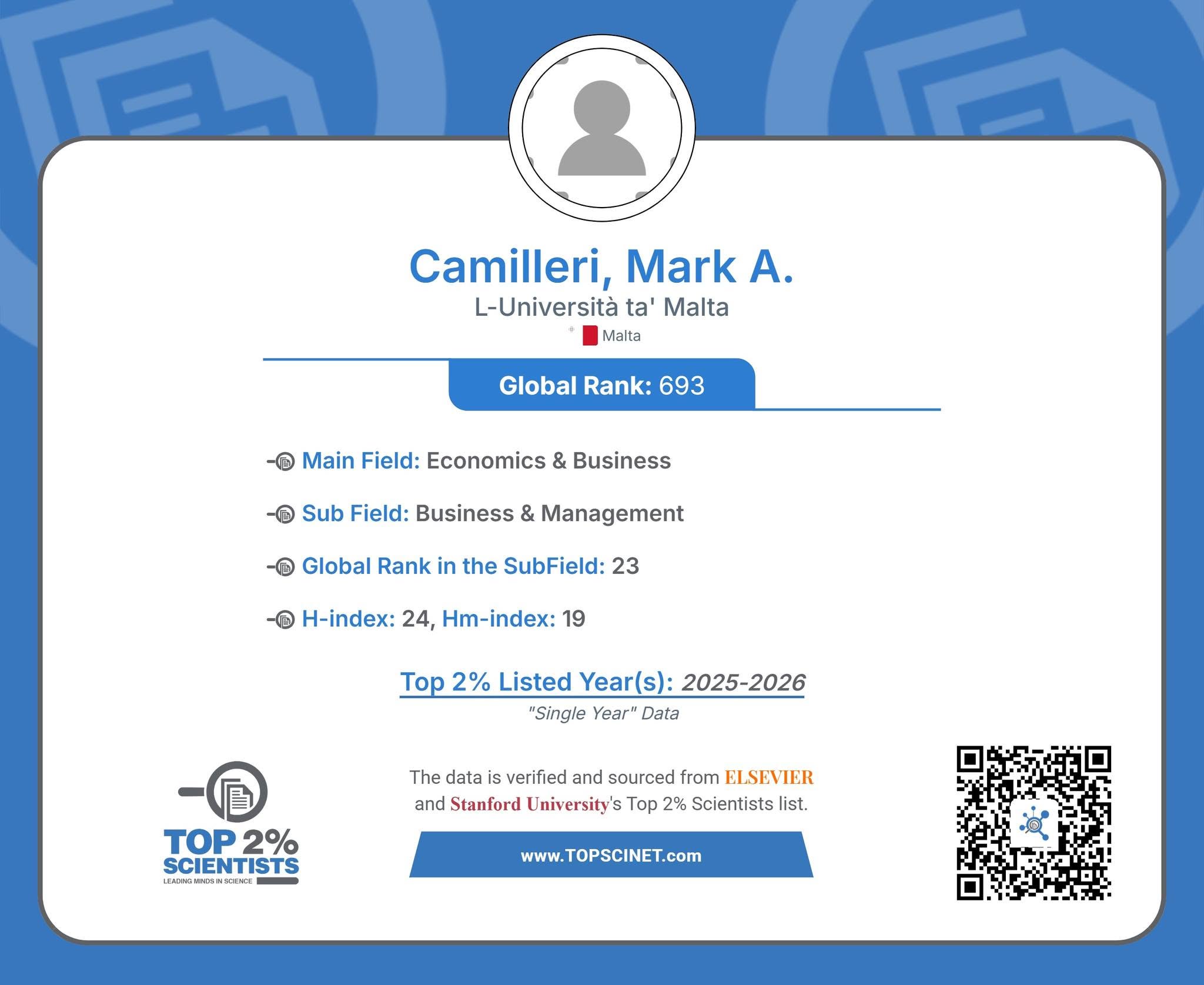
Figure 1. Top 2% Scientists profile
Exceptional international standing
I achieved an overall global ranking of 693rd across all disciplines, 23rd in business and management research and placed 2nd worldwide in Sport, Leisure and Tourism (second research subfield). These distinctions demonstrate my international visibility of my scholarship across several disciplines.
Leading impact in Malta
The latest data also listed me first in Malta in both the career-long and single-year research impact assessments. My leading position in Malta highlights the international impact of my research. My inclusion in both rankings shows that my publications continue to attract attention and citations from researchers worldwide.
Research, collaboration and future priorities
My research addresses business and management, digital marketing, tourism, sustainability, education and emerging technologies, including artificial intelligence. Hence, my publications explore how organisations and societies respond to technological change, responsible innovation and evolving stakeholder expectations. These areas connect academic theory with practical challenges affecting businesses, institutions and communities.
I am sincerely grateful to the scholars and colleagues who cited my publications as well as to all of the co-authors and research collaborators who have contributed to this journey.
These academic rankings mark another milestone in my academic career and highlight the international contribution of research carried out at the University of Malta. Looking ahead, I remain committed to continue producing relevant, rigorous research, forging international partnerships and sharing knowledge that benefits academia, industry and society.
Understanding the recognition
The Stanford University–Elsevier Top 2% Scientists database uses Scopus-based citation indicators to assess scholarly influence. These include citation counts, the h-index, co-authorship-adjusted measures and a composite citation score. Separate career-long and single-year datasets allow readers to distinguish sustained academic impact from influence measured within a particular citation year. Rankings reflect bibliometric indicators rather than a comprehensive assessment of research quality.
Source: Stanford University–Elsevier Top 2% Scientists database, 2026 update (citation data through 2025).
Citation: Ioannidis, John P.A. (2026), “August 2026 data-update for “Updated science-wide author databases of standardized citation indicators””, Elsevier Data Repository, V9, doi: 10.17632/btchxktzyw.9


You must be logged in to post a comment.