
Featuring snippets from an article that was accepted for publication through Springer’s “Service Business”.
Suggested citation: Camilleri, M.A., Bhatnagar, S.B. & Chakraborty, D. (2025). Exaggerated statements in online consumer reviews: Causes and implications. Service Business, 19, Art. 19, https://doi.org/10.1007/s11628-025-00590-6
Abstract
This study investigates the factors that contribute to the creation of inflated consumer testimonials. Quantitative data were gathered from four hundred forty (440) respondents who shared their service experiences through popular social media platforms. A covariance-based structural equations model approach has been used to analyze the data. The results suggest that psychological and emotional factors including the consumers’ self-image, self-enhancement as well as their motivations for retribution against service providers, are having a significant effect on the development of amplified review content.
Keywords: Consumer reviews, Constructive reviews, Altruistic reviews, Overblown reviews; tourism and hospitality.
1 Introduction
Researchers have frequently reported that certain individuals tend to misrepresent facts and may willingly decide to deceive other persons, in their daily conversations, including in virtual ones (Moqbel and Jain 2025; Sahut et al. 2024). It is very likely that such persons would fabricate content when they engage in online conversations (Plotkina et al. 2020) and may even create inflated claims in their user generated content, while sharing personal experiences with online users (Belarmino et al. 2022; Bozkurt et al. 2023). Electronic word of mouth communications, like online reviews, are not always truthful (Camilleri, 2022; Kapoor et al. 2021; Lee et al. 2022; Tomazelli et al. 2024), as they may frequently feature inflated claims (Román et al. 2023). A few researchers have even suggested that exaggerated reviews can have an adverse effect on their credibility (Chatterjee et al. 2023).
A lack of credibility and trustworthiness in online reviews could negatively affect the consumers’ perceptions and attitudes toward the business (Camilleri and Filieri 2023; Tan and Chen 2023). For instance, Fong et al. (2024) distinguished between trustworthy and untrustworthy content presented in online consumer testimonials. Yet, for the time being, there is still scarce research focused on the propagation of inflated claims in online reviews (Arif and Chandwani 2024). Various researchers have often attempted to find ways to detect misinformation and prefabricated online content including in social media and review platforms (Chen et al. 2022).
However, in many cases, it proves difficult to recognize the identities of those reviewers who are sharing overblown and deceitful statements about their experiences in online platforms (Bylok 2022). Notwithstanding, there may be different reasons why individuals engage in deceptive behaviors. People may decide to deceive others for personal gain, and/or to protect their own image or reputation. Their intention could be to manipulate others to achieve desired outcomes (Min and Wakslak 2022). Alternatively, they may rationalize their deceitful behaviors due to psychological factors. Such individuals would probably convince themselves that their actions are justified or harmless (Costa Filho et al. 2023; Petrescu et al. 2022).
Undoubtedly, the topic about deceitful, unreliable and inflated online reviews warrants further investigation, as these electronic word-of-mouth communications may constitute false advertising or fraud. Prospective consumers can be manipulated and misled into buying substandard or misrepresented products/services. For example, the use of generative AI could exacerbate the pervasiveness of fake inflated review content with high linguistic sophistication. Hence, it may prove hard for online users to detect the legitimacy and veracity of consumer reviews. Certainly, further investigation is warranted on this topic, to better understand the incidence and the scale of the exaggerated claims featured in user-generated content, their underlying motivations and drivers, as well as the identification of technological and regulatory responses.
In this light, this research identifies the factors and the extent to which online users share overstatements and amplified assertions in consumer review platforms. Specifically, the underlying research questions are: [RQ1] How and to what extent are the consumers’ altruistic intentions to provide customer-focused reviews contributing to the development of exaggerated claims in their testimonials? [RQ2] How and to what extent are the consumers’ constructive reviews aimed at service providers having an effect on the development of exaggerated claims in their testimonials? [RQ3] How and to what extent are the consumers’ psychological factors including their self-esteem and self-image having an effect on the development of exaggerated claims in their testimonials? [RQ4] How and to what extent are the consumers’ dissatisfaction levels with the services they receive and their retribution motivations having an effect on the development of exaggerated claims in their testimonials?
This empirical study builds on extant theoretical underpinnings related to the interpersonal deception theory (Buller and Burgoon 1996; Buller et al. 1996; Burgoon 2015; Gaspar et al. 2022) to delve into the factors that can lead consumers to create inflated claims in online reviews (Hill Cummings et al. 2024; Valdez et al. 2018). The researchers validate constructs that were tried and tested in academia including altruistic motivations to support prospects and/or businesses (Hennig-Thurau et al. 2004; Yoo and Gretzel 2008), perceived self-enhancement, perceived self-image and retribution behaviors (Yoo and Gretzel 2008).
Unlike previous studies, that focus on how reviews could influence purchase decisions, or those that investigate the rationale for sharing reviews, this contribution examines the processes and motivations that lead to the articulation of exaggerated claims in testimonials (that can be either positive or negative). From the outset, this original research rejects the dominant assumption that inflated reviews are simply driven by the consumers’ egos, or from their malicious intentions. On the contrary, it suggests that altruistic appraisals that are meant to support prospective customers, constructive criticism to service providers or feedback motivated by retributive intentions, after experiencing service failures, and/or the integration of psychological self-concepts could amplify or trigger exaggerated claims in consumer reviews. As far as the authors are aware, for the time being, there are no other studies that have integrated the above factors in the same conceptual model by referring to the interpersonal deception theory as an exploratory lens. Therefore, this contribution aims to address this knowledge gap, in the tourism and hospitality industry context. The study advances a novel theoretical model that is empirically tested, in terms of the constructs’ reliabilities and validities. Moreover, it also sheds light on the significance of the causal paths that predict the consumers’ likelihood of creating exaggerated content in review platforms.
2.6 Consumer retribution
The consumers’ self-image as well as their emotional responses to the service experiences would surely affect the content they share through their online testimonials (MacIntyre et al. 2020). They may decide to appraise or even punish a service business, by disseminating detailed posts about their service encounters through popular review platforms (Jaén et al. 2021). There are instances when consumers publish negative reviews as they desire to achieve retribution, after they have experienced inappropriate service. In this case, they can attempt to tarnish the service providers’ reputation and even cause them economic harm. Again, this reasoning is related to the interpersonal deception theory, as individuals may willfully decide to distort their communications in their interpersonal exchanges, to achieve their strategic goals. In the context of consumer reviews, dissatisfied customers could seek retribution by exaggerating their negative claims to punish service providers. This distortion arises from the consumers’ intentions to retaliate against service providers by amplifying their complaints.
Consumers may use their cognitive skills to articulate their grievances in order to damage the corporate image of service providers. They may seek retribution by exaggerating statements or even by falsifying their experiences and fabricating details. There will be greater emotional response from the part of the consumers, if the service delivered to them does not meet their expectations (Antonetti et al. 2020). The bigger the gap between the consumers’ expectations and the service reality, the stronger their desire for retribution, as well as their likelihood to create elaborate review content to punish the business that did not deliver on its promises (Azemi et al. 2020). Hence, in this case, they would probably resort to naming and shaming the service provider, to seek reprisal.
In an attempt to vent their anger, frustration and disappointment with others, consumers would probably inflate their grievances as a form of revenge through public review platforms to harm the service organizations’ reputation, in retaliation for what they perceive as unfair treatment. Their need for retribution drives consumers to embellish the review details, create hyperbolic content to voice their dissatisfaction in order to cause greater harm to the service provider (Lages et al. 2023; Zhao and Huang 2024). They may exaggerate certain elements in their testimonials out of a sense of moral duty to warn others, and to protect them from experiencing similar dissatisfaction levels. Some reviewers may decide to make overstatements as they perceive that bad reviews gain more attention or validation from online communities. In some cases, consumers may inflate negative criticism in the hopes that their complaint goes viral and reaches larger audiences. Social media and review apps can magnify the impact of exaggerated negative reviews. These platforms can attract the attention of their users when the review content is dramatic or shocking . This creates an incentive for consumers seeking retribution and vengeance, to share articulated reviews featuring their inflated claims about negative aspects of their service experience (Hill Cummings et al. 2024).In this light, the authors hypothesize that:
H5
The consumers’ retribution toward service providers has a positive and significant effect on their inflated claims in online reviews.
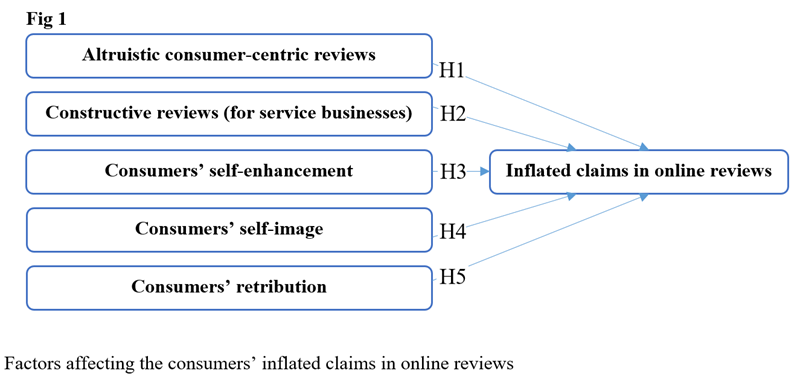
Figure 1. presents an illustration of the five (5) research hypotheses. In sum, it presumes that the consumers’ self enhancement and/or self-image as well as their motivations to share altruistic reviews and/or constructive evaluations, as well as their emotionally driven retribution toward service providers are significant antecedents of their inflated claims in online reviews.
3 Method
This empirical study adopts a deductive research methodology to better understand the antecedents of the consumers’ inflated claims in online reviews of tourism and hospitality services. The interpersonal deception theory has been used as a theoretical base for this quantitative research. The measuring items which were selected for the survey instrument have been drawn from previously validated scales. The researchers carried out slight modifications to ensure that the adapted scales were suitable for the chosen sample. The survey comprised three sections. The first involved a screening question that asked the respondents whether they ever shared their service experiences through social media or review platforms. Only those respondents who have uploaded review(s) in the past, could participate in this study. The second section presented the items featured in Table 1. The last section sought information about the respondents’ demographic backgrounds. The researchers have pilot-tested the questionnaire among academic colleagues and PhD students, a few weeks before they disseminated it among the targeted respondents.
4 Results
The researchers relied on a co-variance-based structural equation modelling approach to analyse their research model. The results reported that there were no multi-collinearity issues within the correlation matrix of latent variables. The correlated figures were less than 0.85 and the standard errors values were very low.
The researchers carried out a confirmatory factor analysis (CFA) to validate their research model in terms of the constructs’ reliability and validity. The CFA results were also used to evaluate model fit and to test the set hypotheses. The values of composite reliability (CR) were more than the recommended value of 0.7. Similarly, the factor loadings were higher than 0.7. This indicated that the items chosen for the study were appropriate. In addition, the convergent as well as the discriminant validity values were appropriate. The average variance extracted (AVE) values were more than the cut-off value of 0.5. Hence, this result proved that there was evidence of the constructs’ convergent validities. The researchers also established their measures’ discriminant validities as they observed that the square roots of AVE were higher than the inter-construct/factor correlation values within the same columns (Fornell and Larcker 1981). Moreover, the AVE values were higher than the Maximum Shared Variance (MSV) figures, as shown in Table 3. The findings confirm that the potential for common method bias (CMB) was reduced in this study (MacKenzie and Podsakoff 2012).
5 Discussion, conclusions and implications
5.1 Discussion
The findings contradict the results obtained from previous studies about the individuals’ rationale for sharing online reviews. This empirical investigation indicates that the consumers were not interested in helping prospective customers in choosing the best service provider. As a matter of fact, the altruistic consumer-centric reviews construct did not have a significant effect on the consumers’ inflated claims featured in their online reviews. This result may suggest that the consumers may not be completely honest in their testimonials, particularly if they provide false or misleading information to prospective customers about the service they experienced (Wong et al. 2023).
Nevertheless, this study reported that constructive consumers’ reviews which were aimed at the businesses, to improve their service quality, had a significant effect on their inflated review content. This finding shows that the consumers do care about the hospitality businesses’ service quality standards and long-term prospects. Evidently, there are instances where consumers are sharing genuine testimonials to help service providers to consistently improve the delivery of their services and to address their weaknesses. One may argue that both positive as well as negative reviews are beneficial for the service provider (Malik et al. 2024; Zhang and Xu 2024). Whilst the positive reviews would indicate that the consumers were satisfied with the service they experienced, the negative criticisms would enable the service provider to identify their pitfalls, and to get to know where they are providing poor service quality.
Interestingly, other constructs including the individuals’ self-enhancement were also having a significant and positive impact on their inflated claims in online reviews. The findings suggest that consumers may be inclined to share their online reviews, as they want to be recognised for their contributions, by other people. They may want to share information about their service encounters to satisfy their ego and/or to obtain recognition from online users (Sayin and Gürhan‐Canlı 2024; Zell et al. 2020).
In a similar vein, self-image was also reported to have a positive impact on the consumers’ inflated claims in their online reviews. Notably, this factor had the most significant effect in the proposed structured model. The results confirm that a person’s self-image can significantly influence the way consumers formulate their messages in online reviews. This finding is consistent with other studies that found that self-image plays a key role in explaining the reviewers’ motivations for posting inflated claims in their testimonials (Malik et al 2024). It suggests that reviewers have a positive self-image as they feel confident in their opinions. Hence, they are compelled to share inflated claims with other online users. This research suggests that consumers who regularly share reviews of their service experiences might believe that their opinions are valuable to prospective customers. As a result, they appear to be intrigued to continue contributing to online conversations about service encounters and to seek validation from others. Alternatively, they may do so for emotional reasons to enhance their self-image.
This research reported that the consumers’ retribution also had a significant and positive impact on their inflated claims in their online reviews. It confirms that exaggerated and overstated criticisms or complaints are usually prepared after the consumers have experienced negative experiences. Overstatements and amplified assertions are usually driven by the consumer’s desire to seek justice for perceived wrongdoings (Hill Cummings et al. 2024). The consumers’ retributive behaviours can heavily influence the content and tone of online reviews, often leading them to prepare inflated negative claims. This kind of vengeance can distort their objectivity about the actual services they received. Their retaliation could even escalate into conflicts with the service providers, thereby making it difficult for them to address consumers’ dissatisfaction and complaints or in a constructive manner.
5.2 Theoretical implication
This contribution relied on the Interpersonal Deception Theory (Buller et al. 1996; Buller and Burgoon 1996) as a conceptual base to investigate the reviewers’ motivations behind their exaggerated testimonials. While not all consumer reviews contain explicit “deception” and “untruthful” content, this theory’s key concepts including cognitive effort, message control for impression management, the strategic omission and framing of the content, as well as the interactive nature of deceptive communication, can be considered as highly relevant aspects across the spectrum of consumer review motivations (Min and Wakslak 2022). This argumentation applies to each construct featured in this study’s proposed model.
This research reports that some reviewers may exaggerate when they narrate their experiences, in order to present themselves in a positive manner, to gain recognition, or reinforce their desired social identities. Their self enhancement motivations may lead them to inflate their claims about their service experiences, for affirmation and attention-seeking purposes. Such individuals’ online behaviors clearly reflect strategic impression management. With regards to their altruistic and constructive reviews: While altruistic reviews are intended to help others, constructive reviews are aimed at improving service quality (McArthur et al. 2023; Wang et al. 2022). In both cases, they may involve a selective emphasis or the framing of experiences, which can unintentionally result in the development of exaggerated content (Weikmann and Lecheler 2023). Furthermore, this article postulates that there are instances where consumers may seek revenge after they have experienced poor service quality. For this reason, they decide to strategically amplify negative claims and craft hyperbolic content to influence prospective consumers’ perceptions and to damage the service providers’ reputation (Abdulqader et al. 2022).
The full references are included in the open-access article.
 Substantia Mea
You must be logged in to post a comment.