Featuring snippets from our latest study that was accepted for publication through Springer’s Technology, Knowledge and Learning (A Q1 journal in Education)
Suggested citation: Camilleri, M.A. & Camilleri, A.C. (2026). Motivations to engage with edutainment games: Developing and testing a ‘PLAY’ framework. Technology, Knowledge and Learning, https://doi.org/10.1007/s10758-026-10062-z
Abstract
Edutainment applications (apps) that merge educational content with entertaining aesthetics and narratives are becoming very popular among gamers. Yet, for the time being, limited research has been conducted on edutainment games’ attributes that could influence the players’ engagement with these learning technologies. This research addresses this knowledge gap. It builds on the uses and gratifications theory, as it explores the individuals’ personal gratifications, as well as the gaming dynamics as antecedents of their perceived enjoyment and emotional attachment. A survey questionnaire was used to capture quantitative data from a sample of 216 university students. A partial least square (PLS) was utilized to shed light on the relative strength and significance of the hypothesized relationships in the proposed structured model. The findings report that edutainment games’ immersive features and competitive elements can play an important role in fostering the students’ emotional engagement with educational games. In conclusion, this contribution advances a novel Playfulness, Learning, Attachment and EnjoYment (PLAY) framework. In plain words, it implies that high-quality audiovisual elements, competitive gaming mechanics and compelling narratives can increase the students’ emotional connection with edutainment learning technologies.
Keywords: personal gratification, enjoyment, emotional attachment, game aesthetics, game narratives, games’ competitive aspects.
Introduction
Edutainment applications (apps) that blend educational content with entertaining aesthetics and narratives are increasingly gaining popularity among gamers (Antonopoulos et al., 2024; Hao et al., 2026; Zogheib & Daniela, 2022). These engaging games are designed to promote their players’ cognitive and emotional development, while providing them with enjoyable and immersive experiences (Chou et al., 2023; Venturi et al., 2025). Generally, they aim to teach specific topics, as they may cover complex subjects like history, science or languages, for different audiences. They may usually incorporate elements of enjoyment and competition in their mechanics (Bontchev et al., 2025; Fokides & Alatzas, 2023). Very often, they feature colorful graphics, amusing storylines and challenges that encourage players to actively participate in the learning process. For these reasons, a number of educators are availing themselves of these interactive technologies to improve their students’ motivations and learning dispositions. At times, they use them in their classrooms, or even during informal learning environments in museums and science centers, to make learning fun and engaging (Illsley et al., 2025).
These learning technologies are a subject of debate among colleagues, as educators and researchers believe that they can be considered valuable tools that add value to traditional teaching methods (DEAP, 2025; EU, 2020). Various stakeholders in education have frequently discussed the effectiveness of edutainment games as learning tools in academic environments. In many cases, they are aware that these technologies can improve their understanding of complex concepts and develop important skills like problem-solving and critical thinking (UNESCO, 2023).
The primary motivation for this study arises from the growing adoption of edutainment and game-based learning technologies in the realms of education. At the same time, for the time being, there is still limited scholarly understanding of the factors that influence the students’ emotional and psychological engagement with these platforms. Although recent research has acknowledged the pedagogical value of serious games and interactive learning applications (e.g. Camilleri & Camilleri, 2026; Hao et al., 2026; Illsley et al., 2025; Venturi et al., 2025), existing literature has usually focused on their cognitive and instructional outcomes (Lee et al., 2025; Rapaka et al., 2025; Yim & Su, 2025).
Consequently, insufficient attention has been devoted to examining how specific game design attributes and experiential features could influence the learners’ enjoyment and emotional attachment with edutainment technologies. Prior studies on serious games have largely emphasized learning effectiveness, knowledge acquisition and performance-related objectives (Dah et al., 2025; Nylen-Eriksen et al., 2025). They have often overlooked the behavioural, affective and psychological dimensions of the students’ gameplay experiences.
In response to this limitation, this empirical investigation explores the factors that are influencing the students’ engagement with edutainment games in higher education contexts. It seeks to examine how different game-related attributes and experiential factors contribute to the users’ perceived enjoyment and emotional attachment toward educational gaming technologies.
Specifically, the objectives of this research are threefold: (RQ1) To determine the extent to which game attributes, including aesthetics, ease of use, narratives, competitive elements and personal gratifications, derived from gameplay, are influencing the gamers’ perceived enjoyment; (RQ2) To examine the effect of the gamers’ perceived enjoyment on their emotional attachment toward edutainment technologies; and (RQ3) To propose and empirically examine a robust conceptual framework comprising Playfulness, Learning, Attachment and EnjoYment (PLAY) that explains the users’ motivations, gratifications, enjoyment and attachment toward edutainment games.
Unlike earlier investigations that primarily focused on functional or educational outcomes, this research integrates behavioural and affective considerations into the analysis of learning technologies. This research seeks to address a significant gap in academic literature by investigating the motivational and experiential determinants that encourage sustained engagement with edutainment applications. It utilizes the Uses and Gratifications Theory (Calderón & Gil-Fernández, 2023; Katz et al., 1973; Ramos Salazar & Peeples, 2025), as a conceptual base, to examine why students actively engage with edutainment technologies and how these platforms satisfy their intrinsic needs for gratifications like personal enjoyment and emotional attachment.
In sum, this research contributes to the advancement of knowledge in game-based learning by providing a multidimensional perspective on the antecedents of students’ emotional and psychological engagement with edutainment technologies. As a result, it offers important theoretical and practical implications for educators, policymakers and game developers seeking to design more engaging, meaningful and effective learning experiences.
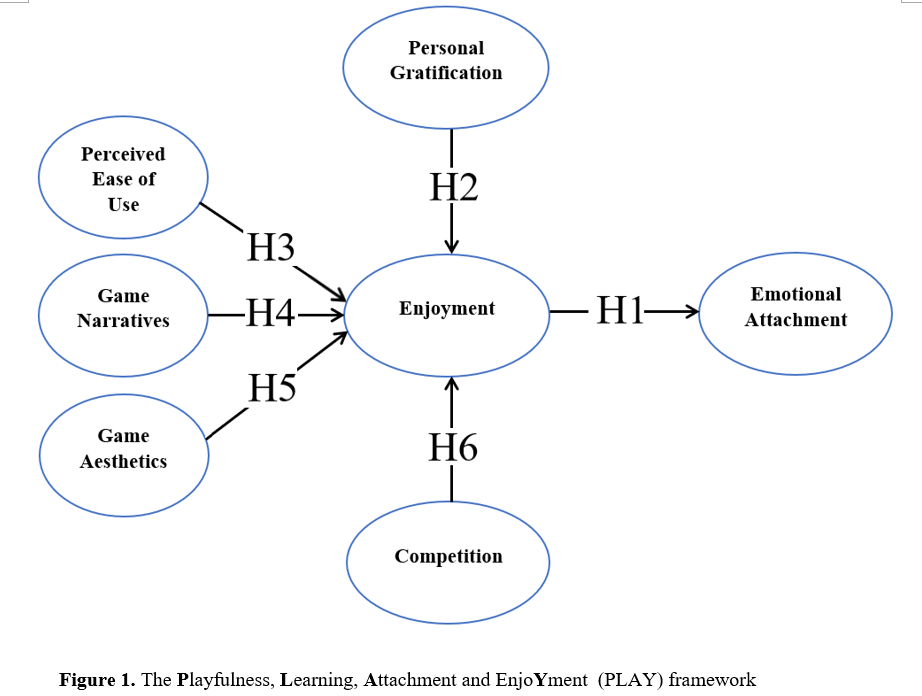
Figure 1 illustrates the proposed Playfulness, Learning, Attachment and EnjoYment (PLAY) framework and presents the set of hypothesized relationships. Specifically, the framework proposes that personal gratification, ease of use, game narratives, aesthetics and competitive aspects are significant antecedents of perceived enjoyment of gameplay. Moreover, it posits that perceived enjoyment is a significant precursor of students’ emotional attachment to the edutainment game.Figure 1. The Playfulness, Learning, Attachment and EnjoYment (PLAY) framework.
Discussion
The proposed theoretical model raises awareness about the multifaceted antecedents of perceived enjoyment derived from entertaining learning games. It clearly evidences that the learning games’ attributes and features as well as their competitive elements play an important role in fostering the students’ enjoyment and emotional attachment with them.
More specifically, the empirical results indicate that aesthetically appealing design elements, including the visual interface, animations and color schemes, were positively associated with students’ perceived enjoyment. Among the antecedents included in the model, aesthetics exhibited the strongest association with enjoyment. This finding suggests that visually engaging design may be an important consideration in the development of educational games. Whether such design also contributes to sustained involvement or to improved learning outcomes requires further investigation.. The strongest structural relationship between aesthetics and perceived enjoyment (β=0.394, p<0.001) confirms that visually engaging educational games are likely to capture the learners’ attention and sustain their involvement throughout the learning process. This result reinforces the view that educational technologies ought to deliver stimulating and enjoyable user experiences that resemble commercial entertainment games, apart from offering instructional value.
The competitive aspects of the games also emerged as a highly significant predictor of perceived enjoyment (β=0.238, p<0.001). Features such as scoring systems, rewards, challenges and leaderboards can motivate students to actively participate and persist in gameplay activities. These competitive mechanisms can create a sense of achievement and progression, thereby increasing the learners’ intrinsic motivations to play educational games. Similarly, the significant associations between the players’ personal gratifications and their perceived enjoyment of gameplay, as well as between the games’ narrative elements and the players’ pleasurable experiences, suggest that students value meaningful and compelling storylines.
Moreover, the games’ ease of use exhibited the smallest effect size, yet, its significance implies that user-friendly interfaces and intuitive navigation still remain important prerequisites for positive gaming experiences. In this regard, seamless interactions with the gaming environment may reduce the students’ cognitive efforts and allow them to focus more effectively on the learning games’ educational content.
In addition to these findings, the results reported that the perceived enjoyment strongly predicts emotional attachment toward edutainment games (β=0.707, p<0.001). This highlights the importance of designing educational applications that integrate aesthetic appeal, competition, narratives and usability. The underlying rationale is to foster the learners’ enjoyment and emotional attachment with educational gaming technologies, which may ultimately contribute to greater engagement, motivation and more positive learning experiences.
Conclusions
Theoretical implications
This research contributes to the advancement of knowledge in game-based learning and educational technology by extending the Uses and Gratifications Theory into the context of edutainment applications in higher education. Although several colleagues have frequently examined serious games from pedagogical and/or performance-oriented perspectives (Alexiou et al., 2022; Bai et al., 2025; Hao et al., 2026; Illsley et al., 2025; Naul & Liu, 2020; Nylen-Eriksen et al., 2025; Venturi et al., 2025), very often, they devoted limited attention to understanding how specific game design attributes and experiential factors are influencing the learners’ affective and emotional responses toward educational gaming technologies. This study contributes to this knowledge gap as it empirically tested multi-item reflective measures that were adapted from prior Uses and Gratifications literature, to develop the Playfulness, Learning, Attachment and EnjoYment (PLAY) framework. This conceptual framework integrates personal, technological and experiential dimensions, drawn from established theoretical underpinnings, within a unified explanatory model.
The research findings position perceived enjoyment as an important intermediate construct linking game-related attributes with emotional attachment Specifically, the results reported that perceived enjoyment was a strong antecedent of emotional attachment in educational gaming environments. This argumentation broadens earlier utilitarian technology adoption theories and their applications that generally focused on the users’ practical motivations to engage with educational technologies for information-seeking purposes and/or to generate knowledge. This study shows that the students’ emotional attachment toward educational technologies can emerge from pleasurable learning experiences that combine both educational as well as hedonic values.
Debatably, this contribution does not simply confirm that enjoyable games are engaging. Rather, it appraises the relative explanatory power of the key attributes of entertainment games within educational contexts. Within the present model and sample, gaming aesthetics and competitive aspects exhibited stronger associations with perceived enjoyment than ease of use and gaming narratives. These differences highlight the potential importance of experiential game attributes in explaining enjoyment within edutainment environments. However, the relative magnitude of the results’ coefficients of determination, should not be interpreted as evidence that higher-education learners generally prioritize the mentioned gaming attributes over their functional characteristics. In this regard, the PLAY framework contributes a more insightful interpretation of engagement in edutainment settings, by demonstrating that educational game adoption is influenced by multidimensional experiential factors rather than by instructional effectiveness or by usability considerations.
Moreover, the study contributes to the growing body of literature that differentiates edutainment technologies from conventional digital learning systems. While earlier educational technology models, including technology acceptance approaches, have largely emphasized cognitive evaluations such as usefulness and ease of use (Chou et al., 2023; Ghanizadeh et al., 2024; Lee et al., 2025; Rapaka et al., 2025; Venturi et al., 2025; Xiao & Hew, 2024; Yim & Su, 2025), the present findings indicate that emotional and experiential constructs are equally significant in explaining the students’ emotional attachment with educational games. Consequently, this research supports the theoretical argument that edutainment applications ought to be conceptualized as hybrid systems that simultaneously satisfy learning objectives as well as entertainment-oriented gratifications.
Practical implications
This research puts forward several implications for educators, instructional designers, policymakers and developers of educational gaming technologies. The findings suggest that the effectiveness of edutainment applications do not solely depend on the quality of educational content, but also on the extent to which these technologies create immersive, enjoyable and emotionally engaging experiences for learners. Therefore, institutions and developers of educational games are expected to promote the use of immersive games characterized by aesthetically-pleasing, gratifying elements, narrative attributes and competitive aspects. They need to adopt a more holistic approach to the design of educational games by integrating pedagogical objectives with entertainment-oriented features.
According to this study, the strongest predictor of perceived enjoyment was game aesthetics. This result implies that visually appealing interfaces, rich interactive multimedia features including high-quality graphics, sound effects, animations, et cetera, are central determinants for the students’ engagement with educational games. These elements should not be regarded merely as peripheral design features. As game aesthetics exhibited the strongest association with perceived enjoyment within the specified model, developers may consider enhancing the edutainment games’ visual and audiovisual quality, as these multimedia design aspects are appreciated by today’s students. However, the present findings do not establish whether greater investment in sophisticated audiovisual features could improve the students’ learning effectiveness. This relationship should be directly examined in future experimental research. Educational institutions that commission or adopt edutainment technologies must continuously evaluate their instructional performance as well as the quality of their user experience, in addition to their visual presentation.
The positive association between competitive elements and perceived enjoyment suggests that features such as leaderboards, achievement badges, rewards and gameplay challenges may contribute to enjoyable edutainment experiences. Future research could experimentally investigate whether these features also affect participation, persistence and learning outcomes. The games’ competitive dynamics should be carefully balanced with collaborative challenges and team-based activities to avoid excessive pressures or exclusion among students with different skill levels. This may help maintain inclusivity while preserving the motivational benefits of competition.
Furthermore, the significance of narratives and personal gratification suggests that educational games are required to create meaningful and rewarding learning journeys rather than focusing exclusively on task completion. Story-driven gameplay, personalized progression systems and immediate feedback mechanisms can strengthen the students’ emotional investments in educational activities. Thus, instructional designers should consider embedding educational content within compelling scenarios to entice the students’ curiosity and emotional involvement.
Although ease of use reported the weakest effect size, its significance confirms that intuitive interfaces and accessible navigation still remain important prerequisites for positive learning experiences. Complex or confusing systems may discourage students from engaging with gaming technologies. Developers should therefore ensure that edutainment applications minimize cognitive overload and allow learners to focus on educational tasks rather than on technical difficulties.
At a broader level, policymakers and educational administrators may use these findings to support further investments in innovative, edutainment game-based learning initiatives that combine instructional value with engaging experiential features. Training programs for educators could also emphasize the effective integration of edutainment technologies into classroom and online learning environments. Ultimately, this contribution suggests that emotionally engaging educational games can contribute to more motivating, interactive and learner-centered educational experiences in higher education contexts.


You must be logged in to post a comment.