Tag Archives: Strategy

My contribution as foreign expert reviewer

I have just returned back to base after a productive two-day foreign expert meeting.

Once again, it was a positive experience to connect with European academic colleagues, to review and discuss research proposals worth thousands of Euros.

My big congratulations go to the successful scholars who passed the shortlisting phase, based on our evaluation scores.

The best proposals will eventually receive national government funds for transformative projects that will add value to society and the natural environment.

#Academia #AcademiaService #ForeignExpert #ForeignExpertReviewer #Review #AcademicReviewer #ResearchProposal #ResearchProjects

Leave a comment

Filed under academia, Business, education technology, Market Research, Marketing, performance appraisals, Stakeholder Engagement, Strategic Management, Strategy, Sustainability, technology, tourism

Scaling up small enterprises: What’s the growth formula?

Pleased to share that I have recently coauthored an open-access article about the growth hacking capabilities of small and medium-sized enterprises (SMEs). It has been published in collaboration with my Italian colleagues from the University of Turin, via the Journal of Business Research.

Our research confirms that SMEs can leverage their growth potential through return-generating investments in disruptive innovations and by harnessing big data analytics. In sum, it suggests that core competencies, resources, and capabilities in these areas, can enhance the SMEs’ financial and operational performance.

READ FURTHER: The full paper can be accessed here: https://www.sciencedirect.com/science/article/pii/S0148296325001110

Suggested citation: Giordino, D., Troise, C., Bresciani, S. & Camilleri, M.A. (2025). Growth hacking capability: Antecedents and performance implications in the context of SMEs, Journal of Business Research, 192, https://doi.org/10.1016/j.jbusres.2025.115288 

Leave a comment

Filed under Analytics, Big Data, Business, digital, innovation, Marketing, online, Small Business, technology

The Organizations’ Strategic Management Processes

Featuring an excerpt from one of my latest contributions that will be published in my latest edited textbook, “Strategic Corporate Communication in the Digital Age”

The Strategic Management Processes

Strategic Planning Stage  TargetsNarrativeKey questions
1.
Mission, vision and values  
Identify the main purpose and goals of the organization.    The goals are overarching principles which guide marketers in their decision making.

Businesses can plan ahead for their future (if they generate goals).
Why does the organization exist?  

What are its overall goals and objectives?  

What kind of product or service does it provide?  

Who are its primary customers and market?  

Where is the geographical region of operation?  
2.
Strategic objectives
 
Define the organization’s financial and non-financial objectives (including its strategic targets).  

Establish the economic model that will be used throughout the strategic management process.  
Objectives are the specific steps which are required to achieve goals.

The objectives ought to be specific, measurable, attainable, realistic and may have an associated timeline.  

Objectives can be motivating to both management and employees (when they meet their employers’ objectives).
Where is the organization going?  

How can the organization’s strategies contribute toward achieving its goals?  

What are the organization’s short-term, medium-term and long-term objectives?
3.
Strategic analysis  
Identify the organization’s internal strengths and external opportunities that can create long term value.  

Identify the competences, resources and capabilities that can impact and modify organizational strategies.  
Once an organization has decided ‘where it wants to be’, the next step is to identify the possible courses of action or strategies that might enable the organisation to get there.  

The organisation must carry out an information gathering exercise to ensure that it has a full understanding of where it is now.

This strategic analysis involves looking inwards and outwards.  
What are the strengths and weaknesses within the organization?  

What are the opportunities and threats from the external environment?  

How are the political, economic, social, technological, ethical and legal issues affecting the organization?  
4.
Strategy formulation
Evaluate strategies.  

Choose alternative courses of action.

Implement the long-term plan.  
Having carried out a strategic analysis, alternative strategies can be identified.

The strategies must then be evaluated in terms of suitability, feasibility and acceptability.  
Which strategies have the greatest potential to achieve the organization’s objectives?

Should the organization pursue cost leadership / differentiation leadership / cost focus / differentiation focus strategies?
5.
Measuring the effectiveness of the strategic plan
Measure actual results and compare with the plan  Actual results are recorded and analyzed.

The information about actual and planned results is fed back to the management and is often in the form of reports.
How can the organization respond to the divergences from the plan?  
What has gone well?

What has gone wrong?  

What corrective action should be taken?
(Oliveira, Martins, Camilleri & Jayantilal, 2021, adapted from Camilleri, 2018)

References

Camilleri, M.A. (2018). Travel Marketing, Tourism Economics and the Airline Product: An Introduction to Theory and Practice. Springer, Cham, Switzerland. ISBN 978-3-319-49849 2 http://www.springer.com/us/book/9783319498485

Oliveira, C., Martins, A., Camilleri, M.A. & Jayantilal, S. (2021). Using the Balanced Scorecard for strategic communication and performance management. In Camilleri, M.A. (Ed.) Strategic Corporate Communication in the Digital Age, Emerald, Bingley, UK. https://www.researchgate.net/publication/344883011_Using_the_Balanced_Scorecard_for_strategic_communication_and_performance_management (Free downloadable pre-publication version)

Leave a comment

Filed under Marketing, Strategic Management, Strategy

Promoting strategic corporate social responsibility among practitioners

What is Strategic Corporate Social Responsibility?

Organisations engage in Strategic Corporate Social Responsibility (Strategic CSR) when they integrate responsible behaviours in their corporate practices (Camilleri, 2018; Porter & Kramer, 2011). Therefore, Strategic CSR is often evidenced by the businesses’ engagement with key stakeholders, including customers, employees, shareholders, regulatory authorities and communities as their non-financial activities can have an effect on society and the natural environment (Camilleri, 2017a). The ultimate goal of strategic CSR is to create both economic and social value (Carroll & Shabana, 2010; Falck & Heblich, 2007).


Introduction

The businesses’ CSR practices may result in a sustained competitive advantage if they are willing to forge strong relationships with their stakeholders (Camilleri, 2015a; Freeman,  & McVea, 2001). Therefore, businesses ought to communicate with employees, customers, suppliers, regulatory stakeholders as well as with their surrounding community (EU, 2016; Bhattacharya, Korschun & Sen, 2009). Positive stakeholder relationships can lead to an improved organizational performance, in the long run (Camilleri, 2015a).

The most successful businesses are increasingly promoting the right conditions of employment for their employees, within their supply chains (Camilleri, 2017b). They are also instrumental in improving the lives of their suppliers (Camilleri, 2017c; Porter & Kramer, 2011). They do so as they would like to enhance the quality and attributes of their products or services; which are ultimately delivered to customers and consumers. Hence, their long-term investments on strategic CSR activities are likely to yield financial returns for them. At the same time they will add value to society (McWilliams et al., 2006; Falck & Heblich, 2007). Therefore, the strategic CSR involves the promotion of socially and environmentally responsible practices they are re-aligned with the businesses’ profit motives (Camilleri, 2017b,c).


Key Theoretical Underpinnings

The Strategic CSR perspective resonates well with the agency theory. In the past, scholars argued that the companies’ only responsibility was to maximise their owners’ and shareholders’ wealth (Levitt, 1958; Friedman, 1970). Hence, companies were often encouraged to undertake CSR strategies which can bring value to their businesses and to disregard those activities which are fruitless. However, at times, the fulfilment of philanthropic responsibilities can also  benefit the bottom line (Lantos, 2001).

Although, it could be difficult to quantify the returns of responsible behaviours, relevant research has shown that those companies that practiced social and environmental responsibility did well by doing good (Falck & Heblich, 2007, Porter & Kramer, 2011).Some of the contributions on this topic suggest that corporate philanthropy should be deeply rooted in the firms’ competences and linked to their business environment (Camilleri, 2015; Porter & Kramer, 2002; Godfrey, 2005). Many authors often referred to the CSR’s core domains (economic, legal and ethical responsibilities) that were compatible and consistent with the relentless call for the business case of CSR (Camilleri, 2015b; Carroll & Shabana, 2010, Vogel, 2005).

Many commentators argued that the strategic CSR practices may result in a new wave of social benefits as well as gains for the businesses themselves (Fombrun et al., 2000; Porter & Kramer, 2011) rather than merely acting on well-intentioned impulses or by reacting to outside pressures (Van Marrewijk, 2003). Lozano (2015) indicated that the business case is the most important driver for CSR engagement. Thus, proper incentives may encourage managers ‘to do well by doing good’ (Falck & Heblich, 2007). If it is a company’s goal to survive and prosper, it can do nothing better than to take a long-term view and understand that if it treats society well, society will return the favour. Companies could direct their discretionary investments to areas (and cost centres) that are relevant to them (Gupta & Sharma, 2009). The reconciliation of shareholder and other stakeholders addresses the perpetual relationship between business and society, as companies are expected to balance the conflicting stakeholder interests for long term sustainability (Orlitzky et al., 2011; Camilleri, 2017c; Camilleri 2019).


Conclusion
Many companies are increasingly recognising the business case for CSR as they allocate adequate and sufficient resources to financial and non-financial activities that will ultimately benefit their stakeholders. Their motivation behind their engagement in strategic CSR practices is to increase their profits and to create shareholder value. At the same time, they strengthen their competitive advantage through stakeholder management.

References

Bhattacharya CB, Korschun D, Sen S (2009). Strengthening stakeholder–company relationships through mutually beneficial corporate social responsibility initiatives. J Bus Ethics 85(2):257–272.

Camilleri, M.A. (2015a). Valuing Stakeholder Engagement and Sustainability Reporting. Corporate Reputation Review, 18 (3), 210-222.

Camilleri, M.A. (2015b) The Business Case for Corporate Social Responsibility. In Menzel Baker, S. & Mason, M.(Eds.) Marketing & Public Policy as a Force for Social Change Conference. (Washington D.C., 4th June). Proceedings, pp. 8-14, American Marketing Association.

Camilleri M.A. (2017a) Corporate sustainability, social responsibility and environmental management: an introduction to theory and practice with case studies. Springer, Cham, Switzerland.

Camilleri, M.A. (2017b). Corporate Citizenship and Social Responsibility Policies in the United States of America. Sustainability Accounting, Management and Policy Journal. 8 (1), 77-93.

Camilleri, M.A. (2017c). The Rationale for Responsible Supply Chain Management and Stakeholder Engagement. Journal of Global Responsibility. 8 (1), 111-126.

Camilleri, M.A. (2018). The SMEs’ Technology Acceptance of Digital Media for Stakeholder Engagement. Journal of Small Business and Enterprise Development.  26(4), 504-521.

Camilleri, M.A. (2019). Measuring the corporate managers’ attitudes toward ISO’s social responsibility standard. Total Quality Management & Business Excellence. 30(14), 1549-1561.

Carroll AB, Shabana KM (2010). The business case for corporate social responsibility: a review of concepts, research and practice. Int J Manag Rev 12(1):85–105.

European Union (2016). Corporate social responsibility (CSR) in the EU. European Commission Publications, Brussels, Belgium http://ec.europa.eu/social/main.jsp?catId=331.

Falck O, Heblich S (2007). Corporate social responsibility: doing well by doing good. Business Horizons 50(3):247–254.

Freeman, R. E., & McVea, J. (2001). A stakeholder approach to strategic management. The Blackwell handbook of strategic management, 189-207.

Friedman M (1970). The social responsibility of business is to increase its profits. New York Times Magazine 13:32–33.

Godfrey PC (2005). The relationship between corporate philanthropy and shareholder wealth: a risk management perspective. Acad Manag Rev 30(4):777–798.

Gupta S, Sharma N (2009). CSR-A business opportunity. Indian Journal of Industrial Relations:396–401.

Lantos GP (2001). The boundaries of strategic corporate social responsibility. J Consum Mark 18(7):595–632.

Levitt T (1958). The dangers of social-responsibility. Harv Bus Rev 36(5):41–50.

Lozano R (2015). A holistic perspective on corporate sustainability drivers. Corp Soc Responsib Environ Manag 22(1): 32–44.

Orlitzky M, Siegel DS, Waldman DA (2011). Strategic corporate social responsibility and environmental sustainability. Business & society 50(1):6–27.

Porter ME, Kramer MR (2011). Creating shared value. Harv Bus Rev 89(1/2):62–77.

Van Marrewijk M (2003). Concepts and definitions of CSR and corporate sustainability: between agency and communion. J Bus Ethics 44(2):95–105.

Vogel DJ (2005). Is there a market for virtue? The business case for corporate social responsibility. Calif Manag Rev 47(4):19–45.

Leave a comment

Filed under Business, Corporate Social Responsibility, Corporate Sustainability and Responsibility, CSR, Shared Value, Small Business, SMEs, Stakeholder Engagement, Sustainability, sustainable development

Announcing Emerald’s latest academic textbook, “The Branding of Tourist Destinations”

This authoritative book was edited by Mark Anthony Camilleri. It provides students and practitioners with a good understanding of different tourism products, marketing strategies and tactics on destination branding, as well as useful insights on sustainable and responsible tourism practices, among other topics. The readers are equipped with a strong pedagogical base on the attractiveness of tourist destinations as this publication presents contemporary conceptual discussions and empirical studies on several aspects of destination branding.


Tourism marketers, including destination management organizations (DMOs) are formulating strategies and tactics to attract prospective visitors. Hence, this book also sheds light on the latest industry developments in travel, tourism, hospitality and events in different contexts around the world.

Chapter 1 introduces the readers to different aspects of the travel, tourism, hospitality and leisure industries, including; the visitors’ accessibility, accommodation, attractions, activities and amenities. The author explains how tourist destinations are capable of customizing their products to customer segments and individuals, by offering; adventure tourism, business tourism (including meetings, incentives, conferences and events), culinary tourism, cultural (or heritage) tourism, eco-tourism (or sustainable tourism), educational tourism, health (or medical tourism), religious tourism, rural tourism, seaside tourism, sports tourism, urban (or city) tourism, wine tourism, among other niche areas.

Chapter 2 provides an explanation of destination marketing, place branding and their related notions. The authors critically review the conceptual developments on the branding of tourist destinations.

Chapter 3 suggests that destination management organisations ought to engage in fruitful relationships with internal and external stakeholders. The authors maintain that there are several factors that can affect the strategic management of these organisations.

Chapter 4 explores how Sweden is branding its destinations by improving its cultural identify and by providing multi-sensory experiences to its visitors.

Chapter 5 sheds light on the agritourism businesses in Italy’s Campania region. The author analyses the main critical success factors for a thriving rural tourism market.

Chapter 6 explains the key elements of cultural tourism, including the destination’s heritage, lifestyle, and “Made in Italy”. The authors put forward a tourism development model. They suggest that it represents a functional framework for the benefit of tourism practitioners.

Chapter 7 explores the consumer-based brand equity of events. The authors explain how the organization of events, including music festivals could add value to the destinations’ image. They imply that the visitors’ positive experiences and their word-of-mouth publicity can contribute to the destinations’ branding.

Chapter 8 explores the destination branding of Porto in Portugal. The authors analyze the visitors’ attitudes on Porto’s largest wine festival. They assess their visitors’ level of satisfaction with the event and their intention to return.

Chapter 9 identifies the key elements that serve as drivers for the development of oleotourism in Jaen, Spain. The authors suggest that there is scope in stakeholder engagement amongst the main actors and drivers in the sector.

Chapter 10 investigates the environmental behaviour of three-, four- and five-star hotels in Azuay, Ecuador. The authors explored the relationship between environmental responsibility and stakeholder engagement. Their findings suggest that the hotel managers strive in their endeavours to implement responsible environmental practices to avoid regulatory pressures.

Chapter 11 examines the relationship between the destinations’ image and brand equity. The author contends that the tourists’ hedonic and monetary values can have a moderating effect on the country-of-origin’s image and brand extension.

Chapter 12 investigates the relationship between the customers’ satisfaction, commitment, trust and loyalty toward hospitality brands. It develops and empirically test the social identity construct (customer brand identification and other critical social exchange constructs (satisfaction, trust, commitment).

This publication was written by academics for other scholars, researchers, advanced under-graduate and post-graduate students. However, it is also relevant to the industry practitioners, including consultants, senior executives and managers who work for destination management organizations, tourism offices, hotels, inbound / outbound tour operators and travel agents, among others. The book explains all the theory and the empirical studies in a simple and straightforward manner. It describes the various marketing environments that comprise a wide array of economic, socio-cultural and environmental realities.

Leave a comment

Filed under Business, destination marketing, digital media, Hospitality, Marketing, tourism, Travel

Emerald’s must-read textbook for tourism students and practitioners

“Tourism Planning and Destination Marketing” was recently edited by Dr. Mark Anthony Camilleri, Ph.D. (Edinburgh).

This publication is written in an engaging style to entice the curiosity of its readers. It presents all the theory and the empirical studies in a simple and straightforward manner. It reports on the global tourism marketing environments that comprise a wide array of economic, socio-cultural and environmental issues. It also explains how ongoing advances in technology are bringing interesting developments in the tourism industry and its marketing mix.

This authoritative book provides theoretical and empirical insights on different tourism topics, including; destination marketing and branding, sustainable and responsible tourism, tourism technologies, digital marketing, travel distribution and more. It is also relevant to the industry practitioners, including consultants, senior executives and managers who work for destination management organisations, tourism offices, hotels, inbound / outbound tour operators and travel agents, among others.


Preface

The marketing of a destination relies on planning, organisation and the successful execution of strategies and tactics. Therefore, this authoritative book provides students and practitioners with relevant knowledge of tourism planning and destination marketing. The readers of this publication are equipped with a strong pedagogical base as they are presented conceptual discussions as well as empirical studies on different aspects of the travel and tourism industries.

The readers of this book will acquire a good understanding of the tourism marketing environment, destination branding, distribution channels, etourism, as well as relevant details on sustainable and responsible tourism practices, among other topics. They will appreciate that the tourism marketers, including destination management organisations (DMOs) are increasingly using innovative tools, including; digital media and ubiquitous technologies to engage with prospective visitors. Hence, this book also sheds light on contemporary developments in travel, tourism, hospitality, festivals and events.

Chapter 1 introduces the readers to the tourism concept as it describes the travel facilitators and motivators. Afterwards, it explains several aspects of the tourism product, including; the visitors’ accessibility, accommodation, attractions, activities and amenities. It categorises different travel markets; including; adventure tourism, business tourism (including meetings, incentives, conferences and events), culinary tourism, cultural (or heritage) tourism, eco-tourism (or sustainable tourism), educational tourism, health (or medical tourism), religious tourism, rural tourism, seaside tourism, sports tourism, urban (or city) tourism, wine tourism, among other niche areas.

Chapter 2 offers a critical review and analysis of relevant literature on the tourism product’s experiential perspective. The authors suggest that the customers’ experience is affected by cognitive, emotional, relational and sensorial aspects.

Chapter 3 examines Plog’s model of venturesomeness. The author provides a thorough review of 26 studies that have adopted this behavioural model. He maintains that this model could be used to identify the travellers’ psychographic characteristics as he correlates them with the destinations they visit.

Chapter 4 focuses on the coopetition features of tourism destinations. The author held that (competing) tourism service providers, including destination marketing organisations often cooperate to deliver positive customer experiences. In addition, he explained how seasonality and colocation issues can influence specific features of coopetition and collaborative practices in tourism destinations.

Chapter 5 explored the residents’ attitudes towards incoming tourism at Punta del Este, Uruguay. The authors suggest that the respondents were perceiving economic benefits from increased tourism figures. However, the same respondents indicated that they were aware about the socio-cultural costs of tourism.

Chapter 6 appraises the notions of sustainable and responsible tourism. It traces the origins of the concept of sustainable development and includes a critical review of key theoretical underpinnings. The author provides relevant examples of the social, environmental and economic impacts of tourism in vulnerable or sensitive climates.

Chapter 7 investigates the tourists’ experiences of Japan’s Tateyama and Hirakawa rural areas. The author suggests that the tourists’ experience of rural tourism has led them to appreciate the Japanese culture.

Chapter 8 sheds light on the eco-tourism concept. Following a thorough literature review, the authors imply that the service providers ought to identify their visitors’ motivation for eco-tourism destinations.

Chapter 9 clarifies how emerging technologies, including; augmented reality (AR) and virtual reality (VR) are being used in the travel and tourism industries. The authors introduce the readers to the term, “phygital” as they argue that the tourists are seeking physical and virtual experiences. They suggest that AR and VR have the power to blend together the individuals’ perception of real and virtual spaces.

Chapter 10 explains the importance of organising events for destination marketing. The authors suggest that festivals and events can create a positive image of a destination. The destinations’ ongoing activities may lead to economic benefits to tourism operators as well as to the community, at large.

Chapter 11 posits that the destinations marketers ought to formulate their strategies prior to the planning and organising of events. The author contends that the effective management of events relies on stakeholder engagement, attracting sponsorships and the use of interactive media.

Chapter 12 describes Smart Tourism Local Service Systems (S-TLSS) that are intended to facilitate the engagement among various stakeholders. The authors suggest that S-TLSS supports the tourism planning and destination marketing in Caserta, Italy.

Leave a comment

Filed under Airlines, Business, Corporate Social Responsibility, destination marketing, digital media, responsible tourism, SMEs, Stakeholder Engagement, Sustainability, tourism, Travel

Closing the loop for resource efficiency, sustainable consumption and production: a critical review of the circular economy

Abstract: The circular economy proposition is not a novel concept. However, it has recently stimulated sustainable consumption and production ideas on remanufacturing, refurbishing and recycling of materials. A thorough literature review suggests that the circular economys regenerative systems are intended to minimise industrial waste, emissions, and energy leakages through the creation of long-lasting designs that improve resource efficiencies. In this light, this research critically analyses the circular economys closed loop systems. The findings suggest that this sustainable development model could unleash a new wave of operational improvements and enhanced productivity levels through waste management and the responsible use and reuse of materials in business and industry. In conclusion, this research implies that closed loop and product service systems could result in significant efficiencies in sustainable consumption and production of resources

How to Cite: Camilleri, M.A. (2018). Closing the Loop for Resource Efficiency, Sustainable Consumption and Production: A Critical Review of the Circular Economy. International Journal of Sustainable Development (forthcoming). DOI: 10.1504/IJSD.2018.10012310

Keywords: circular economy; resource efficiency; corporate sustainability; creating shared value; corporate social responsibility; strategic CSR; stakeholder engagement; social responsibility; recycling resources; reusing resources; restoring resources; reducing resources.

Leave a comment

Filed under Circular Economy, Corporate Social Responsibility, Corporate Sustainability and Responsibility, Shared Value, Sustainability, sustainable development

An Authoritative Textbook on Responsible Management for Business Students

Springer Nature’s “Corporate Sustainability, Social Responsibility and Environmental Management” was one of the top 25% most downloaded eBooks in 2017.

This book can be ordered/downloaded directly from its home pa ge.Alternatively,  it is available in the following online shop(s):


This publication provides a concise and authoritative guide on corporate social responsibility (CSR) and related paradigms, including environmental responsibility, corporate sustainability and responsibility, creating shared value, strategic CSR, stakeholder engagement, corporate citizenship, business ethics and corporate governance, among others. It is primarily intended for advanced undergraduate and / or graduate students. Moreover, it is highly relevant for future entrepreneurs, small business owners, non-profit organisations and charitable foundations, as it addresses the core aspects of contemporary strategies, public policies and practices. It also features case studies on international policies and principles, exploring corporate businesses’ environmental, social and governance reporting.

“Mark Camilleri’s new book provides an excellent overview of the eclectic academic literature in this area, and presents a lucid description of how savvy companies can embed themselves in circular systems that reduce system-wide externalities, increase economic value, and build reputation. A valuable contribution.”
Charles J. Fombrun, Founder of Reputation Institute and a former Professor of Management at New York University and The Wharton School, University of Pennsylvania, USA

“I am pleased to recommend Dr. Camilleri’s latest book, Corporate Sustainability, Social Responsibility, and Environmental Management. The book is a rich source of thought for everyone who wants to get deeper insights into this important topic. The accompanying five detailed case studies on a wide array of corporate sustainable and responsible initiatives are helpful in demonstrating how theoretical frameworks have been implemented into practical initiatives. This book is a critical companion for academics, students, and practitioners.”
Adam Lindgreen, Professor and Head of Department of Marketing, Copenhagen Business School, Denmark

“This book is an essential resource for students, practitioners, and scholars. Dr. Mark Camilleri skillfully delivers a robust summary of research on the business and society relationship and insightfully points to new understandings of and opportunities for responsible business conduct. I highly recommend Corporate Sustainability, Social Responsibility, and Environmental Management: An Introduction to Theory and Practice with Case Studies.”
Diane L. Swanson, Professor and Chair of Distinction in Business Administration and Ethics Education at Kansas State University, KS, USA

“Mark’s latest book is lucid, insightful, and highly useful in the classroom. I strongly recommend it.”
Donald Siegel, Dean of the School of Business and Professor of Management at the University at Albany, State University of New York, NY, USA

“The theory and practice of corporate sustainability, social responsibility and environmental management is complex and dynamic. This book will help scholars to navigate through the maze. Dr Camilleri builds on the foundations of leading academics, and shows how the subject continues to evolve. The book also acknowledges the importance of CSR 2.0 – or transformative corporate sustainability and responsibility – as a necessary vision of the future.”
Wayne Visser, Senior Associate at Cambridge University, UK. He is the author of CSR 2.0: Transforming Corporate Sustainability & Responsibility and Sustainable Frontiers: Unlocking Change Through Business, Leadership and Innovation

“Corporate Sustainability, Social Responsibility and Environmental Management: An Introduction to Theory and Practice with Case Studies” provides a useful theoretical and practical overview of CSR and the importance of practicing corporate sustainability.”
Geoffrey P. Lantos, Professor of Business Administration, Stonehill College. Easton, Massachusetts, USA

“This book offers a truly comprehensive guide to current concepts and debates in the area of corporate responsibility and sustainability. It gives helpful guidance to all those committed to mainstreaming responsible business practices in an academically reflected, yet practically relevant, way.”
Andreas Rasche, Professor of Business in Society, Copenhagen Business School, Denmark

“A very useful resource with helpful insights and supported by an enriching set of case studies.”
Albert Caruana, Professor of Marketing at the University of Malta, Malta and at the University of Bologna, Italy

“A good overview of the latest thinking about Corporate Social Responsibility and Sustainable Management based on a sound literature review as well as useful case studies. Another step forward in establishing a new business paradigm.”
René Schmidpeter, Professor of International Business Ethics and CSR at Cologne Business School (CBS), Germany

“Dr. Camilleri’s book is a testimony to the continuous need around the inquiry and advocacy of the kind of responsibility that firms have towards societal tenets. Understanding how CSR can become a modern manifestation of deep engagement into socio-economic undercurrents of our firms, is the book’s leading contribution to an important debate, that is more relevant today than ever before.”
Mark Esposito, Professor of Business and Economics at Harvard University, MA, USA

“Mark’s book is a great addition to the literature on CSR and EM; it will fill one of the gaps that have continued to exist in business and management schools, since there are insufficient cases for teaching and learning in CSR and Environmental Management in Business Schools around the globe.”
Samuel O. Idowu, Senior Lecturer in Accounting at London Metropolitan University, UK; Professor of CSR at Nanjing University of Finance and Economics, China and a Deputy CEO, Global Corporate Governance Institute, USA

“Corporate Social Responsibility has grown from ‘nice to have’ for big companies to a necessity for all companies. Dr Mark Camilleri sketches with this excellent book the current debate in CSR and CSR communication and with his cases adds valuable insights in the ongoing development and institutionalization of CSR in nowadays business.”
Wim J.L. Elving, Professor at the University of Amsterdam, Netherlands

Leave a comment

Filed under Circular Economy, Corporate Governance, Corporate Social Responsibility, Corporate Sustainability and Responsibility, CSR, ESG Reporting, Impact Investing, Integrated Reporting, Shared Value, Social Cohesion, Socially Responsible Investment, SRI, Stakeholder Engagement, sustainable development

Corporate Sustainability and Responsibility: Creating Value for Business, Society and the Environment


This an excerpt from my latest open-access paper in Springer’s Asian Journal of Sustainability and Social Responsibility.

This review paper has built on the previous theoretical underpinnings of the corporate social responsibility agenda including Stakeholder Management, Corporate Citizenship and Creating Shared Value as it presents the latest Corporate Sustainability and Responsibility perspective. This value-based model reconciles strategic CSR and environmental management with a stakeholder approach to bring long term corporate sustainability, in terms of economic performance for the business, as well as corporate responsibility’s social outcomes.

Recently, some international conferences including Humboldt University’s gatherings in 2014 and 2016 have also raised awareness on this proposition. The corporate sustainability and responsibility concept is linked to improvements to the companies’ internal processes including environmental management, human resource management, operations management and marketing (i.e. Corporate Sustainability). At the same time, it raises awareness on the businesses’ responsible behaviours (i.e. Corporate Responsibility) toward stakeholders including the government, suppliers, customers and the community, among others. The fundamental motivation behind this approach is the view that creating connections between stakeholders in the value chain will open-up unseen opportunities for the competitive advantage of responsible businesses, as illustrated in Table 2. Corporate sustainability and responsibility focuses on exploiting opportunities that reconcile differing stakeholder demands as many corporations out there are investing in corporate sustainability and responsible business practices (Lozano 2015). Their active engagement with multiple stakeholders (both internal and external stakeholders) will ultimately create synergistic value for all (Camilleri 2017).


Multinational organisations are under increased pressures from stakeholders (particularly customers and consumer associations) to revisit their numerous processes in their value chain activities. Each stage of the company’s production process, from the supply chain to the transformation of resources could add value to their businesses’ operational costs as they produce end-products. However, the businesses are always expected to be responsible in their internal processes toward their employees or toward their suppliers’ labour force. Therefore, this corporate sustainability and responsibility perspective demands that businesses create economic and societal value by re-aligning their corporate objectives with stakeholder management and environmental responsibility. In sum, corporate sustainability and responsibility may only happen when companies demonstrate their genuine willingness to add corporate responsible dimensions and stakeholder engagement to their value propositions. This occurs when businesses opt for responsible managerial practices that are integral to their overall corporate strategy. These strategic behaviours create opportunities for them to improve the well-being of stakeholders as they reduce negative externalities on the environment. The negative externalities can be eliminated by developing integrated approaches that are driven by ethical and sustainability principles. Very often, multinational businesses are in a position to mitigate risk and to avoid inconveniences to third parties. For instance, major accidents including BP’s Deep Horizon oil spill in 2010, or the collapse of Primark’s Rana Plaza factory in Bangladesh, back in 2013, could have been prevented if the big businesses were responsible beforehand.

In conclusion, the corporate sustainability and responsibility construct is about embedding sustainability and responsibility by seeking out and connecting with the stakeholders’ varied interests. As firms reap profits and grow, there is a possibility that they generate virtuous circles of positive multiplier effects (Camilleri 2017). Therefore, corporate sustainability and responsibility can be considered as strategic in its intents and purposes. Indeed, the businesses are capable of being socially and environmentally responsible ‘citizens’ as they are doing well, economically. This theoretical paper has contributed to academic knowledge as it explained the foundations for corporate sustainability and responsibility. Although this concept is still evolving, the debate among academic commentators is slowly but surely raising awareness that are needed to deliver strategic results that create value for businesses, society and the environment.

References

Camilleri MA (2017) Corporate sustainability, social responsibility and environmental management: an introduction to theory and practice with case studies. Springer, Heidelberg, Germany

Lozano R (2015) A holistic perspective on corporate sustainability drivers. Corp Soc Responsib Environ Manag 22(1): 32-44.


How to Cite: Camilleri, M.A. (2017) Corporate Sustainability and Responsibility: Creating Value for Business, Society and the Environment. Asian Journal of Sustainability and Social Responsibility. 1-16. DOI: 10.1186/s41180-017-0016-5


1 Comment

Filed under Business, Corporate Social Responsibility, Corporate Sustainability and Responsibility, CSR, Human Resources, Shared Value, sustainable development

Springer’s textbook for tourism students and practitioners, including airline managers

book

Reserve an Online Book Review Copy

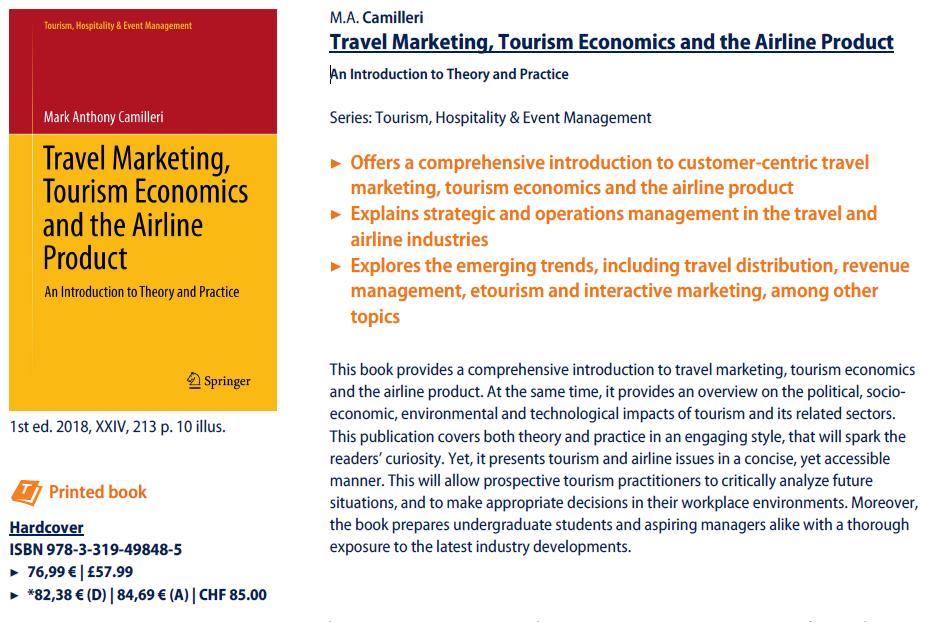
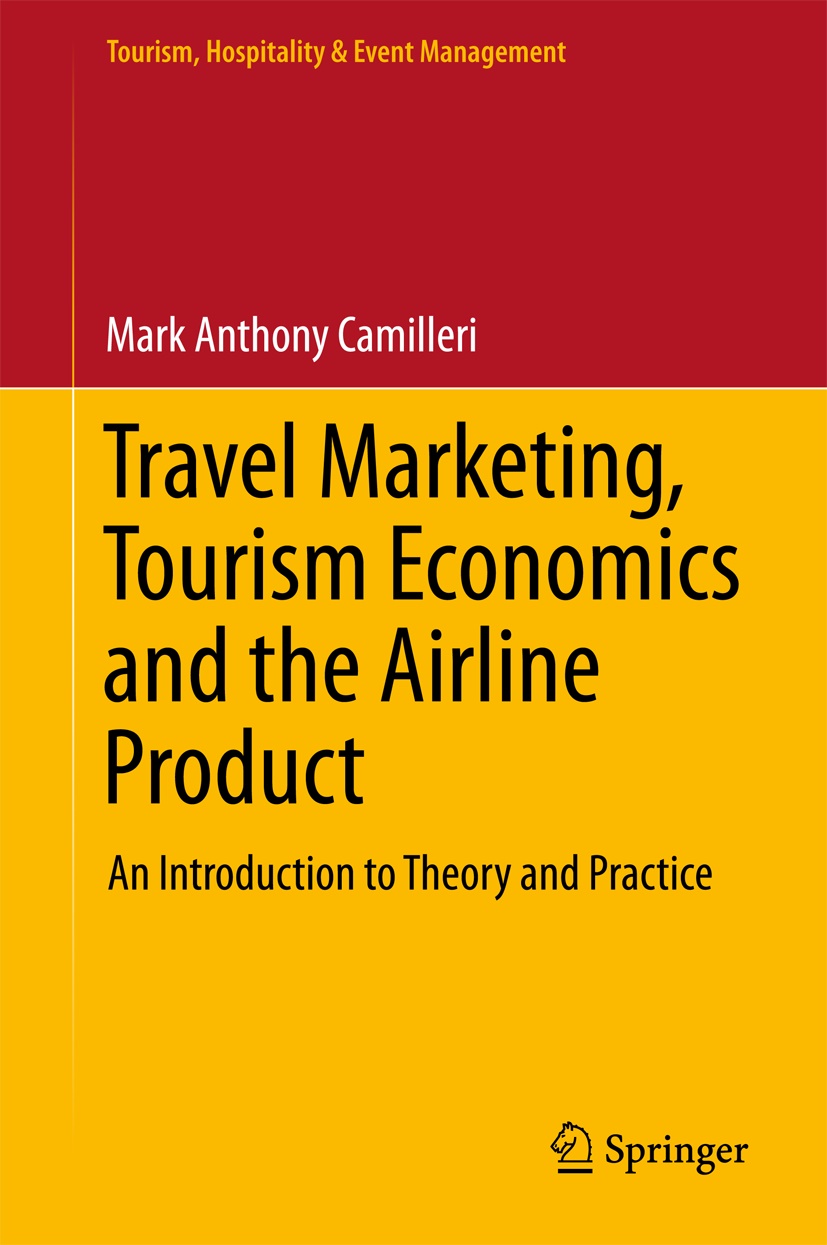
Springer’s authoritative textbook, Travel Marketing, Tourism Economics and the Airline Product has received numerous endorsements from leading academics.

“Dr. Camilleri provides tourism students and practitioners with a clear and comprehensive picture of the main institutions, operations and activities of the travel industry.”
Philip Kotler
, S.C. Johnson & Son Distinguished Professor of International Marketing, Kellogg School of Management, Northwestern University, Evanston/Chicago, IL, USA

“This book is the first of its kind to provide an insightful and well-structured application of travel and tourism marketing and economics to the airline industry. Student readers will find this systematic approach invaluable when placing aviation within the wider tourism context, drawing upon the disciplines of economics and marketing.”
Brian King, Professor of Tourism and Associate Dean, School of Hotel and Tourism Management, The Hong Kong Polytechnic University, Hong Kong

“The remarkable growth in international tourism over the last century has been directly influenced by technological, and operational innovations in the airline sector which continue to define the nature, scale and direction of tourist flows and consequential tourism development. Key factors in this relationship between tourism and the airline sector are marketing and economics, both of which are fundamental to the success of tourism in general and airlines in particular, not least given the increasing significance of low-cost airline operations. Hence, uniquely drawing together these three themes, this book provides a valuable introduction to the marketing and economics of tourism with a specific focus on airline operations, and should be considered essential reading for future managers in the tourism sector.”
Richard Sharpley, Professor of Tourism, School of Management, University of Central Lancashire, UK

“The book’s unique positioning in terms of the importance of and the relationships between tourism marketing, tourism economics and airline product will create a distinct niche for the book in the travel literature.”
C. Michael Hall, Professor of Tourism, Department of Management, Marketing and Entrepreneurship, University of Canterbury, Christchurch, New Zealand

“A very unique textbook that offers integrated lessons on marketing, economics, and airline services. College students of travel and tourism in many parts of the world will benefit from the author’s thoughtful writing style of simplicity and clarity.”
Liping A. Cai, Professor and Director, Purdue Tourism & Hospitality Research Center, Purdue University, West Lafayette, IN, USA

“An interesting volume that provides a good coverage of airline transportation matters not always well considered in tourism books. Traditional strategic and operational issues, as well as the most recent developments and emerging trends are dealt with in a concise yet clear and rational way. Summaries, questions and topics for discussion in each chapter make it a useful basis for both taught courses or self-education.”
Rodolfo Baggio, Professor of Tourism and Social Dynamics, Bocconi University, Milan, Italy

“This is a very useful introductory book that summarises a wealth of knowledge in an accessible format. It explains the relation between marketing and economics, and applies it to the business of airline management as well as the tourism industry overall.”
Xavier Font, Professor of Sustainability Marketing, School of Hospitality and Tourism Management, University of Surrey, UK and Visiting Professor, Hospitality Academy, NHTV Breda, Netherlands

“This book addresses  the key principles of tourism marketing, economics and the airline industry. It  covers a wide range of theory at the same time as offering real-life case studies, and offers readers a comprehensive understanding of  how these important industries work, and the underpinning challenges that will shape their future. It is suitable for undergraduate students as well as travel professionals, and I would highly recommend it.”
Clare Weeden, Principal Lecturer in Tourism and Marketing at the School of Sport and Service Management, University of Brighton, UK

“In the current environment a grasp of the basics of marketing to diverse consumers is very important. Customers are possessed of sophisticated knowledge driven by innovations in business as well from highly developed technological advances. This text will inform and update students and those planning a career in travel and tourism. Mark Camilleri has produced an accessible book, which identifies ways to accumulate and use new knowledge to be at the vanguard of marketing, which is both essential and timely.”
Peter Wiltshier, Senior Lecturer & Programme Leader for Travel & Tourism, College of Business, Law and Social Sciences, University of Derby, UK

“This contemporary text provides an authoritative read on the dynamics, interactions and complexities of the modern travel and tourism industries with a necessary, and much welcomed, mixture of theory and practice suitable for undergraduate, graduate and professional markets.” 
Alan Fyall, Orange County Endowed Professor of Tourism Marketing, University of Central Florida, FL, USA

cover2

Leave a comment

Filed under Airlines, Marketing, tourism, Travel