Category Archives: internet technologies and society

Call for papers: Community-driven (Social) Innovation in Collaborative Ecosystems

I am delighted to share this call for papers for the European Academy of Management’s (EURAM2026’s) SIG01: Business for Society (B4S).

My colleagues, Mario Tani, University of Naples Federico II, Naples, Italy; Gianpaolo Basile, Università Telematica Universitas Mercatorum, Rome, Italy; Ciro Troise, University of Turin, Turin, Italy; Maria Palazzo, Università Telematica Universitas Mercatorum, Rome, Italy; Asha Thomas, Wrocław University of Science and Technology AND I, are guest editing a track entitled: “Relationships, Values, and Community-driven (Social) Innovation in Collaborative Ecosystems” (T01-14).

We are inviting conceptual, empirical and methodological papers on the interplay between open innovation, digital platforms and the power of the crowd in navigating today’s grand challenges.

“This track explores the strategic shift from firm-centric models to dynamic, collaborative ecosystems. We examine how deep stakeholder engagement, shared values, and community-driven innovation can generate sustainable economic, social, and environmental value”.

Further details about this conference track are available here: https://lnkd.in/djN8KpDw [T01-14].

Keywords: EURAM2026; Business For Society B4S; Collaborative Ecosystems; Open Innovation Community Driven Innovation; Stakeholder Engagement; Digital; Digital Platforms; Digital Transformation; Crowdsourcing; Sustainable Development Goals (SDGs); UNSDGs; SDG9 [Industry, Innovation And Infrastructure]; SDG11 [Sustainable Cities And Communities]; SDG12 [Responsible Consumption And Production]; SDG17 [Partnerships For The Goals].

Leave a comment

Filed under digital, digital media, digital transformation, innovation, internet technologies, internet technologies and society, Marketing, online, Open Innovation, Stakeholder Engagement, Sustainability, technology, Web

An artificial intelligence governance framework

This is an excerpt from my latest contribution on responsible artificial intelligence (AI).

Suggested citation: Camilleri, M. A. (2023). Artificial intelligence governance: Ethical considerations and implications for socialresponsibility. Expert Systems, e13406. https://doi.org/10.1111/exsy.13406

The term “artificial intelligence governance” or “AI governance” integrates the notions of “AI” and “corporate governance”. AI governance is based on formal rules (including legislative acts and binding regulations) as well as on voluntary principles that are intended to guide practitioners in their research, development and maintenance of AI systems (Butcher & Beridze, 2019; Gonzalez et al., 2020). Essentially, it represents a regulatory framework that can support AI practitioners in their strategy formulation and in day-to-day operations (Erdélyi & Goldsmith, 2022; Mullins et al., 2021; Schneider et al., 2022). The rationale behind responsible AI governance is to ensure that automated systems including ML/DL technologies, are supporting individuals and organizations in achieving their long terms objectives, whist safeguarding the interests of all stakeholders (Corea et al., 2023; Hickok et al., 2022).

AI governance requires that the organizational leaders comply with relevant legislation, hard laws and regulations (Mäntymäki et al., 2022). Moreover, they are expected to follow ethical norms, values and standards (Koniakou, 2023). Practitioners ought to be trustworthy, diligent and accountable in how they handle their intellectual capital and other resources including their information technologies, finances as well as members of staff, in order to overcome challenges, minimize uncertainties, risks and any negative repercussions (E.g. decreased human oversight in decision making, among others) (Agbese et al., 2023; Smuha, 2019).

Procedural governance mechanisms ought to be in place to ensure that AI technologies and ML/DL models are operating in a responsible manner. Figure 1 features some of the key elements that are required for the responsible governance of artificial intelligence. The following principles are aimed to provide guidelines for the modus operandi of AI practitioners (including ML/DL developers).

Figure 1. A Responsible Artificial Intelligence Governance Framework

Accountability and transparency

“Accountability” refers to the stakeholders’ expectations about the proper functioning of AI systems, in all stages, including in the design, creation, testing or deployment, in accordance with relevant regulatory frameworks. It is imperative that AI developers are held accountable for the smooth operation of AI systems throughout their lifecycle (Raji et al., 2020). Stakeholders expect them to be accountable by keeping a track record of their AI development processes (Mäntymäki et al., 2022).

The transparency notion refers to the extent to which end-users could be in a position to understand how AI systems work (Andrada et al., 2020; Hollanek, 2020). AI transparency is associated with the degree of comprehension about algorithmic models in terms of “simulatability” (an understanding of AI functioning), “decomposability” (related to how individual components work), and algorithmic transparency (this is associated to the algorithms’ visibility).

 In reality, it is difficult to understand how AI systems, including deep learning models and their neural networks are learning (as they acquire, process and store data) during training phases. They are often considered as black box models. It may prove hard to algorithmically translate derived concepts into human-understandable terms, even though developers may use certain jargon to explain their models’ attributes and features. Many legislators are striving in their endeavors to pressurize AI actors to describe the algorithms they use in automated decision-making, yet the publication of algorithms is useless if outsiders cannot access the data of the AI model.

Explainability and interpretability

Explainability is the concept that sheds light on how AI models work, in a way that is comprehensible to a human being. Arguably, the explainabilty of AI systems could improve their transparency, trustworthiness and accountability. At the same time, it can reduce bias and unfairness. The explainability of artificial intelligence systems could clarify how they reached their decisions (Arya et al., 2019; Keller & Drake, 2021). For instance, AI could explain how and why autonomous cars decide to stop or to slow down when there are pedestrians or other vehicles in front of them.

Explainable AI systems might improve consumer trust and may enable engineers to develop other AI models, as they are in a position to track provenance of every process, to ensure reproducibility, and to enable checks and balances (Schneider et al., 2022). Similarly, interpretability refers to the level of accuracy of machine learning programs in terms of linking the causes to the effects (John-Mathews, 2022).

Fairness and inclusiveness

The responsible AI’s fairness dimension refers to the practitioners’ attempts to correct algorithmic biases that may possibly (voluntarily or involuntarily) be included in their automation processes (Bellamy et al., 2019; Mäntymäki, et al., 2022). AI systems can be affected by their developers’ biases that could include preferences or antipathies toward specific demographic variables like genders, age groups and ethnicities, among others (Madaio et al., 2020). Currently, there is no universal definition on AI fairness.

However, recently many multinational corporations have developed instruments that are intended to detect bias and to reduce it as much as possible (John-Mathews et al., 2022). In many cases, AI systems are learning from the data that is fed to them. If the data are skewed and/or if they comprise implicit bias into them, they may result in inappropriate outputs.

Fair AI systems rely on unbiased data (Wu et al., 2020). For this reason, many companies including Facebook, Google, IBM and Microsoft, among others are striving in their endeavors to involve members of staff hailing from diverse backgrounds. These technology conglomerates are trying to become as inclusive and as culturally aware as possible in order to minimize bias from affecting their AI processes. Previous research reported that AI’s bias may result in inequality, discrimination and in the loss of jobs (Butcher & Beridze, 2019).

Privacy and safety for consumers

Consumers are increasingly concerned about the privacy of their data. They have a right to control who has access to their personal information. The data that is collected or used by third parties, without the authorization or voluntary consent of individuals, would result in the violations of their privacy (Zhu et al., 2020; Wu et al., 2022).

AI-enabled products, including dialogue systems like chatbots and virtual assistants, as well as digital assistants (e.g. like Siri, Alexa or Cortana), and/or wearable technologies such as smart watches and sensorial smart socks, among others, are increasingly capturing and storing large quantities of consumer information. The benefits that are delivering these interactive technologies may be offset by a number of challenges. The technology businesses who developed these products are responsible to protect their consumers’ personal data (Rodríguez-Barroso et al., 2020). Their devices are capable of holding a wide variety of information on their users. They are continuously gathering textual, visual, audio, verbal, and other sensory data from consumers. In many cases, the customers are not aware that they are sharing personal information to them.

For example, facial recognition technologies are increasingly being used in different contexts. They may be used by individuals to access websites and social media, in a secure manner and to even authorize their payments through banking and financial services applications. Employers may rely on such systems to track and monitor their employees’ attendance. Marketers can utilize such technologies to target digital advertisements to specific customers. Police and security departments may use them for their surveillance systems and to investigate criminal cases. The adoption of these technologies has often raised concerns about privacy and security issues. According to several data privacy laws that have been enacted in different jurisdictions, organizations are bound to inform users that they are gathering and storing their biometric data. The businesses that employ such technologies are not authorized to use their consumers’ data without their consent.

Companies are expected to communicate about their data privacy policies with their target audiences (Wong, 2020). They have to reassure consumers that the consented data they collect from them is protected and are bound to inform them that they may use their information to improve their customized services to them. The technology giants can reward their consumers to share sensitive information. They could offer them improved personalized services among other incentives, in return for their data. In addition, consumers may be allowed to access their own information and could be provided with more control (or other reasonable options) on how to manage their personal details.

The security and robustness of AI systems

AI algorithms are vulnerable to cyberattacks by malicious actors. Therefore, it is in the interest of AI developers to secure their automated systems and to ensure that they are robust enough against any risks and attempts to hack them (Gehr et al., 2018; Li et al., 2020).

The accessibility to AI models ought to be continuously monitored at all times during their development and deployment (Bertino et al., 2021). There may be instances when AI models could encounter incidental adversities, leading to the corruption of data. Alternatively, they might encounter intentional adversities when they experience sabotage from hackers. In both cases, the AI model will be compromised and can result in system malfunctions (Papagiannidis et al., 2023).

AI models have to prevent such contingent issues from happening. Their developers’ responsibilities are to improve the robustness of their automated systems, and to make them as secure of possible, to reduce the chances of threats, including by inadvertent irregularities, information leakages, as well as by privacy violations like data breaches, contamination and poisoning by malicious actors (Agbese et al., 2023; Hamon et al., 2020).

AI developers should have preventive policies and measures related to the monitoring and control of their data. They ought to invest in security technologies including authentication and/or access systems with encryption software as well as firewalls for their protection against cyberattacks. Routine testing can increase data protection, improve security levels and minimize the risks of incidents.

Conclusions

This review indicates that more academics as well as practitioners, are increasingly devoting their attention to AI as they elaborate about its potential uses, as well as on its opportunities and threats. It reported that its proponents are raising awareness on the benefits of AI systems for individuals as well as for organizations. At the same time, it suggests that a number of scholars and other stakeholders including policy makers, are raising their concerns about its possible perils (e.g. Berente et al., 2021; Gonzalez et al., 2020; Zhang & Lu, 2021).

Many researchers identified some of the risks of AI (Li et al., 2021; Magas & Kiritsis, 2022). In many cases, they warned that AI could disseminate misinformation, foster prejudice, bias and discrimination, raise privacy concerns, and could lead to the loss of jobs (Butcher & Beridze, 2019). A few commentators argue about the “singularity” or the moment where machine learning technologies could even surpass human intelligence (Huang & Rust, 2022). They predict that a critical shift could occur if humans are no longer in a position to control AI anymore.

In this light, this article sought to explore the governance of AI. It sheds light on substantive regulations, as well as on reflexive principles and guidelines, that are intended at practitioners who are researching, testing, developing and implementing AI models. It clearly explains how institutions, non-governmental organizations and technology conglomerates are introducing protocols (including self-regulations) to prevent contingencies from even happening due to inappropriate AI governance.

Debatably, the voluntary or involuntary mishandling of automated systems can expose practitioners to operational disruptions and to significant risks including to their corporate image and reputation (Watts & Adriano, 2021). The nature of AI requires practitioners to develop guardrails to ensure that their algorithms work as they should (Bauer, 2022). It is imperative that businesses comply with relevant legislations and to follow ethical practices (Buhmann & Fieseler, 2023). Ultimately, it is in their interest to operate their company in a responsible manner, and to implement AI governance procedures. This way they can minimize unnecessary risks and safeguard the well-being of all stakeholders.

This contribution has addressed its underlying research objectives. Firstly, it raised awareness on AI governance frameworks that were developed by policy makers and other organizations, including by the businesses themselves. Secondly, it scrutinized the extant academic literature focused on AI governance and on the intersection of AI and CSR. Thirdly, it discussed about essential elements for the promotion of socially responsible behaviors and ethical dispositions of AI developers. In conclusion it put forward an AI governance conceptual model for practitioners.

This research made reference to regulatory instruments that are intended to govern AI expert systems. It reported that, at the moment there are a few jurisdictions that have formalized their AI policies and governance frameworks. Hence, this article urges laggard governments to plan, organize, design and implement regulatory instruments that ensure that individuals and entities are safe when they utilize AI systems for personal benefit, educational and/or for commercial purposes.

Arguably, one has to bear in mind that, in many cases, policy makers have to face a “pacing problem” as the proliferation of innovation is much quicker than legislation. As a result, governments tend to be reactive in the implementation of regulatory interventions relating to innovations. They may be unwilling to hold back the development of disruptive technologies from their societies. Notwithstanding, they may face criticism by a wide array of stakeholders in this regard, as they may have conflicting objectives and expectations.

The governments’ policy is to regulate business and industry to establish technical, safety and quality standards as well as to monitor their compliance. Yet, they may consider introducing different forms of regulation other than the traditional “command and control” mechanisms. They may opt for performance-based and/or market-based incentive approaches, co-regulation and self-regulation schemes, among others (Hepburn, 2009), in order to foster technological innovations.

This research has shown that a number of technology giants, including IBM and Microsoft, among others, are anticipating the regulatory interventions of different governments where they operate their businesses. It reported that they are communicating about their responsible AI governance initiatives as they share information on their policies and practices that are meant to certify, explain and audit their AI developments. Evidently, these companies, among others, are voluntarily self-regulating themselves as they promote accountability, fairness, privacy and robust AI systems. These two organizations, in particular, are raising awareness about their AI governance frameworks to increase their CSR credentials with stakeholders.

Likewise, AI developers who work for other businesses, are expected to forge relationships with external stakeholders including with policy makers as well as with actors including individuals and organizations who share similar interests in AI. Innovative clusters and network developments may result in better AI systems and can also decrease the chances of possible risks.  Indeed, practitioners can be in better position if they cooperate with stakeholders for the development of trustworthy AI and if they increase their human capacity to improve the quality of their intellectual properties (Camilleri et al., 2023). This way, they can enhance their competitiveness and growth prospects (Troise & Camilleri, 2021). Arguably, it is in their interest to continuously engage with internal stakeholders (and employees), and to educate them about AI governance dimensions, that are intended to promote accountable, transparent, explainable interpretable reproducible, fair, inclusive and secure AI solutions. Hence, they could maximize AI benefits, minimize their risks as well as associated costs.

Future research directions

Academic colleagues are invited to raise more awareness on AI governance mechanisms as well as on verification and monitoring instruments. They can investigate what, how, when and where protocols could be used to protect and safeguard individuals and entities from possible risks and dangers of AI.

The “what” question involves the identification of AI research and development processes that require regulatory or quasi regulatory instruments (in the absence of relevant legislation) and/or necessitate revisions in existing statutory frameworks.

The “how” question is related to the substance and form of AI regulations, in terms of their completeness, relevance, and accuracy. This argumentation is synonymous with the true and fair view concept applied in the accounting standards of financial statements.

The “when” question is concerned with the timeliness of the regulatory intervention. Policy makers ought to ensure that stringent rules do not hinder or delay the advancement of technological innovations.

The “where” question is meant to identify the context where mandatory regulations or the introduction of soft laws, including non-legally binding principles and guidelines are/are not required.

Future researchers are expected to investigate further these four questions in more depth and breadth. This research indicated that most contributions on AI governance were discursive in nature and/or involved literature reviews. Hence, there is scope for academic colleagues to conduct primary research activities and to utilize different research designs, methodologies and sampling frames to better understand the implications of planning, organizing, implementing and monitoring AI governance frameworks, in diverse contexts.

The full article is also available here: https://www.researchgate.net/publication/372412209_Artificial_intelligence_governance_Ethical_considerations_and_implications_for_social_responsibility

Leave a comment

Filed under artificial intelligence, chatbots, Corporate Social Responsibility, internet technologies, internet technologies and society

Interactive engagement through travel and tourism social media groups

This an an excerpt from one of my latest article that was published through Technology in Society (An Elsevier Journal).

Credit: Joel Saget / AFP

Suggested Citation: Camilleri, M.A. & Kozak, M. (2022). Interactive engagement through travel and tourism social media groups: A social facilitation theory perspective. Technology in Societyhttps://doi.org/10.1016/j.techsoc.2022.102098

This study builds on previous academic knowledge on the acceptance and use of social media groups. It relied on valid constructs that were drawn from the Theory of Reasoned Action (TRA), Theory of Planned Behavior (TPB) and Theory of Acceptance Model (TAM), as the proposed research model comprised “attitudes toward technology” and “behavioral intentions” constructs. However, it integrated them with perceived interactivity constructs, including “real-time conversation” and “engaging” as well as with “content attractiveness” from Electronic Retail Quality (eTailQ).

This empirical investigation clarifies that the content attractiveness of social media posts as well as their engaging content and real-time conversation capabilities, can have significant effects on social facilitation behaviors of individuals, and on their intentions to revisit social media groups. The findings from this study reiterate the importance of continuously creating relevant content that appeals to social media followers.

Previous research posited that online users should keep their followers engaged through rich media ([77]). Other theoretical underpinnings reported that interactive websites, particularly social media and video sharing platforms, can offer great potential to DMOs to promote tourism and hospitality services ([88]).  Internet domains can showcase a wide array of high-res images and video clips to lure online users to book their travel itineraries to visit destinations ([90]). The digital media and mobile applications (app) ought to be as functional and responsive as possible ([99]). They should load quickly without delays to reduce the likelihood of dissatisfied visitors, who can easily switch to another website or app ([74]).

In this case, the results suggest that there are very significant effects between the online users’ perceptions about engaging content and their intentional behaviors to check out the social media pages (on a regular basis); and between their perceptions about engaging content and their social facilitation dispositions to communicate about social media groups through online and offline channels, in the presence of others. The respondents are appreciating the attractive content, including images or videos, that are disseminated through the social media groups’ posts. Moreover, the findings indicate that they hold positive perceptions about the co-creation of user generated content. Evidently, the exchange of information as well as the responsiveness between two or more online users was leading them to revisit the social media groups.

This study is consistent with the relevant literature that sought to explore the online users’ perceptions about the websites’ interactivity features ([30], [34]). Other researchers maintained that real-time conversations had a positive effect on the online users’ attitudes toward engaging websites ([84]). In this case, this argumentation holds for social media groups, as well.

This contribution underlines the importance of posting engaging content including appealing images and videos through social media. It clearly indicates that interactive content as well as the social networks’ real-time conversation capabilities can foster positive social facilitation behaviors. Arguably, individuals are interested and intrigued to interact with other online users through popular social media groups in the presence of other members. They are likely to join in online discussions and conversations in prolific social media groups, particularly in those that are regularly disseminating attractive content, and in those that facilitate interactive engagement among their members.

The cocreation of user generated content in social media, blogs and review sites is driven by online audiences. This study confirms that the relevance and attractiveness of social media content can have a positive effect on triggering real-time conversations as well as on social facilitation. This reasoning is consistent with the social facilitation theory ([33],[40],[60],[61]). This research corroborates that while the presence of other individuals can increase the likelihood of social engagement, a passive audience may inhibit them from sharing their comments about the attractiveness of interactive content.

The findings of this research also yield plausible implications to practitioners. The researchers indicate that social media subscribers are attracted by the online content that is being posted by DMOs and travel marketers. Online users and prospective travelers are increasingly browsing through interactive content including images and videos of travel destinations. The social media groups are offering a variety of multimedia content that is appealing to online users. Very often, they allow their followers to engage in two-way communications, as members can comment on posts and may also interact with other online users, in real-time. This study suggests that the research participants are visiting the social media groups as they considered them as helpful for their decision making, prior to booking their travel itineraries. Apparently, they were intrigued to revisit these groups and were likely to communicate about their content with other people through offline and online channels, as it appealed to them and captured their attention.

Therefore, travel marketers ought to focus on publishing quality content. This increases the chances of their engagement. Prospective travelers are attracted by multi-media features including high-res images with zooming effects and video content; that are adapted for mobile technologies, including tablets and smartphone devices. Travel marketers and DMOs ought to curate their social media group(s) with appealing content to raise awareness about their tourism products. It is in their interest to share relevant and attractive material to increase the number of followers and their engagement. More importantly, they are expected to interact with online users, in a timely manner, to turn them into brand advocates and to encourage social facilitation behaviors.

In sum, this empirical research clarifies that the attractiveness of online content of social media groups, including their images and videos of destinations, as well as their interactive and real-time conversation capabilities are affecting their subscribers’ revisit intentions. They are also influencing their social facilitation behaviors – in the presence of others. This study raises awareness on the importance of sharing engaging content and of encouraging interactive discussions among social media subscribers. The researchers contend that content creators can lure individuals to visit and revisit their social media pages/groups to generate leads and conversions. Arguably, the more engagement (e.g. through emojis and shares) and conversations (e.g. comments), the greater the chances of captivating the attention of existing followers and of enticing the curiosity of new ones. For the time being, the social facilitation paradigm is still relatively under-explored in academia, particularly within the travel and tourism marketing literature.

Future researchers are encouraged replicate this study in different contexts. They may adapt the measures that were used in this research, including engaging content, real time conversation and social facilitation constructs, in addition to other popular constructs that are drawn from TRA, TPB and TAM. They may include other constructs in their research models, including those relating to psychological theories that can clarify their motivations to engage with other individuals through such digital channels. Further research could focus on the demographic backgrounds of their respondents to better understand who, why, when and where they are engaging with other users through social media groups. Perhaps, there is scope for other studies to employ different sampling frames and methodologies, including inductive ones, to explore this topic in more depth and breadth.

The full list of references are available in the full article. You can download a prepublication version here: 362888940_Interactive_engagement_through_travel_and_tourism_social_media_groups_A_social_facilitation_theory_perspective

Leave a comment

Filed under digital media, internet technologies, internet technologies and society, Marketing, social media

Learning from anywhere, anytime: The use of mobile technologies for educational purposes

This contribution is a excerpt from my latest article that was published by Springer’s Technology, Knowledge and Learning (Journal). The content has been adapted for this blog post.

Suggested citation: Camilleri, M.A. & Camilleri, A.C. (2022). Learning from anywhere, anytime: Utilitarian motivations and facilitating conditions to use mobile learning applications. Technology, Knowledge and Learninghttps://doi.org/10.1007/s10758-022-09608-8

dailymail.co.uk

University students are using mobile technologies to improve their learning outcomes. In the past years, a number of academic authors contended that educational apps were supporting many students in different contexts Butler et al., 2021; Crompton & Burke, 2018; Hamidi & Chavoshi, 2018; Sung et al., 2016; Tosuntas et al., 2015). In the main, they maintained that ubiquitous technologies enable them to access learning management systems and to engage in synchronous conversations with other individuals (Camilleri & Camilleri, 2021).

One may argue that the m-learning paradigm is associated with the constructivist approaches (Chang et al., 2018), including those related with discovery-based learning (Camilleri & Camilleri, 2019c). Relevant theoretical underpinnings suggest that the use of mobile apps can improve the delivery of quality, student-centered education (Camilleri & Camilleri, 2021; Camilleri, 2021b; Chang et al., 2018; Crompton & Burke, 2018; Furió et al., 2015; Lameu, 2020; Nikolopoulou et al., 2021; Sung et al., 2016; Swanson, 2020). This research raises awareness on m-learning technologies that enable students to search for solutions for themselves through the Internet and via learning management systems. It also indicated that mobile apps like Microsoft Teams or Zoom, among others, allow them to engage in synchronous conversations with course instructors and with their peers, in real time.

This study explored the users’ perceptions about m-learning technologies. It validated key constructs from TAM Briz-Ponce et al., 2017; Cheung & Vogel, 2013; Granić & Marangunić, 2019; Ngai et al., 2007; Scherer et al., 2019; Thong Hong & Tam, 2002) and UTAUT (Gunasinghe et al., 2019; Yang et al., 2019), as shown in Table 1.

The descriptive statistics clearly indicated that the research participants felt that m-learning technologies were useful for them to continue their course programs. The principal component analysis confirmed that the students’ engagement with their educational apps was primarily determined by their ease of use. This is one of the main factors that influenced their intentions to engage with m-learning apps.

The findings revealed that higher education students were using m-learning apps as they considered them as useful tools to enhance their knowledge. Evidently, their perceptions about the ease of use of m-learning technologies were significantly correlated with their perceived usefulness. In addition, it transpired that both constructs were also affecting their attitudes towards usage, that in turn preceded their intentions to use m-learning apps.

The results also revealed that the respondents were satisfied by the technical support they received during COVID-19. Apparently, their university provided appropriate facilitating conditions that allowed them to engage with to m-learning programs during the unexpected pandemic situation and even when the preventative restrictions were eased.

The stepwise regression analyses shed light on the positive and significant relationships of this study’s research model. Again, these results have proved that the respondents were utilizing m-learning apps because their university (and course instructors) supported them with adequate and sufficient resources (i.e. facilitating conditions). The findings indicated that they were assisted (by their institution’s helpdesk) during their transition to emergency remote learning. In fact, the study confirmed that there was a positive and significant relationship between facilitating conditions and the students’ engagement with m-learning technologies.

On the other hand, this empirical research did not yield a statistically significant relationship between the students’ social influences and their intentions to use the mobile technologies. This is in stark contrast with the findings from past contributions, where other researchers noted that students were pressurized by course instructors to use education technologies (Camilleri & Camilleri, 2020; Teo & Zheng, 2014). The researchers presume that in this case, the majority of university students indicated that they were not coerced by educators or by their peers, to use m-learning apps. This finding implies that students became accustomed or habituated with the use of mobile technologies to continue their course programs.

This research builds on previous technology adoption models Davis et al., 1989; Venkatesh et al., 2003; 2012) to better understand the students’ dispositions to engage with m-learning apps. It integrated constructs from TAM with others that were drawn from UTAUT/UTAUT2. To the best of the researchers’ knowledge, currently, there are no studies that integrated facilitating conditions and social influences (from UTAUT/UTAUT2) with TAM’s perceived ease of use, perceived usefulness and attitudes. This contribution addresses this knowledge gap in academia. In sum, it raises awareness on the importance of providing appropriate facilitating conditions to students (and educators). This way, they will be in a better position to use educational technologies to improve their learning outcomes.

Practical implications

This research indicated that students held positive attitudes and perceptions on the use of m-learning technologies in higher educational settings. Their applications allow them to access course material (through Moodle or other virtual learning environments) and to avail themselves from video conferencing facilities from everywhere, and at any time. The respondents themselves considered the mobile technologies as useful tools that helped them improve their learning journeys, even during times when COVID-19’s preventative measures were eased. Hence, there is scope for university educators and policy makers to create and adopt m-learning approaches in addition to traditional teaching methodologies, to deliver quality education (Camilleri, 2021).

Arguably, m-learning would require high-quality wireless networks with reliable connections. Course instructors have to consider that their students are accessing their asynchronous resources as well as their synchronous apps (like Zoom or Microsoft Teams) on campus or in other contexts. Students using m-learning technologies should have appropriate facilitating conditions in place, including adequate Wi-Fi speeds (that enable access to high-res images, and/or interactive media, including videos, live streaming, etc.). Furthermore, higher education institutions ought to provide ongoing technical support to students and to their members of staff (Camilleri & Camilleri, 2021).

This study has clearly shown that the provision of technical support, as well as the utilization of user-friendly, m-learning apps, among other factors, would probably improve the students’ willingness to engage with these remote technologies. Thus, course instructors are encouraged to create attractive and functional online environments in formats that are suitable for the screens of mobile devices (like tablets and smartphones). There can be instances where university instructors may require technical training and professional development to learn how to prepare and share customized m-learning resources for their students.

Educators should design appealing content that includes a good selection of images and videos to entice their students’ curiosity and to stimulate their critical thinking. Their educational resources should be as clear and focused as possible, with links to reliable academic sources. Moreover, these apps could be developed in such a way to increase the users’ engagement with each other and with their instructors, in real time.

Finally, educational institutions ought to regularly evaluate their students’ attitudes and perceptions toward their m-learning experiences, via quantitative and qualitative research, in order to identify any areas of improvement.

Research limitations and future research directions

To date, there have been limited studies that explored the institutions’ facilitating conditions and utilitarian motivations to use m-learning technologies in higher education, albeit a few exceptions. A through review of the relevant research revealed that researchers on education technology have often relied on different research designs and methodologies to capture and analyze their primary data. In this case, this study integrated measures that were drawn from TAM and UTAUT. The hypotheses were tested through stepwise regression analyses. The number of respondents that participated in this study was adequate and sufficient for the statistical purposes of this research.

Future research could investigate other factors that are affecting the students’ engagement with m-learning technologies. For example, researchers can explore the students’ intrinsic and extrinsic motivations to use educational apps. These factors can also have a significant effect on their intentions to continue their learning journeys. Qualitative research could shed more light on the students’ in-depth opinions, beliefs and personal experiences on the usefulness and the ease of use of learning via mobile apps, including serious games and simulations. Inductive studies may evaluate the effectiveness as well as the motivational appeal of gameplay. They can possibly clarify how, where and when mobile apps can be utilized as teaching resources in different disciplines. They can also identify the strengths and weaknesses of integrating them in the curricula of specific subjects.

Prospective researchers can focus on the design, structure and content of m-learning apps that are intended to facilitate the students’ learning experiences. Furthermore, longitudinal studies may provide a better understanding of the students’ motivations to engage with such educational technologies. They can measure their progress and development, in the long term. The students’ perceptions, attitudes and intentions to use m-learning technologies can change over time, particularly as they become experienced users.

A prepublication of the full article is available here: https://www.researchgate.net/publication/360541461_Learning_from_anywhere_anytime_Utilitarian_motivations_and_facilitating_conditions_to_use_mobile_learning_applications

Leave a comment

Filed under Conferencing Technologies, Education, education technology, internet technologies, internet technologies and society, Learning management systems, Mobile, mobile learning, online streaming, Remote Learning

The pros and cons of remote learning

This is an excerpt from one of my latest articles that was accepted for publication by the 6th International Conference on E-Education, E-Business & E-Technology (ICEBT2022).

Suggested Citation: Camilleri, M.A. & Camilleri, A.C. (2022). A cost-benefit analysis on remote learning: A systematic review and implications for the future. 6th International Conference on e-Education, e-Business and e-Technology (Beijing, China: 26th June 2022). https://papers.ssrn.com/sol3/papers.cfm?abstract_id=4104629

(image source: CrushPixel)

After the outbreak of COVID-19 pandemic, educational institutions were expected to adapt to an unexpected crisis situation. In many cases, they had to follow their policy makers’ preventative measures to mitigate the contagion of the pandemic [1, 2]. As a result, they introduced contingency plans, and disseminated information on the virus, among students and employees. In many cases, educators were coerced to shift from the provision of traditional, face-to-face teaching and blended learning approaches, to a fully virtual remote course delivery [3, 4]. This transition resulted in a number of challenges to students and instructors [5]. Educators were pressurized to utilize digital technologies including learning management systems (LMS) as well as video conferencing programs [6]. Very often, they relied on their institutions’ Moodle or virtual learning environment (VLE) software to share digital resources including videos, power point presentations and links to online notes [7]. During the pandemic educators also acquainted themselves with video-conferencing platforms [8].

Subsequently, when COVID-19 restrictions were eased, a number of educational institutions reopened their doors to students and employees [9]. They introduced social distancing policies and hygienic procedures in their premises [4, 10]. At the time of writing, a number of academic members of staff, in various contexts, are still utilizing learning technologies including LMS and video conferencing programs [6]. Currently, student-centered educators are adopting hybrid/blended learning approaches, as they deliver face-to-face lectures in addition to online learning methodologies. Very often, they do so to support students who are not in a position to attend their lectures on campus.

A synthesis of the literature on the costs and benefits of remote learning

The costs

Many researchers noted that Covid-19 disrupted the provision of education. In the main, they reported that there were various challenges for the successful implementation of remote learning [17, 23-25]. For example, one of the contributions implied that the prolonged use of virtual platforms might negatively impact the efficacy of synchronous learning [27].

Various studies indicated that the research participants were not always pleased with the quality of education that was provided by their educators, during the pandemic [28]. Academic commentators indicated that faculty members were not experts in the delivery of remote/online instruction. They implied that instructors could require periodic developmental training to improve the service quality of their courses [4, 10].

While a few researchers noted that students appreciated the availability of recorded lectures [29], others reported that educators were not always recording their lectures and/or did not share learning resources with them [21]. This issue could have affected the students’ learning outcomes [30, 31]. In fact, some students were worried about their academic progress during COVID-19 [32]. In many cases, they encountered a number of difficulties during remote course delivery. For instance, online group work involved additional planning as well as institutional support [33]. Previous literature suggests that students necessitate counseling, tutoring and mentoring as well as ongoing assurances to succeed [34, 35].

In many cases, the researchers discovered that course participants required adequate training and support to complete their assessments [23, 24, 36]. A few of them also hinted that was a digital divide among students could have been evidenced among those who experienced connectivity and equipment problems, among other issues [5, 37]. Other authors argued about the individuals’ challenges to focus on their screens for long periods of time [6]. Notwithstanding, educators and students may develop bad postures and other physical problems due to staying hunched in front of a screen. Therefore, students ought to be given regular breaks from the screen to refresh their minds and their bodies.

The benefits

Generally, a number of contributions shed light on the benefits of using remote learning technologies, including learning management systems [1, 21, 29, 32] and interactive conferencing programs (1, 6, 17, 33]. Such educational technologies can help in creating rich social interactions [38-40] as well as positive learning environments – that foster learning and retention [41, 42]. Previous research indicated that digital learning resources can enhance the students’ knowledge and skills [43]. Remote instruction approaches can also provide supportive environments to students [39] and could even increase their chances of learning [30, 31]. Virtual lectures may be recorded or archived for future reference [29]. Hence, students or educators could access their learning materials at their convenience [44-46].

Several researchers underlined the importance of maintaining ongoing, two-way communications with students, and of providing them with appropriate facilitating conditions, to continue improving their learning journeys [6, 47-48]. Video conferencing technologies allow educators to follow up on their students’ progress. They facilitate online interactions, in real time, and enable them to obtain immediate feedback from their students [1, 49]. Notwithstanding, there are fewer chances of students’ absenteeism and on missing out on their lessons, as they can join online meetings from home or from other locations of their choice.

Conclusions

This review implies that online technologies have opened a window of opportunity for educators. Indeed, learning management systems as well as conferencing programs are useful tools for educators to continue delivering education in a post covid-19 context. However, it is imperative that educational institutions invest in online learning infrastructures, resources and facilitating conditions, for the benefit of their students and faculty employees. They should determine whether their instructors are (or are not) delivering high levels of service quality through the utilization of remote learning technologies to continue delivering student-centered education.

This paper can be downloaded from: https://www.researchgate.net/publication/360474225_A_cost-benefit_analysis_on_the_use_of_remote_learning_technologies_A_systematic_review_and_a_synthesis_of_the_literature

References (these are all the references that were featured in the full paper)

  1. Mark Anthony Camilleri, and Adriana Caterina Camilleri. 2021. The acceptance of learning management systems and video conferencing technologies: Lessons learned from COVID-19. Tech, Know and Learning, https://link.springer.com/article/10.1007/s10758-021-09561-y
  2. OECD 2020. OECD Policy Response to CoronaVirus: Education responses to COVID-19: Embracing digital learning and online collaboration”, Organization for Economic Cooperation and Development, Paris, France.  http://www.oecd.org/coronavirus/policy-responses/education-responses-to-covid-19-embracing-digital-learning-and-online-collaboration-d75eb0e8/
  3. Sir John Daniel. 2020. Education and the COVID-19 pandemic. Prospects, 49(1), 91-96. https://doi.org/10.1007/s11125-020-09464-3
  4. Mark Anthony Camilleri. 2021. Evaluating service quality and performance of higher education institutions: A systematic review and a post COVID-19 outlook. Int J. of Qual & Serv Sciences 13, 2, 268-281. https://doi.org/10.1108/IJQSS-03-2020-0034
  5. Tewathia, Nidhi, Anant Kamath, and P. Vigneswara Ilavarasan. 2020. Social inequalities, fundamental inequities, and recurring of the digital divide: Insights from India. Tech in Soc, 61, 101251.
  6. Mark Anthony Camilleri, and Adriana Camilleri. 2022. Remote learning via video conferencing technologies: Implications for research and practice. Tech in Society, https://doi.org/10.1016/j.techsoc.2022.101881
  7. Fathema, Nafsaniath, David Shannon, and Margaret Ross. 2015. Expanding the Technology Acceptance Model (TAM) to examine faculty use of Learning Management Systems (LMSs) in higher education institutions. J of Online Learning & Teach, 11(2), 210-232.
  8. Worldbank 2020 The COVID-19 Crisis Response: Supporting tertiary education for continuity, adaptation, and innovation. Worldbank Group Education, Washington, USA. http://pubdocs.worldbank.org/en/621991586463915490/WB-Tertiary-Ed-and-Covid-19-Crisis-for-public-use-April-9.pdf
  9. Mark Anthony Camilleri. 2021. Shifting from traditional and blended learning approaches to a fully virtual and remote course delivery: Implications from COVID-19. Acad Letters, Article, 481.
  10. Ronald W. Welch, Robert J. Rabb, and Alyson Grace Eggleston. 2021. Using the SWIVL for Effective HyFlex Instruction: Best Practices, Challenges, and Opportunities. ASEE Annual Conference and Exposition, Conference Proceedings
  11. Rabab Ali Abumalloh, Shahla Asadi, Mehrbakhsh Nilashi, Behrouz Minaei-Bidgoli, Fatima Khan Nayer, Sarminah Samad, Saidatulakmal Mohd, and Othman Ibrahim. 2021. The impact of coronavirus pandemic (COVID-19) on education: The role of virtual and remote laboratories in education. Tech in Soc, 67, 101728.
  12. Stephen J. Aguilar, 2020. Guidelines and tools for promoting digital equity. Inf and Lear Sci, 121(5/6), 285-299.
  13. Amy B. Smoyer, Kyle O’Brien, and Elizabeth Rodriguez-Keyes. 2020. Lessons learned from COVID-19: Being known in online social work classrooms. Int Social Work, 63(5), 651-654.
  14. Anthony F. Tasso, Nesrin Hisli Sahin, and Gabrielle J. San Roman.2021. COVID-19 disruption on college students: Academic and socioemotional implications. Psych Trauma: Theory, Res, Practice, and Pol, 13(1), 9-15.
  15. Jingrong Xie, and Mary F. Rice. 2021. Instructional designers’ roles in emergency remote teaching during COVID-19. Dist Ed, 42(1), 70-87.
  16. Lata Kanyal Butola, 2021. E-learning-a new trend of learning in 21st century during COVID-19 pandemic. Indian J of Foren Med and Toxicology, 15(1), 422-426.
  17. William Hurst, Adam Withington, and Hoshang Kolivand. 2022. Virtual conference design: features and obstacles. Multimedia Tools and Applic. https://doi.org/10.1007/s11042-022-12402-4
  18. Mark Anthony Camilleri, and Adriana Caterina Camilleri. 2019. The students’ readiness to engage with mobile learning apps. Interactive Tech and Smart Educ 17,1, 28-38. https://doi.org/10.1108/ITSE-06-2019-0027
  19. Andrzej Szymkowiak, Boban Melović, Marina Dabić, Kishokanth Jeganathan, and Gagandeep Singh Kundi. 2021. Information technology and Gen Z: The role of teachers, the internet, and technology in the education of young people. Tech in Soc, 65, 101565.
  20. Mark Anthony Camilleri, and Adriana Caterina Camilleri. 2017. Digital learning resources and ubiquitous technologies in education. Tech, Know and Learning 22,1, 65-82. https://link.springer.com/article/10.1007/s10758-016-9287-7
  21. Patricia R. Backer, Maria Chierichetti, Laura E. Sullivan-Green, and Liat Rosenfeld. 2021. Learning from the Student Experience: Impact of Shelter-in-Place on the Learning Experiences of Engineering Students at SJSU. ASEE Annual Conference and Exposition, Conference Proceedings.
  22. Timothy Boye, and Tania Machet. 2021. Emerging from COVID-19 to future practice. Proceedings – SEFI 49th Annual Conference: Blended Learning in Engineering Education: Challenging, Enlightening – and Lasting, 697-704.
  23. Andrea N. Giordano, and Casey R. Christopher. 2020. Repurposing best teaching practices for remote learning environments: Chemistry in the news and oral examinations during covid-19. J of Chemical Educ, 97(9), 2815-2818.
  24. Mohamed Shaik Honnurvali, Ayman A. El-Saleh, Abdul Manan Sheikh, Keng Goh, Naren Gupta, and Tariq Umar. 2022. Sustainable Engineering higher education in Oman-lessons learned from the pandemic (COVID-19), improvements, and suggestions in the teaching, learning and administrative framework. J of Eng Education Trans, 35(3), 52-69.
  25. Rizwana Wahid, Oveesa Farooq, and Ahtisham Aziz. 2021. The New Normal: Online Classes and Assessments during the COVID-19 Outbreak. J of E-Learning and Know Society, 17(2), 85-96.
  26. Brenda Van Wyk, Gillian Mooney, Martin Duma, and Samuel Faloye, 2020. Emergency remote learning in the times of covid: A higher education innovation strategy. Proceedings of the European Conference on e-Learning, ECEL2020, 499-507.
  27. Andrew Darr, Jenna Regan, and Yerko Berrocal. 2021. Effect of Video Conferencing on Student Academic Performance: Evidence from Preclinical Summative Assessment Scores. Medical Science Educator, 31(6), 1747-1750.
  28. Ji-Hee Jung, and Jae-Ik Shin 2021. Assessment of university students on online remote learning during COVID-19 pandemic in Korea: An empirical study, Sustainability (Switzerland), 13(19), 10821.       
  29. John Michael Cotter, and Rasim Guldiken. 2021. Remote Versus In-Class Active Learning Exercises for an Undergraduate Course in Fluid Mechanics, ASEE Annual Conference and Exposition, Conference Proceedings                 
  30. Mark Anthony Camilleri, and Adriana Caterina Camilleri. 2017. Digital learning resources and ubiquitous technologies in education. Tech, Knowledge and Learning, 22(1), 65-82.
  31. Mark Anthony Camilleri, and Adriana Caterina Camilleri. 2017. The students’ perceptions of digital game-based learning. In European Conference on Games Based Learning (pp. 56-62). Academic Conferences International Limited.
  32. Marilyn Barger, and Lakshmi Jayaram. 2021. Students Talk: The Experience of Advanced Technology Students at Two-Year Colleges during COVID-19, ASEE Annual Conference and Exposition, Conference Proceedings.  
  33. Kennedy Saldanha, Jennifer Currin-McCulloch, Barbara Muskat, Shirley R. Simon, Ann M. Bergart, Ellen Sue Mesbur, Donna Guy, Namoonga B. Chilwalo, Mamadou M. Seck, Greg Tully, Kristina Lind, Cheryl D. Lee, Neil Hall,and Diana Kelly, 2021. Turning boxes into supportive circles: Enhancing online group work teaching during the COVID-19 pandemic. Social Work with Groups, 44(4), 310-327.
  34. Mark Anthony Camilleri, and Adriana Caterina Camilleri. 2017. The technology acceptance of mobile applications in education. In 13th International Conference on Mobile Learning (Budapest, April 10th). Proceedings, pp., International Association for Development of the Information Society.
  35. Adriana Caterina Camilleri, and Mark Anthony Camilleri. 2019. Mobile learning via educational apps: an interpretative study. In Proceedings of the 2019 5th International Conference on Education and Training Technologies (pp. 88-92).
  36. Galina Ilieva, and Tania Yankova. 2020. IoT in Distance Learning during the COVID-19 Pandemic.TEM Journal, 9(4), 1669-1674.
  37. Emily S. Kinsky, Patrick F. Merle, and Karen Freberg. 2021. Zooming through a Pandemic: An Examination of Marketable Skills Gained by University Students during the COVID-19 Crisis. Howard J of Comm, 32(5), 507-529
  38. Anne E. Drake, Jonathan Hy, Gordon A. MacDougall, Brendan Holmes, Lauren Icken, Jon W. Schrock, and Robert A. Jones.. 2021. Innovations with tele-ultrasound in education sonography: the use of tele-ultrasound to train novice scanners. Ultrasound J, 13(1), Article 6, https://doi.org/10.1186/s13089-021-00210-0
  39. Ming Lei, Ian M. Clemente, Haixia Liu, and John Bell. 2022. The Acceptance of Telepresence Robots in Higher Education. Int J of Social Robotics, https://doi.org/10.1007/s12369-021-00837-y                                                           
  40. Yuan Li, David Hicks, Wallace S. Lages, Sang Won Lee, Akshay Sharma, and Doug A. Bowman   2021. ARCritique: Supporting remote design critique of physical artifacts through collaborative augmented reality. Proceedings – 2021 IEEE Conference on Virtual Reality and 3D User Interfaces Abstracts and Workshops, VRW 2021, 9419257, 585-586
  41. Vivekananth Subbiramaniyan, Chandrashekhar Apte, and Ciraj Ali Mohammed. 2021. A meme-based approach for enhancing student engagement and learning in renal physiology, Adv in Physio Educ, 46(1), 27-29.                 
  42. Joshua Zavitz, Aarti Sarwal, Jacob Schoeneck, Casey Glass, Brandon Hays, E. Shen, Casey Bryant, and Karisma Gupta. 2021. Virtual multispecialty point-of-care ultrasound rotation for fourth-year medical students during COVID-19: Innovative teaching techniques improve ultrasound knowledge and image interpretation. AEM Education and Training, 5(4), e10632.                         
  43. Vikash Gayah, Sarah E. Zappe, and Stephanie Cutler. 2021.Impact of Remote Instructional Format on Student Perception of a Supportive Learning Environment for Expertise Development. ASEE Annual Conference and Exposition, Conference Proceedings.
  44. Butler, A., Camilleri, M. A., Creed, A., & Zutshi, A. 2021. The use of mobile learning technologies for corporate training and development: A contextual framework. In Strategic corporate communication in the digital age. Emerald Publishing Limited.
  45. Adriana Caterina Camilleri, and Mark Anthony Camilleri. 2019. The Students Intrinsic and Extrinsic Motivations to Engage with Digital Learning Games. In Shun-Wing N.G., Fun, T.S. & Shi, Y. (Eds.) 5th International Conference on Education and Training Technologies (ICETT 2019). Seoul, South Korea. International Economics Development and Research Center (IEDRC). ACM Digital Library. https://dl.acm.org/doi/abs/10.1145/3337682.3337689
  46. Mark Anthony Camilleri, and Adriana Caterina Camilleri. 2019. The Acceptance and Use of Mobile Learning Applications in Higher Education. In Pfennig, A. & Chen, K.C. (Eds.) 3rd International Conference on Education and eLearning (ICEEL2019), Barcelona, Spain. ACM Digital Library. https://dl.acm.org/doi/10.1145/3371647.3372205
  47. Adriana Caterina Camilleri, and Mark Anthony Camilleri. 2019. Mobile Learning via Educational Apps: An Interpretative Study. In Shun-Wing N.G., Fun, T.S. & Shi, Y. (Eds.) 5th International Conference on Education and Training Technologies (ICETT 2019). Seoul, South Korea. International Economics Development and Research Center (IEDRC). ACM Digital Library. https://doi.org/10.1145/3337682.3337687
  48. Mark Anthony Camilleri, and Adriana Caterina Camilleri. 2020. The students’ acceptance and use of their university’s virtual learning environment. In Chen, K.C., Ma, Y., & Kawamura, M., The 11th International Conference on E-Education, E-Business, E-Management, and E-Learning (IC4E 2020). Ritsumeikan University, Osaka, Japan. ACM Digital Library. https://www.mendeley.com/catalogue/037e2920-3bc5-3f9f-8b92-210a2e924156/
  49. Paul Capriotti, Iliana Zeler, and Mark Anthony Camilleri. 2021. Corporate communication through social networks: The identification of the key dimensions for dialogic communication. In M.A. Camilleri (Ed.) Strategic Corporate Communication in the Digital Age, Emerald, UK. https://doi.org/10.1108/978-1-80071-264-520211003
  50. Valeria Aloizou, Tania Chasiotou, Symeon Retalis, Theodoros Daviotis, and Panagiotis Koulouvaris. 2021. Remote learning for children with Special Education Needs in the era of COVID-19: Beyond tele-conferencing sessions. Educ Media Int, 58 (2), 181-201.
  51. Yelena Chaiko, Nadezhda Kunicina, Antons Patlins, and Anastasia Zhiravetska. 2020. Advanced practices: Web technologies in the educational process and science. 2020 IEEE 61st Annual International Scientific Conference on Power and Electrical Engineering of Riga Technical University, RTUCON 2020 – Proceedings, 9316567.
  52. Courtney J. Chatha, and Stacey Lowery Bretz. 2020. Adapting Interactive Interview Tasks to Remote Data Collection: Human Subjects Research That Requires Annotations and Manipulations of Chemical Structures during the COVID-19 Pandemic. Journal of Chemical Educ, 97(11), 4196-4201.
  53. Phil Legg, Thomas Higgs, Pennie Spruhan, Jonathan White, and Ian Johnson. 2021. ‘Hacking an IoT Home’: New opportunities for cyber security education combining remote learning with cyber-physical systems. 2021 International Conference on Cyber Situational Awareness, Data Analytics and Assessment, CyberSA 2021, 9478251.
  54. Jenifer M. Ross, Lauri Wright, and Andrea Y. Arikawa, 2021. Adapting a classroom simulation experience to an online escape room in nutrition education. Online Learning J, 25(1), 238-244.
  55. Jintawat Sangpratoom, Atima Tharatipyakul, Natnaree Ua-Arak, Kejkaew Thanasuan, and Suporn Pongnumkul. 2021.Comparing Remote Learning between Live Lectures and Self-paced Interactive Tutorials for Learning an Introduction to Blockchain Proceedings – 2021 International Conference on Information Systems and Advanced Technologies, ICISAT 2021
  56. Sharon Wallace, Monika S. Schuler, Michelle Kaulback, Karen Hunt, and Manisa Baker. 2021. Nursing student experiences of remote learning during the COVID‐19 pandemic. In Nursing Forum, 56(3), 612-618.

Leave a comment

Filed under Digital Learning Resources, digital media, Education, Education Leadership, education technology, Higher Education, internet technologies, internet technologies and society, online

The businesses’ interactive engagement through digital media

This is an excerpt from one of my latest contributions on corporate communication.

How to Cite: Camilleri, M.A. & Isaias, P. (2020). The corporate communications executives’ interactive engagement through digital media. In Camilleri, M.A. (Ed.) Strategic Corporate Communication in the Digital Age, Emerald, Bingley, UK .

Several businesses are increasingly promoting their products and services through different channels. Their marketing managers and executives are utilizing different digital media (including social networks, blogs, wikis, electronic fora, webinars, podcasts, videos, et cetera) to reach wider audiences (Camilleri, 2019a). Very often, they are publishing relevant, high quality content online, at the right place and at the right times. Such content may be targeted at particular segments, niches or individual prospects.  At times, they are also benefiting of digital content that is co-created by other online users (Harrigan & Miles, 2014), as the Internet’s lack of gatekeeping has led to an increased engagement from many users (Camilleri, 2018a). The interactive media have enabled the emergence of a new participatory public sphere where everybody can dialogically interact and collaborate in the co-creation of content (Lamberton & Stephen, 2016; Kaplan & Haenlein, 2010).

The communications through digital media can be dynamic and in real time. Therefore, online users can increase direct interactions with organizations and other audiences (Camilleri, 2018b; Schultz, Utz & Göritz, 2011). Such interactive communications are often referred to as “viral” because ideas and opinions can spread through the web via word‐of‐mouth (Hajarian, Camilleri, Diaz & Aedo, 2020). There are several online channels that incorporate highly scalable, product recommender systems that feature independent reviews and rankings. These channels are often perceived as highly trustworthy sources by prospective customers (Filieri, 2016). The emergence of user-generated content in newsgroups, social media and crowdsourcing have led to positive or negative word of mouth publicity on brands, products and services (Rios Marques, Casais & Camilleri, 2020).

Such communicative features have become widely pervasive online (Tiago & Veríssimo 2014; Kaplan & Haenlein, 2010). For this reason, businesses need to acquaint themselves with the use of digital media in order to increase the impact of their communications. There is an opportunity for them to use interactive technologies to increase the frequency and reach of their messages (Camilleri, 2019a; Kaplan & Haenlein, 2010). Hence, their marketing executives ought to embrace the digital media to amplify the impact of their message. However, they need to create the right message to reach out to their chosen prospects. Notwithstanding, the businesses’ online engagement is neither automatic nor easy (Tiago & Veríssimo, 2014; Besiou, Hunter & Van Wassenhove, 2013). The dialogic features that are enabled by web pages, blogs, and other social media may prove difficult to apply (Camilleri, 2020a; Capriotti, Zeler & Camilleri, 2020).

To date, little empirical research has measured the corporate communications executives’ acceptance to use the digital media to promote products and/or to engage with online users. Previous studies reported that there are still many businesses that are not benefiting enough of social media, as they did not untap its full potential (Taiminen & Karjaluoto, 2015). Perhaps, they did not consider them as effective communications channels to promote products and services (Rather & Camilleri, 2019; Sin Tan, Choy Chong, Lin & Uchenna, 2010), or they depended on traditional advertising and promotions. Alternatively, businesses may lack the digital competences and skills to engage with online prospects; or may not possess sufficient resources to engage with them through the digital media (Camilleri, 2019b; Brouthers, Nakos & Dimitratos, 2015).

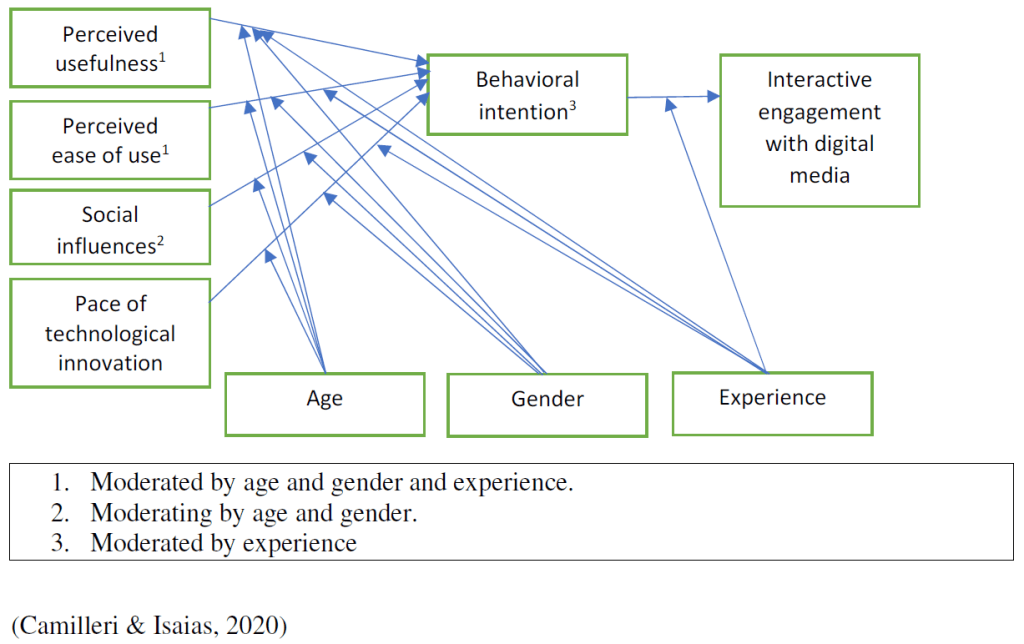
This contribution addresses a knowledge gap in academic literature as it examines the corporate communications executives’ technology acceptance and their behavioral intentions to engage in interactive technologies. It adapted valid and reliable measures that explored the respondents’ pace of technological innovation, social influences, as well as their perceptions on the usefulness and the ease of use of digital media. Moreover, this study examined the participants’ intentions to engage with interactive technologies. It investigated whether the chosen constructs of our research model, were affected by the demographic variables, including age, gender and experiences. It shed light on the causal path that explains the rationale behind the utilization of digital media for interactive engagement with online users.

_________________________

The study adapted the constructs from the technology acceptance model and from the theory of planned behavior. In sum, it hypothesizes that the individuals’ pace of technological innovation, perceived usefulness, ease of use and social influences are the antecedents of their behavioral intention to use the digital media for interactive engagement with online users. Moreover, it presumes that the demographic variables, including age, gender and experience mediate these relationships, as illustrated in Figure 1.

Figure 1. A research model on the users’ interactive engagement with digital media

References

Brouthers, K. D., Nakos, G. & Dimitratos, P. (2015). SME entrepreneurial orientation, international performance, and the moderating role of strategic alliances. Entrepreneurship Theory and Practice39(5), 1161-1187.

Camilleri, M. A. (2018a). The SMEs’ technology acceptance of digital media for stakeholder engagement. Journal of Small Business and Enterprise Development, 26(4), 504-521.

Camilleri, M. A. (2018b). The promotion of responsible tourism management through digital media. Tourism Planning & Development15(6), 653-671.

Camilleri, M. A. (2019a). Measuring the hoteliers’ interactive engagement through social media. In 14th European Conference on Innovation and Entrepreneurship (ECIE2019), University of Peloponnese, Kalamata, Greece.

Camilleri, M. A. (2019b). The online users’ perceptions toward electronic government services. Journal of Information, Communication and Ethics in Society, 18(2), 221-235.

Camilleri, M.A. (2020a). Strategic dialogic communication through digital media during COVID-19. In Camilleri, M.A. (Ed.), Strategic Corporate Communication in the Digital Age, Emerald, UK.

Capriotti, P., Zeler, I. & Camilleri, M.A. (2020). Corporate communication through social networks: The identification of key dimensions for dialogic communication. In Camilleri, M.A. (Ed.), Strategic Corporate Communication in the Digital Age, Emerald, UK.

Filieri, R. (2016). What makes an online consumer review trustworthy?. Annals of Tourism Research58, 46-64.

Hajarian, M., Camilleri, M.A.. Diaz, P & Aedo, I. (2020). A taxonomy of online marketing methods for corporate communication. In Camilleri, M.A. (Ed.), Strategic Corporate Communication in the Digital Age, Emerald, UK.

Harrigan, P. & Miles, M. (2014). From e-CRM to s-CRM. Critical factors underpinning the social CRM activities of SMEs. Small Enterprise Research21(1), 99-116.

Kaplan, A. M. & Haenlein, M. (2010). Users of the world, unite! The challenges and opportunities of Social Media. Business Horizons53(1), 59-68.

Lamberton, C. & Stephen, A. T. (2016). A thematic exploration of digital, social media, and mobile marketing: Research evolution from 2000 to 2015 and an agenda for future inquiry. Journal of Marketing80(6), 146-172.

Rather, R. A., & Camilleri, M. A. (2019). The effects of service quality and consumer-brand value congruity on hospitality brand loyalty. Anatolia30(4), 547-559.

Rios Marques, I., Casais, B. & Camilleri, M.A. (2020). The effect of macro celebrity and micro influencer endorsements on consumer-brand engagement on Instagram. In Camilleri, M.A. (Ed.), Strategic Corporate Communication in the Digital Age, Emerald, UK.

Schultz, F., Utz, S. & Göritz, A. (2011). Is the medium the message? Perceptions of and reactions to crisis communication via twitter, blogs and traditional media. Public Relations Review37(1), 20-27

Sin Tan, K., Choy Chong, S., Lin, B. & Cyril Eze, U. (2010). Internet-based ICT adoption among SMEs: Demographic versus benefits, barriers, and adoption intention. Journal of Enterprise Information Management23(1), 27-55.

Taiminen, H. M. & Karjaluoto, H. (2015). The usage of digital marketing channels in SMEs. Journal of Small Business and Enterprise Development22(4), 633-651.

Leave a comment

Filed under corporate communication, digital media, internet technologies, internet technologies and society, Marketing, online, social media, Stakeholder Engagement

A useful book on corporate communications through digital media

This authoritative book features a broad spectrum of theoretical and empirical contributions on topics relating to corporate communications in the digital age. It is a premier reference source and a valuable teaching resource for course instructors of advanced, undergraduate and post graduate courses in marketing and communications. It comprises fourteen engaging and timely chapters that appeal to today’s academic researchers including doctoral candidates, postdoctoral researchers, early career academics, as well as seasoned researchers. All chapters include an abstract, an introduction, the main body with headings and subheadings, conclusions and research implications. They were written in a critical and discursive manner to entice the curiosity of their readers.

Photo by Headway on Unsplash

Chapter 1 provides a descriptive overview of different online technologies and presents the findings from a systematic review on corporate communication and digital media. Camilleri (2020) implies that institutions and organizations ought to be credible and trustworthy in their interactive, dialogic communications during day-to-day operations as well as in crisis situations, if they want to reinforce their legitimacy in society. Chapter 2 clarifies the importance of trust and belonging in individual and organizational relationships. Allen, Sven, Marwan and Arslan (2020) suggest that trust nurtures social interactions that can ultimately lead to significant improvements in corporate communication and other benefits for organizations. Chapter 3 identifies key dimensions for dialogic communication through social media. Capriotti, Zeler and Camilleri (2020) put forward a conceptual framework that clarifies how organizations can enhance their dialogic communications through interactive technologies. Chapter 4 explores the marketing communications managers’ interactive engagement with the digital media. Camilleri and Isaias (2020) suggest that the pace of technological innovation, perceived usefulness, ease of use of online technologies as well as social influences are significant antecedents for the businesses’ engagement with the digital media. Chapter 5 explains that the Balanced Scorecard’s (BSC) performance management tools can be used to support corporate communications practitioners in their stakeholder engagement. Oliveira, Martins, Camilleri and Jayantilal (2020) imply that practitioners can use BSC’s metrics to align their communication technologies, including big data analytics, with organizational strategy and performance management, in the digital era. Chapter 6 focuses on UK universities’ corporate communications through Twitter. Mogaji, Watat, Olaleye and Ukpabi (2020) find that British universities are increasingly using this medium to attract new students, to retain academic employees and to promote their activities and events. Chapter 7 investigates the use of mobile learning (m-learning) technologies for corporate training. Butler, Camilleri, Creed and Zutshi (2020) shed light on key contextual factors that can have an effect on the successful delivery of continuous professional development of employees through mobile technologies.

Chapter 8 evaluates the effects of influencer marketing on consumer-brand engagement on Instagram. Rios Marques, Casais and Camilleri (2020) identify two types of social media influencers. Chapter 9 explores in-store communications of large-scale retailers. Riboldazzi and Capriello (2020) use an omni-channel approach as they integrate traditional and digital media in their theoretical model for informative, in-store communications. Chapter 10 indicates that various corporations are utilizing different social media channels for different purposes. Troise and Camilleri (2020) contend that they are using them to promote their products or services and/or to convey commercial information to their stakeholders. Chapter 11 appraises the materiality of the corporations’ integrated disclosures of financial and non-financial performance. Rodríguez-Gutiérrez (2020) identifies the key determinants for the materiality of integrated reports.Chapter 12 describes various electronic marketing (emarketing) practices of micro, small and medium sized enterprises in India. Singh, Kumar and Kalia (2020) conclude that Indian owner-managers are not always engaging with their social media followers in a professional manner. Chapter 13 suggests that there is scope for small enterprises to use Web 2.0 technologies and associated social media applications for branding, advertising and corporate communication. Oni (2020) maintains that social media may be used as a marketing communications tool to attract customers and for internal communications with employees. Chapter 14 shed light on the online marketing tactics that are being used for corporate communication purposes. Hajarian, Camilleri, Diaz and Aedo (2020) outline different online channels including one-way and two-way communication technologies.

Endorsements

“Digital communications are increasingly central to the process of building trust, reputation and support.  It’s as true for companies selling products as it is for politicians canvasing for votes.  This book provides a framework for understanding and using online media and will be required reading for serious students of communication”.

Dr. Charles J. Fombrun, Former Professor at New York University, NYU-Stern School, Founder & Chairman Emeritus, Reputation Institute/The RepTrak Company.

“This book has addressed a current and relevant topic relating to an important aspect of digital transformation. Various chapters of this book provide valuable insights about a variety of issues relating to “Strategic Corporate Communication in the Digital Age”. The book will be a useful resource for both academics and practitioners engaged in marketing- and communications-related activities. I am delighted to endorse this valuable resource”.

Dr. Yogesh K. Dwivedi, Professor at the School of Management at Swansea University, UK and Editor-in-Chief of the International Journal of Information Management.

“This title covers a range of relevant issues and trends related to strategic corporate communication in an increasingly digital era. For example, not only does it address communication from a social media, balanced scorecard, and stakeholder engagement perspective, but it also integrates relevant contemporary insights related to SMEs and COVID-19. This is a must-read for any corporate communications professional or researcher”.

Dr. Linda Hollebeek, Associate Professor at Montpellier Business School, France and Tallinn University of Technology, Estonia.

“Corporate communication is changing rapidly, and digital media represent a tremendous opportunity for companies of all sizes to better achieve their communication goals. This book provides important insights into relevant trends and charts critical ways in which digital media can be used to their full potential” 

Dr. Ulrike Gretzel, Director of Research at Netnografica and Senior Fellow at the Center for Public Relations, University of Southern California, USA.

“This new book by Professor Mark Camilleri promises again valuable insights in corporate communication in the digital era with a special focus on Corporate Social Responsibility. The book sets a new standard in our thinking of responsibilities in our digital connected world”. 

Dr. Wim Elving, Professor at Hanze University of Applied Sciences, Groningen, The Netherlands. 

References

Allen, K.A. Sven, G.T., Marwan, S. & Arslan, G. (2020). Trust and belonging in individual and organizational relationships. In Camilleri, M.A. (Ed.), Strategic Corporate Communication in the Digital Age, Emerald, UK.

Butler, A. Camilleri, M.A., Creed, A. & Zutshi, A. (2020). The use of mobile learning technologies for corporate training and development: A contextual framework. In Camilleri, M.A. (Ed.), Strategic Corporate Communication in the Digital Age, Emerald, UK.

Camilleri, M.A. (2020). Strategic dialogic communication through digital media during COVID-19. In Camilleri, M.A. (Ed.), Strategic Corporate Communication in the Digital Age, Emerald, UK.

Camilleri, M.A. & Isaias, P. (2020). The businesses’ interactive engagement through digital media. In Camilleri, M.A. (Ed.), Strategic Corporate Communication in the Digital Age, Emerald, UK.

Capriotti, P., Zeler, I. & Camilleri, M.A. (2020). Corporate communication through social networks: The identification of key dimensions for dialogic communication. In Camilleri, M.A. (Ed.), Strategic Corporate Communication in the Digital Age, Emerald, UK.

Hajarian, M., Camilleri, M.A.. Diaz, P & Aedo, I. (2020). A taxonomy of online marketing methods for corporate communication. In Camilleri, M.A. (Ed.), Strategic Corporate Communication in the Digital Age, Emerald, UK.

Mogaji, E., Watat, J.K., Olaleye, S.A. & Ukpabi, D. (2020). Recruit, retain and report: UK universities’ strategic communication with stakeholders on Twitter. In Camilleri, M.A. (Ed.), Strategic Corporate Communication in the Digital Age, Emerald, UK.

Oliveira, C., Martins, A., Camilleri, M.A. & Jayantilal, S. (2020). Using the balanced scorecard for strategic communication and performance management. In Camilleri, M.A. (Ed.), Strategic Corporate Communication in the Digital Age, Emerald, UK.

Oni, O. (2020). Small and medium sized enterprises’ engagement with social media for corporate communication. In Camilleri, M.A. (Ed.), Strategic Corporate Communication in the Digital Age, Emerald, UK.

Riboldazzi, S. & Capriello, A. (2020). Large-scale retailers, digital media and in-store communications. In Camilleri, M.A. (Ed.), Strategic Corporate Communication in the Digital Age, Emerald, UK.

Rios Marques, I., Casais, B. & Camilleri, M.A. (2020). The effect of macro celebrity and micro influencer endorsements on consumer-brand engagement on Instagram. In Camilleri, M.A. (Ed.), Strategic Corporate Communication in the Digital Age, Emerald, UK.

Rodríguez-Gutiérrez, P. (2020). Corporate communication and integrated reporting: the materiality determination process and stakeholder engagement in Spain. In Camilleri, M.A. (Ed.), Strategic Corporate Communication in the Digital Age, Emerald, UK.

Singh, T., Kumar, R. & Kalia, P. (2020). E-marketing practices of micro, small and medium sized enterprises. Evidence from India. In Camilleri, M.A. (Ed.), Strategic Corporate Communication in the Digital Age, Emerald, UK.

Troise, C. & Camilleri, M.A. (2020). The use of the digital media for marketing, CSR communication and stakeholder engagement. In Camilleri, M.A. (Ed.), Strategic Corporate Communication in the Digital Age, Emerald, UK.

Leave a comment

Filed under Analytics, Big Data, Business, corporate communication, Corporate Social Responsibility, COVID19, CSR, digital media, Integrated Reporting, internet technologies, internet technologies and society, Marketing, Mobile, mobile learning, online, performance management, Small Business, SMEs, social media, Stakeholder Engagement, Sustainability, Web

Top social media platforms

Image by Sara Kurfeß

Many online users have subscribed to different social media, including Facebook, YouTube, Instagram, Twitter and LinkedIn, among others for different reasons. Individuals and groups use them to publish their ideas in writing, images or videos. They also enable them to share hyperlinks to articles, pictures and videos. There are social media users who like to follow the updates of their friends, colleagues, acquaintances or individuals who share their interests. Very often, the news is broadcast through social networks and is disseminated in a viral manner through the social media users’ likes or shares before it is covered by the traditional media like television and newspapers. Online users may be intrigued to use the social media create their social network, or to join virtual communities. They may do so to connect with other individuals who shared their interests and values. Many online users have subscribed to different social media, including Facebook, Youtube, Instagram, Twitter and Linkedin, among others for different reasons.

Currently, Facebook has 2.45 billion users. Other popular social media networks include Instagram (1 billion users), Reddit (430 million users), Snapchat (360 million users), Twitter (330 million users), Pinterest (322 million users) and Linkedin (310 million users).

Individuals and groups use these social media to publish their ideas in writing, images or videos. They also enable them to share hyperlinks to articles, pictures and videos. There are social media users who like to follow the updates of their friends, colleagues, acquaintances or individuals who share their interests. Very often, the news is broadcast through social networks and is disseminated in a viral manner through the social media users’ likes or shares before it is covered by the traditional media like television and newspapers. Online users may be intrigued to use the social media create their social network, or to join virtual communities. They may do so to connect with other individuals who shared their interests or values.

Facebook is used by various organisations, including businesses to engage with its users. For example, different businesses are creating interactive pages and groups to disseminate information about their products and services. They utilise Facebook Messenger, or live videos to enhance their communications. Facebook is also used by academics to enhance the visibility of their publications and to raise awareness about the findings from their research. However, individuals use this medium to keep in touch with friends, colleagues, classmates, former classmates, former co-workers, and with other individuals who may share similar interests.

Like Facebook, other social media, including Twitter can be used to target large audiences and communities. Twitter is a platform that is based on topical content. Generally, its users are encouraged to use keywords and hashtags on particular topics, in particular locations. Twitter is restricted with a 280-character limit. Therefore, its subscribers have to post short, focused messages with relevant content that appeals to their followers. Moreover, they are expected to dedicate time to look after their account as they need to respond to their followers to avoid negative criticism. However, it allows direct, two-way communications among subscribers. Hence, it can be used to engage in interactive conversations with other users. Other digital networks include Instagram, Snapchat and Pinterest.  Instagram and Pinterest are focused on the dissemination of images and visual content. Like Instagram, Snapchat also features videos and user-generated content and may include influencer marketing material. On the other hand, Reddit appeals to more than 150,000 communities and niches, who share similar interests on various topics.

The usage of social media has radically influenced the style of communication and the dissemination of knowledge and information. Platforms can be personalised, self-managed and interconnected as they can blend written content with images, videos and hyperlinks. This disruptive innovation has led individuals from different demographic segments in society, to refine their digital and communication skills. It is obvious that social media has impacted our way of thinking, talking and even our social lives.

This is an excerpt from one of my latest working papers entitled; “The impact of social media and fake news on socio-political contexts”.

Leave a comment

Filed under digital media, internet technologies, internet technologies and society, Marketing, online, social media, Web

The online users’ engagement with e-Government services

This is an excerpt from my latest academic contribution.

How to Cite: Camilleri, M.A. (2019). The online users’ perceptions toward electronic government services. Journal of Information, Communication & Ethics in Society. 10.1108/JICES-09-2019-0102


tech

Several governments around the globe are utilizing the digital and mobile technologies to enhance the provision of their public services (EuroParl, 2015; Zuiderwijk Janssen & Dwivedi. 2015). Digital and mobile services are the facilitating instruments that are enabling all levels of the governments’ operations, to better service their citizens, big businesses, small enterprises and non-profit organizations (Wirtz & Birkmeyer, 2018; Rana & Dwivedi, 2015; Evans & Campos, 2013). The-governments are increasingly relying on ICT, including computers, websites and business process re-engineering (BPR) to engage with online users (Isaías, Pífano & Miranda, 2012; Weerakkody, Janssen & Dwivedi, 2011). Hence, the delivery of e-government and m-government services may usually demand the public service to implement specific transformational processes and procedures that are ultimately intended to add value to customers (Pereira, Macadar, Luciano & Testa, 2017).  Previously, the-governments’ consumers relied on face-to-face interactions or on telephone communications to engage with their consumers. Gradually, many governments had introduced interactive communications as departments and their officials started using the emails to engage with online users. Today, citizens and businesses can communicate and interact with the-government departments and agencies in real-time, through virtual call centers, via instant-messaging (IM), graphical user interfaces (GUI) and audio/video presentations.

In the past, the-governments’ services were operated in administrative silos of information (EuroParl, 2017). However, the electronic governance involves the data exchange between the-government and its stakeholders, including the businesses as well as the general public (Pereira et al., 2017; Rana & Dwivedi, 2015; Chun et al., 2010). The advances in interactive technologies have brought significant improvements in the delivery of service quality to online users of the Internet (Sá, Rocha & Cota, 2016; Isaías et al., 2012). As a result, the e-government and m-government services have become refined and sophisticated. Thus, the provision of online services is more efficient and less costly when compared to the offline services.

However, there are still many citizens and businesses who for various reasons may not want to engage with the-governments’ electronic and/or mobile services (Shareef, Kumar, Dwivedi & Kumar, 2016; 2014). This argumentation is conspicuous with the digital divide in society as not everyone is benefiting from an equitable access and democratic participation in the Internet or from the e-government systems (Ebbers, Jansen & van Deursen, 2016; Friemel, 2016; Luna-Reyes, Gil-Garcia & Romero, 2012; Isaías, Miranda & Pífano, 2009). The low usage of e-government systems impedes the ability of many governments to connect to citizens (Danila & Abdullah, 2014). Mensah (2018) held that the government authorities should promote the utilization of user-friendly mobile applications as the majority of citizens are increasingly engaging with their smartphones for different purposes, including to access information and services. Many countries around the world have introduced online government portals can be accessed through desktop computers as well as via mobile-friendly designs (Camilleri, 2019a; Ndou, 2004). Massey et al. (2019) posited that the government’s electronic services can be integrated among different devices in order to ensure an effective service delivery. These authors also maintained that the citizens are increasingly relying on the features of the mobile technologies as they are always connected to wireless networks. Their portable, mobile devices can provide access to a wide array of public information at any time and in any place (Camilleri & Camilleri, 2019; Wirtz & Birkmeyer, 2018; Sareen, Punia, & Chanana, 2013).

In a similar vein, many citizens may easily access their respective government’s online portal via virtual, open networks. They can also receive instantaneous messages and responses from the governments’ public service systems in their mobile devices, including smart phones or tablets (Shareef et al., 2016). Therefore, m-governance can possibly enhance the quality of the public services in terms of improved efficiency and cost savings (Madden, Bohlin, Oniki, & Tran, 2013). Notwithstanding, in the near future, the government’s electronic systems will be in a better position to exceed their citizens’  expectations, in terms of quality of service (Li & Shang, 2019). The advances in technology, including the increased massive wireless data traffic from different application scenarios, as well as the efficient resource allocation schemes will be better exploited to improve the capacity of online and mobile networks (Zhang, Liu, Chu, Long, Aghvami & Leung, 2017). For instance, the fifth generation (5G) of mobile communication systems is expected to enhance  the citizens’ service quality as they may offer higher mobile connection speeds, capacities and reduced latencies (Osseiran, Boccardi, Braun, Kusume, Marsch, Maternia & Tullberg, 2014; Zhang et al., 2017).

Nevertheless, despite these technological breakthroughs, there are many citizens who are still reluctant to use the-governments’ electronic and/or mobile services as they hold negative perceptions toward public administration (Wirtz & Birkmeyer, 2018; Shareef, Dwivedi, Stamati, & Williams, 2014). These individuals are not comfortable to share their personal information online (Van Deursen & Van Dijk, 2014). They may perceive that e-government and/or m-government platforms are risky and unsecure (Conradie & Choenni, 2014; Bélanger & Carter, 2008). Consequentially, they will decide not to upload their data as they suspect that it can be used by third parties (Picazo-Vela et al., 2012; Bélanger & Carter, 2008).

References (these are all the references that appeared in the bibliography section of the full paper).

Al-Hujran, O., Al-Debei, M. M., Chatfield, A., & Migdadi, M. (2015), “The imperative of influencing citizen attitude toward e-government adoption and use”, Computers in human Behavior, Vol 53, pp. 189-203.

Ajzen, I. (1991), “The theory of planned behavior”, Organizational Behavior and Human Decision Processes, Vol. 50, No. 2, pp. 179-211.

Bélanger, F. and Carter, L. (2008), “Trust and risk in e-government adoption”, The Journal of Strategic Information Systems, Vol. 17, No. 2, pp. 165-176.

Camilleri, M. A. and Camilleri, A.C. (2017a), “The technology acceptance of mobile applications in education”, In 13th International Conference on Mobile Learning (Budapest, April 10th). Proceedings, International Association for Development of the Information Society.

Camilleri, M.A., and Camilleri, A.C. (2017b), “Digital learning resources and ubiquitous technologies in education”, Technology, Knowledge and Learning, Vol. 22, No. 1, pp. 65-82.

Camilleri, M. A. (2019a), “Exploring the Behavioral Intention to Use e-Government Services: Validating the Unified Theory of Acceptance and Use of Technology”. 9th International Conference on Internet Technologies & Society, Lingnan University, Hong Kong. IADIS.

Camilleri, M. (2019b), “The SMEs’ technology acceptance of digital media for stakeholder engagement”, Journal of Small Business and Enterprise Development, Vol. 26 No. 4, pp. 504-521.

Camilleri, M.A. and Camilleri, A.C. (2019), “The Students’ Readiness to Engage with Mobile Learning Apps”, Interactive Technology and Smart Education”, available at: DOI: 10.1108/ITSE-06-2019-0027 (accessed 5 September 2019).

Carter, L. and Bélanger, F. (2005), “The utilization of e‐government services: citizen trust, innovation and acceptance factors”, Information Systems Journal, Vol. 15, No. 1, pp. 5-25.

Chun, S., Shulman, S., Sandoval, R. and Hovy, E. (2010), “Government 2.0: Making connections between citizens, data and government”, Information Polity, Vol. 15, Nos. (1, 2), pp. 1-9.

Conradie, P. and Choenni, S. (2014), “On the barriers for local government releasing open data”, Government Information Quarterly, Vol. 31, pp. S10-S17.

Davis, F.D. (1989), “Perceived usefulness, perceived ease of use, and user acceptance of information technology”, MIS Quarterly, pp. 319-340.

Davis, F.D., Bagozzi, R.P. and Warshaw, P.R. (1989), “User acceptance of computer technology: a comparison of two theoretical models”, Management Science, Vol. 35, No. 8, pp. 982-1003.

Davis, F. D., Bagozzi, R.P. and Warshaw, P.R. (1992), “Extrinsic and intrinsic motivation to use computers in the workplace”, Journal of Applied Social Psychology, Vol. 22, No. 14, pp. 1111-1132.

Ebbers, W. E., Jansen, M. G. and van Deursen, A. J. (2016), “Impact of the digital divide on e-government: Expanding from channel choice to channel usage”, Government Information Quarterly, Vol. 33, No. 4, pp. 685-692.

EU (2018), “EU Data Protection Rules”, https://ec.europa.eu/commission/priorities/justice-and-fundamental-rights/data-protection/2018-reform-eu-data-protection-rules/eu-data-protection-rules_en

EuroParl (2015), “e-government: Using technology to improve public services and democratic participation”, available at: http://www.europarl.europa.eu/RegData/etudes/IDAN/2015/565890/EPRS_IDA(2015)565890_EN.pdf (accessed 12 August 2019).

EuroParl (2017), “The role of e-government in deepening the single market”, available at: http://www.europarl.europa.eu/RegData/etudes/BRIE/2017/608706/EPRS_BRI(2017)608706_EN.pdf (accessed 12 August 2019).

Evans, A. M. and Campos, A. (2013), “Open government initiatives: Challenges of citizen participation”, Journal of Policy Analysis and Management, Vol. 32, No. 1, pp. 172-185.

Fishbein, M. and Ajzen, I. (1975), “Belief, Attitude, Intention, and Behavior: An Introduction to Theory and Research”, Reading, MA, USA: Addison-Wesley.

Fornell, C. and Larcker, D.F. (1981), “Evaluating structural equation models with unobservable variables and measurement error”, Journal of Marketing Research, Vol. 48, pp. 39-50.

Friemel, T. N. (2016), “The digital divide has grown old: Determinants of a digital divide among seniors”, New Media & Society, Vol. 18, No. 2, pp. 313-331.

Isaías, P., Miranda, P. and Pífano, S. (2009), “Critical success factors for web 2.0–A reference framework”, In International Conference on Online Communities and Social Computing (pp. 354-363). Berlin,Germany: Springer.

Isaías, P., Pífano, S. and Miranda, P. (2012), “Web 2.0: Harnessing democracy’s potential”, In Public Service, Governance and Web 2.0 Technologies: Future Trends in Social Media (pp. 223-236). Hershey, USA: IGI Global.

Jaeger, P. and Matteson, M. (2009), “e-Government and Technology Acceptance: The Case of the Implementation of Section 508 Guidelines for Websites”, Electronic Journal of E-Government, Vol. 7, No. 1, pp. 87-98.

Kline, R.B. (2005), “Principles and practice of structural equation modeling” (2nd ed.). New York, USA: Guilford Press.

Layne, K. and Lee, J. (2001), “Developing fully functional E-government: A four stage model”, Government Information Quarterly, Vol. 18, No. 2, pp. 122-136.

Lee, J. B. and Porumbescu, G. A. (2019), “Engendering inclusive e-government use through citizen IT training programs”, Government Information Quarterly, Vol. 36, No. 1, pp. 69-76.

Li, Y. and Shang, H. (2019), “Service quality, perceived value, and citizens’ continuous-use intention regarding e-government: Empirical evidence from China”, Information & Management, https://www.sciencedirect.com/science/article/pii/S0378720617306912

Luna-Reyes, L. F., Gil-Garcia, J. R. and Romero, G. (2012), “Towards a multidimensional model for evaluating electronic government: Proposing a more comprehensive and integrative perspective”, Government Information Quarterly, Vol. 29, No. 3, pp. 324-334.

Madden, G., Bohlin, E., Oniki, H. and Tran, T. (2013), “Potential demand for m-government services in Japan”, Applied Economics Letters, Vol. 20, No. 8, pp. 732-736.

Mensah, I. K. (2018), “Citizens’ Readiness to adopt and use e-government services in the city of Harbin, China”, International Journal of Public Administration, Vol. 41, No. 4, pp. 297-307.

Mossey, S., Bromberg, D. and Manoharan, A. P. (2019), “Harnessing the power of mobile technology to bridge the digital divide: a look at US cities’ mobile-government capability”, Journal of Information Technology & Politics, Vol. 16, No. 1, pp. 52-65.

Ndou, V. (2004), “E–Government for developing countries: opportunities and challenges”, The electronic journal of information systems in developing countries, Vol 18, No. 1, pp. 1-24.

Osseiran, A., Boccardi, F., Braun, V., Kusume, K., Marsch, P., Maternia, M. and Tullberg, H. (2014), “Scenarios for 5G mobile and wireless communications: the vision of the METIS project”, IEEE Communications Magazine, Vol. 52, No. 5, pp. 26-35.

Park, S.Y., Nam, M.W. and Cha, S. B. (2012), “University students’ behavioral intention to use mobile learning: Evaluating the technology acceptance model”, British Journal of Educational Technology, Vol. 43, No. 4, pp. 592-605.

Pereira, G. V., Macadar, M. A., Luciano, E. M. and Testa, M. G. (2017), “Delivering public value through open government data initiatives in a Smart City context”, Information Systems Frontiers, Vol. 19, No. 2, pp. 213-229.

Picazo-Vela, S., Gutiérrez-Martínez, I. and Luna-Reyes, L. F. (2012), “Understanding risks, benefits, and strategic alternatives of social media applications in the public sector”, Government Information Quarterly, Vol. 29, No. 4, pp. 504-511.

Rana, N. P., Dwivedi, Y. K. and Williams, M. D. (2013), “Analysing challenges, barriers and CSF of e gov adoption”, Transforming Government: People, Process and Policy, Vol. 7, No. 2, pp. 177-198.

Rana, N. P. and Dwivedi, Y.K. (2015), “Citizen’s adoption of an e-government system: Validating extended social cognitive theory (SCT)”, Government Information Quarterly, Vol. 32, No. 2, pp. 172-181.

Sá, F., Rocha, Á. and Cota, M. P. (2016), “From the quality of traditional services to the quality of local e-Government online services: A literature review”, Government Information Quarterly, Vol. 33, No. 1, pp. 149-160.

Scott, M., DeLone, W. and Golden, W. (2016), “Measuring e-government success: a public value approach”, European Journal of Information Systems, Vol. 25, No. 3, pp. 187-208.

Shareef, M. A., Dwivedi, Y. K., Stamati, T. and Williams, M. D. (2014), “SQ m gov: a comprehensive service-quality paradigm for mobile-government”, Information Systems Management, Vol. 31, No. 2, pp. 126-142.

Shareef, M. A., Kumar, V., Dwivedi, Y. K. and Kumar, U. (2016), “Service delivery through mobile-government (m gov): Driving factors and cultural impacts”, Information Systems Frontiers, Vol. 18, No. 2, pp. 315-332.

Sharma, R., Yetton, P. and Crawford, J. (2009), “Estimating the effect of common method variance: The method—method pair technique with an illustration from TAM Research”, MIS Quarterly, Vol. 33, No. 3, pp. 473-490.

Van Deursen, A. and Van Dijk, J. (2011), “Internet skills and the digital divide”, New Media & Society”, Vol. 13 No. 6, pp. 893-911.

Van Deursen, A. J., & Van Dijk, J. A. (2014), “The digital divide shifts to differences in usage”, New Media & Aociety, Vol. 16 No. 3, pp. 507-526.

Venkatesh, V., Morris, M.G., Davis, G.B. and Davis, F.D. (2003), “User acceptance of information technology: Toward a unified view”, MIS Quarterly, pp. 425-478.

Venkatesh, V., Thong, J.Y. and Xu, X. (2012), “Consumer acceptance and use of information technology: extending the unified theory of acceptance and use of technology”, MIS Quarterly, pp. 157-178.

Wang, Y.S. and Shih, Y.W. (2009), “Why do people use information kiosks? A validation of the Unified Theory of Acceptance and Use of Technology”, Government Information Quarterly, Vol. 26, No. 1, pp. 158-165.

Weerakkody, V., Janssen, M. and Dwivedi, Y.K. (2011), “Transformational change and business process reengineering (BPR): Lessons from the British and Dutch public sector”, Government Information Quarterly, Vol. 28, No. 3, pp. 320-328.

Wirtz, B. W. and Birkmeyer, S. (2018), “Mobile-government Services: An Empirical Analysis of Mobile-government Attractiveness”, International Journal of Public Administration, Vol. 41, No. 16, pp. 1385-1395.

Zhang, H., Liu, N., Chu, X., Long, K., Aghvami, A. H., & Leung, V. C. (2017). Network slicing based 5G and future mobile networks: mobility, resource management, and challenges. IEEE Communications Magazine55(8), 138-145.

Zuiderwijk, A., Janssen, M. and Dwivedi, Y.K. (2015), “Acceptance and use predictors of open data technologies: Drawing upon the unified theory of acceptance and use of technology”, Government Information Quarterly, Vol. 32, No. 4, pp. 429-440.


Leave a comment

Filed under e government, internet technologies, internet technologies and society, Mobile, online

The Students’ Engagement with Mobile Learning Technologies

These are excerpts from our latest academic article.

How to Cite: Camilleri, M.A. & Camilleri, A.C. (2019). The Students’ Readiness to Engage with Mobile Learning Apps. Interactive Technology and Smart Education. https://www.emerald.com/insight/content/doi/10.1108/ITSE-06-2019-0027/full/html


Hand-held mobile devices such as smart phones and tablets allow individuals, including students, to access and review online (educational) content from virtually anywhere. The mobile applications (apps) can provide instant access to the schools’ learning resources (Camilleri & Camilleri, 2019b; Sánchez & Isaías, 2017; Cheon, Lee, Crooks & Song, 2012). Therefore, they are increasingly being utilized in the context of primary education to improve the student experience. Relevant theoretical underpinnings reported that more primary level students are utilizing mobile learning technologies to engage with their instructors (Rodríguez, Riaza & Gómez, 2017; Sánchez & Isaías, 2018). Notwithstanding, it is much easier for the younger pupils to mobile apps to read eBooks, as hard-copy textbooks need to be carried in their bags. Arguably, the proliferation of portable technologies like tablets are lighter and less bulky than laptop computers. Hence, primary school students can easily use mobile technologies anywhere, beyond the traditional classroom environment (Rodríguez et al., 2017). Currently, there is a wide variety of educational apps that are readily available on a wide array of mobile devices (Chee, Yahaya, Ibrahim &Hasan, 2017; Domingo & Garganté, 2016). Such interactive technologies can improve the delivery of quality education as teachers provide direct feedback to their students, in real time. Some of the mobile apps can even engage primary school students in immersive learning experiences (Camilleri & Camilleri,2019c; Isaias, Reis, Coutinho & Lencastre, 2017).

On the other hand, other academic literature posited that some students may not want to engage in mobile learning. Very often, commentators implied that the mobile technologies have their own limitations (Cheon et al., 2012; Wang, Wu & Wang, 2009). A few practitioners contended that mobile devices had small screens with low resolutions. Alternatively, some argued about their slow connection speeds, or pointed out that they lacked standardization features  (Sánchez & Isaías, 2017; Camilleri & Camilleri,2017).

As a matter of fact, Android, Apple and Microsoft Windows have different operating systems. As a result, learning apps may have to be customized to be compatible with such systems. Moreover, individuals, including primary school students may hold different attitudes towards the use of mobile devices. There may be students who may be motivated to engage with mobile technologies (Sánchez & Isaias, 2018; Ciampa, 2014) as they use these devices to play games, watch videos, or to chat with their friends, online (Wang et al., 2009). In this case, the primary school students may use their mobile devices for hedonic reasons, rather than to engage in mobile learning activities. Such usage of the mobile technologies can possibly result in undesired educational outcomes. Nevertheless, those primary level students who already own or have instant access to a mobile device may easily become habitual users of this technology; as they use it for different purposes. However, there is still limited research in academia that explores these students’ readiness to engage in mobile learning at home, and at school.


Results

The findings in this study are consistent with the argument that digital natives are increasingly immersing themselves in digital technologies (Bourgonjon et al., 2010), including educational games (Camilleri & Camilleri,2019; Ge & Ifenthaler, 2018; Carvalho et al., 2015, Wouters et al., 2013). However, the results have shown that there was no significant relationship between the perceived ease of the gameplay and the children’s enjoyment in them. Furthermore, the stepwise regression analysis revealed that there was no significant relationship between the normative expectations and the children’s engagement with the educational apps; although it was evident (from the descriptive statistics) that the parents were encouraging their children to play the games at home and at school. This research relied on previously tried and tested measures that were drawn from the educational technology literature in order to explore the hypothesized relationships. There is a common tendency in academic literature to treat the validity and reliability of quantitative measures from highly cited empirical papers as given.

Future studies may use different sampling frames, research designs and methodologies to explore this topic. To the best of our knowledge, there is no other empirical study that has validated the technology acceptance model within a primary school setting. Further work is needed to replicate the findings of this research in a similar context.


References (the full bibliography of this paper)

Ajzen, I. (1991), “The theory of planned behavior”, Organization Behaviour and Human Decision Processes, Vol. 50, No. 2, pp. 179-211.

Bourgonjon, J., Valcke, M., Soetaert, R., and Schellens, T. (2010), “Students’ perceptions about the use of educational games in the classroom”, Computers & Education, Vol. 54, No. 4, pp. 1145-1156.

Burguillo, J.C. (2010), “Using game theory and competition-based learning to stimulate student motivation and performance”, Computers & Education, Vol. 55, No. 2, pp. 566-575.

Camilleri, M.A. and Camilleri, A. (2017a), “The Technology Acceptance of Mobile Applications in Education”, In Sánchez, I.A. & Isaias, P. (Eds) 13th International Conference on Mobile Learning (Budapest, 11th April). Proceedings, pp 41-48. International Association for Development of the Information Society.

Camilleri, M.A., and Camilleri, A.C. (2017b), “Digital learning resources and ubiquitous technologies in education”, Technology, Knowledge and Learning, Vol. 22, No. 1, pp. 65-82.

Camilleri, M. A., and  Camilleri, A. (2019a), “Student Centred Learning Through Serious Games”, 13th Annual International Technology, Education and Development Conference. Valencia, Spain (March, 2019). International Academy of Technology, Education and Development (IATED).

Camilleri, A.C., and Camilleri, M.A. (2019b), “Mobile Learning via Educational Apps: An Interpretative Study”. In Shun-Wing N.G., Fun, T.S. & Shi, Y. (Eds.) 5th International Conference on Education and Training Technologies (ICETT 2019). Seoul, South Korea (May, 2019). International Economics Development and Research Center (IEDRC).

Camilleri, A.C., and Camilleri, M.A. (2019c), “The Students Intrinsic and Extrinsic Motivations to Engage with Digital Learning Games”, In Shun-Wing N.G., Fun, T.S. & Shi, Y. (Eds.) 5th International Conference on Education and Training Technologies (ICETT 2019). Seoul, South Korea (May, 2019). International Economics Development and Research Center (IEDRC).

Carvalho, M.B., Bellotti, F., Berta, R., De Gloria, A., Sedano, C.I., Hauge, H.B., Hu, J., and Rauterberg, M. (2015), “An activity theory-based model for serious games analysis and conceptual design”, Computers & Education, Vol. 87, pp.166-181.

Chang, C.T., Hajiyev, J., and Su, C.R. (2017), “Examining the students’ behavioral intention to use e-learning in Azerbaijan? The general extended technology acceptance model for e-learning approach”, Computers & Education, Vol. 111, pp. 128-143.

Chee, K. N., Yahaya, N., Ibrahim, N. H., and Hasan, M. N. (2017). Review of mobile learning trends 2010-2015: A meta-analysis. Journal of Educational Technology & Society20(2), 113-126.

Chen, K. C. and Jang, S. J. (2010), “Motivation in online learning: Testing a model of self-determination theory”, Computers in Human Behavior, Vol. 26, No. 4, pp. 741-752.

Cheon, J., Lee, S., Crooks, S. M. and Song, J. (2012), “An investigation of mobile learning readiness in higher education based on the theory of planned behavior”, Computers & Education, Vol. 59, No. 3, pp. 1054-1064.

Ciampa, K. (2014), “Learning in a mobile age: an investigation of student motivation”, Journal of Computer Assisted Learning, Vol. 30, No. 1, pp. 82-96.

Connolly, T.M., Boyle, E.A., MacArthur, E.  Hainey, T., and Boyle, J.M. (2012), “A systematic literature review of empirical evidence on computer games and serious games”, Computers & Education, Vol. 59, No. 2, pp. 661-686.

Davis, F.D. (1989), “Perceived usefulness, perceived ease of use, and user acceptance of information technology”, MIS Quarterly, Vol. 13, No. 3, pp. 319-340.

Davis, F.D., Bagozzi, R.P., and Warshaw, P.R. (1989), “User acceptance of computer technology: a comparison of two theoretical models”, Management Science, Vol. 35, No. 8, pp. 982-1003.

Dickey, M.D. (2011), “Murder on Grimm Isle: The impact of game narrative design in an educational game‐based learning environment”, British Journal of Education Technology, Vol. 42, No.  3, pp. 456-469.

Domingo, M. G. and Garganté, A. B. (2016). Exploring the use of educational technology in primary education: Teachers’ perception of mobile technology learning impacts and applications’ use in the classroom. Computers in Human Behavior, Vol. 56, pp. 21-28.

Dunne, Á., Lawlor, M. A., and Rowley, J. (2010), “Young people’s use of online social networking sites–a uses and gratifications perspective”, Journal of Research in International Marketing,. Vol. 4, No. 1, pp.  46-58.

Ge, X., and Ifenthaler, D. (2018), “Designing engaging educational games and assessing engagement in game-based learning”, In Gamification in Education: Breakthroughs in Research and Practice, IGI Global, Hershey, USA, pp. 1-19.

Harris, J. Mishra, P., and Koehler, M. (2009), “Teachers’ technological pedagogical content knowledge and learning activity types: Curriculum-based technology integration reframed”, Journal of Research on Technology in Education, Vol. 41, No. 4, pp. 393-416.

Huang, W.H., Huang, W.Y., and Tschopp, J. (2010), “Sustaining iterative game playing processes in DGBL: The relationship between motivational processing and outcome processing”,  Computers & Education, Vol. 55, No. 2, pp. 789-97.

Hwang, G.J., and Wu, P.H.  (2012), “Advancements and trends in digital game‐based learning research: a review of publications in selected journals from 2001 to 2010”, British. Journal of Education Technology, Vol. 43, No. 1, pp. E6-E10.

Isaias, P., Reis, F., Coutinho, C. and Lencastre, J. A. (2017), “Empathic technologies for distance/mobile learning: An empirical research based on the unified theory of acceptance and use of technology (UTAUT)”, Interactive Technology and Smart Education, Vol. 14, No. 2, pp. 159-180.

Lee, M. K., Cheung, C. M., and Chen, Z. (2005), “Acceptance of Internet-based learning medium: the role of extrinsic and intrinsic motivation”, Information & Management,. Vol. 42, No. 8, pp. 1095-1104.

Li, H., Liu, Y., Xu, X., Heikkilä, J., and Van Der Heijden, H. (2015), “Modeling hedonic is continuance through the uses and gratifications theory: An empirical study in online games”, Computers in Human Behavior, Vol. 48, pp. 261-272.

Park, S.Y. (2009), “An analysis of the technology acceptance model in understanding university students’ behavioral intention to use e-learning”, Education. Technology & Society, Vol. 12, No. 3, pp. 150-162.

Park, S. Y., Nam, M. W., and Cha, S. B. (2012), “University students’ behavioral intention to use mobile learning: Evaluating the technology acceptance model”, British Journal of Education Technology, Vol. 43, No. 4, pp. 592-605.

Rodríguez, A. I., Riaza, B. G., & Gómez, M. C. S. (2017), “Collaborative learning and mobile devices: An educational experience in Primary Education”, Computers in Human Behavior, Vol. 72, pp. 664-677.

Ryan, R. M., and Deci, E. L. (2000), “Intrinsic and extrinsic motivations: Classic definitions and new directions”, Contemporary Education Psychology, Vol. 25, No. 1, pp. 54-67.

Sánchez, I. A., & Isaías, P. (2017), “Proceedings of the International Association for Development of the Information Society (IADIS)”, International Conference on Mobile Learning (13th, Budapest, Hungary, April 10-12, 2017). International Association for Development of the Information Society.

Sánchez, I. A., & Isaias, P. (2018), “Proceedings of the International Association for Development of the Information Society (IADIS)”, International Conference on Mobile Learning (14th, Lisbon, Portugal, April 14-16, 2018). International Association for Development of the Information Society.

Teo, T., Beng Lee, C., Sing Chai, C., and Wong, S.L. (2009), “Assessing the intention to use technology among pre-service teachers in Singapore and Malaysia: A multigroup invariance analysis of the Technology Acceptance Model (TAM)”, Computers & Education, Vol. 53, No. 3, pp. 1000-1009.

Venkatesh, V., Morris, M.G., Davis, G.B. and Davis, F.D. (2003), “User acceptance of information technology: Toward a unified view”, MIS Quarterly, Vol. 27, No. 3, pp. 425-478.

Venkatesh, V., Thong, Y.T.L., and Xu, X. (2012), “Consumer acceptance and use of information technology: extending the unified theory of acceptance and use of technology”, MIS Quarterly, Vol. 36, No.1, pp. 157-178.

Wang, Y. S., Wu, M. C., & Wang, H. Y. (2009), “Investigating the determinants and age and gender differences in the acceptance of mobile learning”, British Journal of Educational technology, Vol. 40, No. 1, pp. 92-118.

Wouters, P., Van Nimwegen, C., Van Oostendorp, H., and Van Der Spek, E.D. (2013), “A meta-analysis of the cognitive and motivational effects of serious games”,  Journal of Education Psychology,  Vol. 105, No.  2, pp. 249-266.


Related Publications

Camilleri, M.A. & Camilleri, A.C. (2019). The Acceptance and Use of Mobile Learning Applications in Higher Education. In Pfennig, A. & Chen, K.C. (Eds.) 3rd International Conference on Education and eLearning (ICEEL2019), Barcelona, Spain.

Camilleri, A.C. & Camilleri, M.A. (2019). The Students’ Perceived Use, Ease of Use and Enjoyment of Educational Games at Home and at School. 13th Annual International Technology, Education and Development Conference. Valencia, Spain (March, 2019). International Academy of Technology, Education and Development (IATED).Download this paper

Camilleri, M.A. & Camilleri, A. (2017). The Students’ Perceptions of Digital Game-Based Learning. In Pivec, M. & Grundler, J. (Ed.) 11th European Conference on Games Based Learning  (October). Proceedings, pp. 52-62, H JOANNEUM University of Applied Science, Graz, Austria, pp 56-62. http://toc.proceedings.com/36738webtoc.pdf Download this paper

Camilleri, M.A. & Camilleri, A. (2017). Measuring The Educators’ Behavioural Intention, Perceived Use And Ease Of Use Of Mobile Technologies. In Wood, G. (Ed) Re-connecting management research with the disciplines: Shaping the research agenda for the social sciences (University of Warwick, September). Proceedings, pp., British Academy of Management, UK. http://conference.bam.ac.uk/BAM2017/htdocs/conference_papers.php?track_name=%20Knowledge%20and%20Learning Download this paper

Leave a comment

Filed under Education, education technology, internet technologies, internet technologies and society, Marketing, Mobile, mobile learning