Category Archives: Business

Call for Chapters on Tourism Marketing

This book will be published by Routledge

(subject to the publisher’s peer review)

Abstract Submission Deadline: April 30, 2017

Full Chapters Due: October 31, 2017

Submit your Chapter here.

tIntroduction

This academic book will be presenting a critical analysis of the key theoretical underpinnings in the tourism literature. The contributors are expected to engage in conceptual discussions that cover the operational and strategic perspectives of the travel, tourism, hospitality and leisure industries. The rationale behind this student-centered textbook is to instill a strong pedagogical application of the socio-economic, environmental and technological impacts of tourism and its related sectors. This textbook’s content is intended to prepare undergraduate students and aspiring managers with a thorough exposure on the latest industry practices and research developments. It will allow both prospective as well as experienced tourism practitioners to make appropriate decisions in their workplace environments.

It is envisaged that the themes of this textbook could be covered in a university semester. At the start of each chapter, the readers will be presented with relevant learning outcomes that will help them focus and organize their thoughts. The important terms should be defined and clearly explained. This will provide the readers with a convenient source for learning and reviewing the tourism and hospitality vocabulary. Experiential exercises and descriptive case studies shall be illustrating real situations that are meant to help aspiring managers in their future employment prospects. All chapters should contain a succinct summary at the end. This way the readers could review and retain vital information. Finally, all chapters ought to provide relevant suggestions for further insights by featuring web resources that are rich in information.

This comprehensive book will allow its readers to acquire relevant knowledge and skills in tourism management topics, including; Airline Management; Airline Marketing; Destination Marketing; Eco-Tourism; eTourism / Digital Tourism; Events Management; Hospitality; Hospitality Management; Hospitality Marketing; Hospitality Operations; Meetings, Incentives, Conferences and Events; Responsible / Sustainable Tourism; Revenue Management; Sharing Economy; Sports Tourism; Tourism; Tourism Administration; Tourism Economics; Tourism Education; Tourism Geographies; Tourism Management; Tourism Marketing; Tourism Operations; Tourism Planning; Tourism Policy; Tourism Product; Tourism Strategy; Travel; Travel Management; Travel Marketing; among others.

Objective

This book shall be a generic, authoritative guide on the business of tourism. The underlying objective of this book is to explain, in plain words; the tourism processes, strategies and tactics within the travel, leisure and hospitality industries. This publication will highlight some of the opportunities and challenges facing the tourism industry, including; eTourism and digital media, the sharing economy, destination marketing, and tourism planning for the future. It is hoped that the style of this book and its extensive use of case studies, illustrations and links will maintain the reader’s interest through visual aids to learning.

This publication ought to be written in an engaging style that entices the curiosity of prospective readers. It will be clarifying the main concepts in a simple and straightforward manner. Descriptive cases should set the theory in context as they will be chosen to represent the diversity of the industry; the cases may range from small travel agents to large legacy airlines or from multi-national hotel chains to accommodation establishments – that are increasingly advertising on websites like Airbnb. This book shall possibly report on the global tourism marketing environments that are increasingly affected by economic, socio-cultural, political and environmental issues. It could explain how technological advances have brought significant changes in the tourism industry sectors and its marketing mix. Moreover, it is advisable that the authors feature interesting illustrations, including diagrams and color images. Notwithstanding, the contributors are encouraged to provide direct links to further readings on the web to aid both teaching and learning.

Target Audience

This book introduces the students and aspiring practitioners to the subject of tourism studies in a structured manner. It is primarily intended to undergraduate and / or post-graduate students in tourism (including tourism management, hospitality management, airline management and travel agency operations). It is also relevant to airline employees, hoteliers, inbound / outbound tour operators, travel agents and all those individuals who are willing to work within the tourism industry.

Academics in higher education institutions including universities and vocational colleges, small tourism business owners, tourism and hospitality consultants, non-profit tourism organizations, policy makers and legislators.

Submission Procedure

Researchers and practitioners are invited to submit a 300-word abstract on or before the 30th April, 2017. The authors will be notified by the 31st May, 2017 about the status of their abstract. Their full (8,000 word) chapters could be submitted by the 31st October, 2017. All submitted chapters will be reviewed on a double-blind peer-review editorial process. Contributors may also be requested to serve as reviewers of other chapters.

Note: There are no submission or acceptance fees to submit manuscripts for this book.

Publisher

Taylor & Francis Group (an Informa Business) publishes Social Science and Humanities books under the Routledge, Psychology Press and Focal Press imprints.

Important Dates

April 30, 2017: Proposals Submission Deadline

May 31, 2017: Notification of Acceptance

October 31, 2017: Full Chapter Submission

December 31, 2017: Review Results Returned

January 31, 2018: Final Acceptance Notification

February 28, 2018: Final Chapter Submission

For Further Inquiries

Mark Anthony Camilleri, M.B.A., Ph.D. (Edinburgh), I.A.T.A.

Email: Mark.A.Camilleri@um.edu.mt


Leave a comment

Filed under Business, Hospitality, Marketing, tourism, Travel

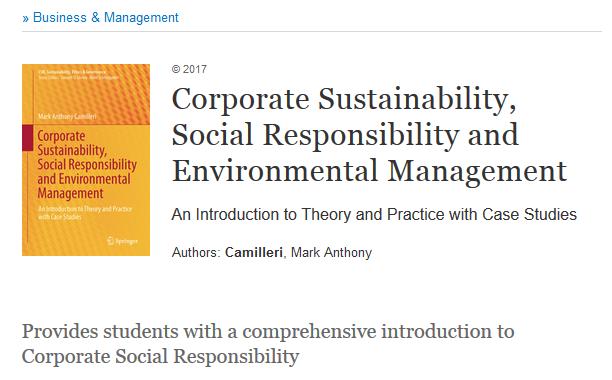
Springer’s latest book on Strategic Management; Corporate Sustainability, Social Responsibility and Environmental Management

csr2This book provides a concise and authoritative guide to corporate social responsibility (CSR) and its related paradigms, including environmental responsibility, corporate sustainability and responsibility, creating shared value, strategic CSR, stakeholder engagement, corporate citizenship, business ethics and corporate governance, among others. It is primarily intended for advanced undergraduate and / or graduate students. Moreover, this publication is highly relevant for future entrepreneurs, small business owners, non-profit organisations and charitable foundations, as it addresses the core aspects of contemporary strategies, public policies and practices. It also features case studies on international policies and principles, exploring corporate businesses’ environmental, social and governance reporting.

Corporate Sustainability, Social Responsibility and Environmental Management: An Introduction to Theory and Practice with Case Studies – by Mark Anthony Camilleri,PhD (Edinburgh)

Google Scholar Citation

Google Books

The book includes a foreword by Professor Emeritus Archie B. Carroll, who is one of the pioneers of the CSR paradigm. It also features numerous endorsements from accomplished academic researchers:

“There’s a revolution taking place, one that’s percolating from the uncoordinated efforts of activist consumers/NGOs, regulators/moralists, and corporate/institutional investors. Mark Camilleri’s new book provides an excellent overview of the eclectic academic literature in this area, and presents a lucid description of how savvy companies can embed themselves in circular systems that reduce system-wide externalities, increase economic value, and build reputation. A valuable contribution.”

Charles J. Fombrun, Founder of Reputation Institute and a former Professor of Management at New York University and The Wharton School, University of Pennsylvania, USA.


“I am pleased to recommend Dr. Camilleri’s latest book, Corporate Sustainability, Social Responsibility, and Environmental Management. The book is a rich source of thought for everyone who wants to get deeper insights into this important topic. The accompanying five detailed case studies on a wide array of corporate sustainable and responsible initiatives are helpful in demonstrating how theoretical frameworks have been implemented into practical initiatives. This book is a critical companion for academics, students, and practitioners.”

Adam Lindgreen, Professor and Head of Department of Marketing, Copenhagen Business School, Denmark.


“This book is an essential resource for students, practitioners, and scholars. Dr. Mark Camilleri skillfully delivers a robust summary of research on the business and society relationship and insightfully points to new understandings of and opportunities for responsible business conduct. I highly recommend Corporate Sustainability, Social Responsibility, and Environmental Management: An Introduction to Theory and Practice with Case Studies.”

Diane L. Swanson, Professor and Chair of Distinction in Business Administration and Ethics Education at Kansas State University, KS, USA.


“Mark’s latest book is lucid, insightful, and highly useful in the classroom. I strongly recommend it.”

Donald Siegel, Dean of the School of Business and Professor of Management at the University at Albany, State University of New York, NY, USA.


“The theory and practice of corporate sustainability, social responsibility and environmental management is complex and dynamic. This book will help scholars to navigate through the maze. Dr Camilleri builds on the foundations of leading academics, and shows how the subject continues to evolve. The book also acknowledges the importance of CSR 2.0 – or transformative corporate sustainability and responsibility – as a necessary vision of the future.”

Wayne Visser, Senior Associate at Cambridge University, UK. He is the author of CSR 2.0: Transforming Corporate Sustainability & Responsibility and Sustainable Frontiers: Unlocking Change Through Business, Leadership and Innovation.


“Corporate Sustainability, Social Responsibility and Environmental Management: An Introduction to Theory and Practice with Case Studies” provides a useful theoretical and practical overview of CSR and the importance of practicing corporate sustainability.”

Geoffrey P. Lantos, Professor of Business Administration, Stonehill College. Easton, Massachusetts, USA.


“This book offers a truly comprehensive guide to current concepts and debates in the area of corporate responsibility and sustainability. It gives helpful guidance to all those committed to mainstreaming responsible business practices in an academically reflected, yet practically relevant, way.”

Andreas Rasche, Professor of Business in Society, Copenhagen Business School, Denmark.


“A very useful resource with helpful insights and supported by an enriching set of case studies”

Albert Caruana, Professor of Marketing at the University of Malta, Malta and at the University of Bologna, Italy.


“A good overview of the latest thinking about Corporate Social Responsibility and Sustainable Management based on a sound literature review as well as useful case studies. Another step forward in establishing a new business paradigm.”

René Schmidpeter, Professor of International Business Ethics and CSR at Cologne Business School (CBS), Germany.


“Dr. Camilleri’s book is a testimony to the continuous need around the inquiry and advocacy of the kind of responsibility that firms have towards societal tenets. Understanding how CSR can become a modern manifestation of deep engagement into socio-economic undercurrents of our firms, is the book’s leading contribution to an important debate, that is more relevant today than ever before”

Mark Esposito, Professor of Business and Economics at Harvard University, MA, USA.


“Mark’s book is a great addition to the literature on CSR and EM; it will fill one of the gaps that have continued to exist in business and management schools, since there are insufficient cases for teaching and learning in CSR and Environmental Management in Business Schools around the globe.”

Samuel O. Idowu, Senior Lecturer in Accounting at London Metropolitan University, UK; a Professor of CSR at Nanjing University of Finance and Economics, China and a Deputy CEO, Global Corporate Governance Institute, US


“Corporate Social Responsibility has grown from ‘nice to have’ for big companies to a necessity for all companies. Dr Mark Camilleri sketches with this excellent book the current debate in CSR and CSR communication and with his cases adds valuable insights in the ongoing development and institutionalization of CSR in nowadays business”.

Wim J.L. Elving, A/Professor at the University of Amsterdam, Netherlands.

Leave a comment

Filed under Business, Circular Economy, Corporate Governance, Corporate Social Responsibility, Corporate Sustainability and Responsibility, CSR, Google, Shared Value, Social Cohesion, Socially Responsible Investment, SRI, Stakeholder Engagement, sustainable development

Mark Camilleri edited a book on sustainable and responsible business

Dr Mark Anthony Camilleri, Ph.D. (Edinburgh) has recently edited a business textbook entitled; ‘CSR 2.0 and the New Era of Corporate Citizenship’.
csr
This contribution is an authoritative reference source (for the latest scholarly research) on the ways in which corporate entities can implement responsible strategies that create synergistic value for both businesses and society. The authors (hailing from leading European universities) contend that responsible behaviors in the realm of business continue to remain a crucial component of organizational development.
By exploring core aspects of contemporary corporate strategies, businesses can create more value through social welfare and sustainable initiatives. This publication features an extensive coverage across a wide range of perspectives and topics, including corporate citizenship, corporate sustainability and responsibility, stakeholder engagement, business ethics, public spending, total responsibility management and social value co-creation, among others.
This publication is ideally designed for students, academics and researchers seeking current concise and authoritative research on the business case for corporate social responsibility.

Chapter 1 presents a thorough literature review on corporate social responsibility and its other related constructs, including corporate citizenship, stakeholder engagement and business ethics. Hence, this chapter reports on how CSR has evolved to reflect the societal realities.

Chapter 2 reviews the different definitions of the corporate responsibility paradigms and draws comparisons between related concepts. The author contends that organization studies; economic, institutional, cultural and cognitive perspectives are shaping the corporate responsibility agenda. She cleverly presents the benefits of integrating multiple perspectives and discusses about the possible research avenues in the realms of corporate responsibility.

Chapter 3 suggests that the field of CSR is ushering a new era in the relationship between business and society. The author puts forward a Total Responsibility Management (TRM) approach that may be useful for business practitioners who intend adopting CSR behaviors. This chapter posits that CSR strategies including managing relationship with stakeholders will contribute to the companies´success and will also bring community welfare.

Chapter 4 focuses on the national governments’ regulatory role of raising awareness on CSR behaviors among businesses. The author suggests that there is scope for the state agencies to promote CSR as a business case for companies. She provides an outline of the current state of “supranational regulative policies on public procurement” within the European Union context.

Chapter 5 uses a stakeholder perspective to encapsulate the CSR concept. The authors investigated social value cocreation (SVCC) through a qualitative study among different stakeholders (customers, employees, and managers). They implied that businesses ought to clarify their motives, by opening channels of communication with stakeholders. This way, there will be a higher level of SVCC with increased (stakeholder) loyalty toward the firms.

Chapter 6 sheds light on Porter and Kramer’s (2011) shared value proposition. The author explains how collaborative stakeholder interactions could lead to significant improvements in the supply chain.

Chapter 7 involved a longitudinal study that investigated how four different State Owned Enterprises communicated with Māori communities between 2008 and 2013. This study contributes to the extant research on the legitimacy theory and CSR communication with ethnic minorities in the Aotearoa (New Zealand) context.

Chapter 8 links the CSR paradigm with risk management. The author suggests that Serbian businesses ought to adopt corporate sustainable and responsible approaches in terms of their disaster risk reduction prior to environmental emergencies.

Chapter 9 involved a quantitative analysis that explored the CSR practices within the hospitality industry. The authors suggested that there were distinct social and environmentally responsible behaviors in different geographical areas. They argued that institutions can take their results into account when drawing up policies that are aimed at fostering responsible tourism practices.

Chapter 10 examined how CSR communication of self-serving motives can lead to more trust and credibility among stakeholders as well as corporate reputation. The authors implied that the marketers should be aware of how the public perceive CSR behaviors.

Chapter 11 reports that corporate (or organizational) storytelling is increasingly being used as a promotional tool to communicate CSR information to stakeholders. The authors present four companies that have used storytelling with the aims of transmitting values, fostering collaboration, leading change and sharing knowledge on responsible practices.

Chapter 12 relates corporate sustainability to the construct of emotional capital. The authors maintain that emotional capital enables businesses to attract and retain talent. They maintain that there are significant improvements to the firms’ bottom lines If they invest in responsible human resources management.

Chapter13 suggests that the transition from the CSR to CSR 2.0 requires the adoption of five new principles – creativity, scalability, responsiveness, glocality and circularity. The authors posit that these principles ought to be embedded within the organizations’ management values and culture. The authors propose a new framework that can be used to manage the processes of socially responsible organizations.

Chapter 14 investigated the banks’ behaviors during the economic crisis in Turkey. The authors reported on the bank’s CSR strategies as they supported small and medium sized enterprises, as well as local communities during the financial turmoil.

Chapter 15 offers insights on sustainable tourism as the authors investigated the constraints that explain why an attitude–behavior gap exists in responsible tourists’ behaviors.

Chapter 16 examines three leading networks that are intended to promote corporate sustainability and responsibility. The author explores their growing influence as he reviews their objectives, organizational structures, types of activities, practices and impacts.

Further details on this contribution is available here: http://www.igi-global.com/book/csr-new-era-corporate-citizenship/166426


About the Editor:

Dr. Mark Anthony Camilleri is a resident academic in the Department of Corporate Communication at the University of Malta. He specializes in strategic management, stakeholder engagement, corporate social responsibility and sustainable business. Mark successfully finalized his PhD (Management) in three years’ time at the University of Edinburgh in Scotland – where he was nominated for his “Excellence in Teaching”. During the past years, Mark taught business subjects at under-graduate, vocational and post-graduate levels in Hong Kong, Malta and the UK.

Dr Camilleri has published his research in peer-reviewed journals, chapters and conference proceedings. He is also a member on the editorial board of Springer’s International Journal of Corporate Social Responsibility and a member of the academic advisory committee in the Global Corporate Governance Institute (USA). Mark is a frequent speaker and reviewer at the American Marketing Association’s (AMA) Marketing & Public Policy conference and in the Academy of Management’s (AoM) Annual Meeting.

The Authors’ Biographies

Ozan Nadir ALAKAVUKLAR is a lecturer in management at Massey University School of Management. His research interests are based on sustainability, community organizing and social movements.

Marcello ATZENI received his PhD at the University of Cagliari. His research interests are related to tourism authenticity and consumer behavior.

Elisa BARAIBAR DIEZ is a Lecturer in Business Administration at the University of Cantabria. Her fields of research are corporate transparency, CSR, corporate governance and reputation. She focuses on transparency and its effects not only in a business context but also in other contexts such as universities.

Jesús BARRENA MARTINEZ is an Assistant Professor postdoctoral in the Department of Business Management at the University of Cadiz. He has a PhD in the field of Economics and Business Management. His teaching and research interests include Human Resource Management, Corporate Social Responsibility and Intellectual Capital. He has presented papers at international and national conferences and published in journals such as Corporate Social Responsibility and Environmental Management, International Journal of Management and Enterprise Development, Journal of Human Values, Tourism and Management Studies and Intangible Capital.

Roland BERBERICH is Independent researcher in Project Management with additional MRes degree from Heriot Watt University. He has acquired more than 10 years of project experience.

Claudiu George BOCEAN is Associate Professor at and PhD supervisor Faculty of Economics and Business Administration within University of Craiova. In 2000, graduated Bachelor Degree, major in Accountancy and Informatics, Faculty of Economics, University of Craiova, Romania. In 2004, graduated Master program in Business Administration, Faculty of Economics, University of Craiova, Romania. In 2007, PhD in Economics, Faculty of Economics, University of Craiova, Romania. In 2015, Habilitation title in Management, Academy of Economic Sciences Bucharest, Romania. Since 2002 – present, teaching and researching in Faculty of Economics and Business Administration, University of Craiova on topics such as Human Resource Management, Corporate Social Responsibility, Organization Theory, Business Economics, and co-operating within projects with national and international universities and organizations.

Michael Devereux obtained both Master in Business Administration (MBA) from University of North Carolina at Wilmington and a Master in International Business from Universitat de Valencia. Prior to graduate school, he gained a Bachelor in Economics and Geography focusing on international economics and Central/South America from Weber State University. Additionally, he has studied in Costa Rica, and in Guatemala participating in a microfinance and economic development project for indigenous women in Guatemala. His current interests are focused on international affairs, humanitarian components, health and well-being, economic development, community engagement, energy and environmental sustainability.

José Ignacio ELICEGUI REYES is Graduate in Management Business Administration and Business Sciences, as well as he has studied a Masters in Human Resource Management at the University of Cadiz. Currently, he is studying a Masters in Teacher Training in Secondary Schools and High Schools, Vocational Training and Language Training for the specialty of Business Administration at the University of Cadiz. Also, he is developing his PhD in the Human Resource Management field.

Martina G. GALLARZA lectures in the Marketing Department of Universidad de Valencia (SPAIN). She has formerly taught at Universidad Católica de Valencia, where she was Dean of the Business Faculty. Her research interests include consumer behavior and tourism services. She has authored more than 40 articles (in Annals of Tourism Research, Tourism Management, Journal of Consumer Behavior, Journal of Services Marketing, International Journal of Hospitality Management, Journal of Hospitality Marketing and Management among others), and has presented more than 70 papers in Congresses (EMAC, MKT TRENDS Conference, AMA Servsig, ATMC). She teaches in several international masters in Europe (MTM in IGC at Bremen (Germany) and MAE at IGR-IAE Rennes (France). Guest scholar for short periods at Columbia University (New York City. USA), ESCP (France), Sassari University (Sardinia. Italia), Strathclyde University (Glasgow, UK), She is member of the American Marketing Association (AMA), Asociación Española de Marketing (AEMARK), Association Française de Marketing (AFM) and formerly of Association Internationale d’Experts Scientifiques en Tourisme (AIEST She is member of the Board of Directors of Pernod Ricard. S.A. since 2012.

Raquel GOMEZ LOPEZ is a Lecturer in Business Management at the University of Cantabria (Spain). Her current research interests include quality management, excellence models, responsible management, family firms, innovation, and tourism. Raquel’s works have been published in journals of international impact such as Cornell Hospitality Quarterly, Total Quality Management & Business Excellence and Journal of Small Business and Enterprise Development among others. She is also author of several chapters in various collective works and one book. She regularly participates in prestigious international and national conferences, such as those organized by FERC, IFERA and ACEDE.

Misra Cagla GUL is an Associate Professor of Marketing and the Vice Director of the Graduate School of Arts and Sciences at Isik University. She holds a PhD degree from Bogazici University, and an MBA degree from Georgia State University. She has published in the fields of marketing and consumer behavior in times of recession, corporate social responsibility, social marketing, status consumption, green consumer behavior and strategic marketing. She teaches various marketing courses including consumer behavior, advertising and services marketing, both at undergraduate and graduate levels. Her professional experience includes over 5 years in marketing in telecommunications and energy sectors. She has a B.Sc. degree in Industrial Engineering from Bogazici University.

Jose Ramon CARDONA received a doctorate in business economics from the University of the Balearic Islands in 2012. He worked as lecturer in marketing at the University of Zaragoza, Pablo de Olavide University and the University of the Balearic Islands. He’s a research associate of the research group Business Management and Tourist Destinations.

Giacomo DEL CHIAPPA is an assistant professor of marketing at the Department of Economics and Business, University of Sassari (Italy), and Associate Researcher at CRENoS. He is also a senior research fellow, School of Tourism and Hospitality, University of Johannesburg, South Africa. His research is related to destination governance and branding, consumer behavior, and digital marketing. He has published articles in several international journals, among others the International Journal of Hospitality Management, Journal of Services Marketing, Journal of Travel Research, International Journal of Tourism Research, International Journal of Contemporary and Hospitality Management, Current Issues in Tourism, and Information Systems and E-Business Management.

Michael DEVEREUX obtained both Master in Business Administration (MBA) from University of North Carolina at Wilmington and a Master in International Business from Universitat de Valencia. Prior to graduate school, he gained a Bachelor in Economics and Geography focusing on international economics and Central/South America from Weber State University. Additionally, he has studied in Costa Rica, and in Guatemala participating in a microfinance and economic development project for indigenous women in Guatemala. His current interests are focused on international affairs, humanitarian components, health and well-being, economic development, community engagement, energy and environmental sustainability.

José Luis FERNANDEZ SANCHEZ, PhD is a Professor of Business Administration at the University of Cantabria. He specializes in CSR, especially social investment.

Paul George HOLLAND, received a Bachelor in Business degree from the Manukau Institute of Technology, Auckland, New Zealand in 2012 and a Master of Business Studies from Massey University, New Zealand in 2015.

Mehmet KAYTAZ is currently professor of economics and the Dean of Faculty of Economics and Administrative Sciences at Işık University, Istanbul, Turkey. He holds a M.A. degree from the University of Manchester (1974) and Ph.D. from the University of Nottingham (1978). He was a faculty member of Boğaziçi University between 1978-2005.He served as President of State Institute of Statistics, Turkey; as Undersecretary of Treasury; as an alternate director in European Bank for Reconstruction and Development, and as Chairman of Board of Directors of Eregli Iron & Steel Factories. He has authored articles and books on small-scale enterprises, income distribution, economic growth, statistics, finance and education.

Valentín-Alejandro MARTINEZ FERNANDEZ is a Permanent Professor at University of A Coruña, Area of Marketing and Market Research. B.A. Information Sciences, Complutense University of Madrid. MBA Management and Business Administration, University of A Coruña. PhD. Information Sciences, Complutense University of Madrid.

Patricia MARTINEZ GARCIA DE LEANIZ is an Assistant Professor at the University of Cantabria (Spain). Her current research interests include corporate social responsibility, consumer behavior, corporate marketing and responsible management. Her research focuses on theoretical and empirical studies in the tourism sector. Patricia’s works have been published in journals of international impact such as International Journal of Hospitality Management, Journal of Business Ethics, International Journal of Contemporary Hospitality Management and Journal of Travel and Tourism Marketing among others. She is also author of several chapters in various collective works and one book. She regularly participates in prestigious international and national conferences, such as those organized by EMAC, AEMARK and ACEDE.

Lars MORATIS is an expert in corporate social responsibility (CSR) affiliated with Antwerp Management School in Belgium as the Academic Director of the Competence Center Corporate Responsibility and with the NHTV University of Applied Sciences in The Netherlands as Professor of Sustainable Business. His research interests lie in the credibility of corporate CSR claims, ISO 26000, CSR strategy, CSR implementation, responsible management education and critical perspectives on CSR. His other interest is the psychology of sustainability. He received an MSc in Business Administration from Erasmus University Rotterdam School of Management and his PhD from the Open University the Netherlands. His PhD dissertation on ISO 26000 carried the title ‘Standardizing a better world? Essays and critical reflections on the ISO 26000 standard for corporate social responsibility’. He publishes on his research interest in both scientific and practitioner-oriented journals and book chapters. He has written several books, among which is ‘ISO 26000: The business guide to the new standard on social responsibility’.

María D. ODRIOZOLA (PhD) is a Lecturer in Business Administration at the University of Cantabria. Her research focuses on Human Resources Management and CSR. Particularly, she is specialized in labor social responsibility practices.

Mariella PINNA is a Research Fellow at the University of Sassari where she teaches in the area of “Ethics”. Her research interest is related to ethical consumption and consumer behavior.

Vesela RADOVIC is an associate professor, works in the Institute for Multidisciplinary Research, Belgrade University, Serbia. Dr. Radovic has an MPH in fire safety protection and a PhD in safety, protection and defense from the Faculty of Safety in Belgrade. She has a long record of experience in the area of disaster management. As an expert in the area of disaster management she prepared the handbook, Methodology of Risk Assessment and Emergency Management Planning at the Local Level. This manual was a part of the activities of the USAID, Serbia Preparedness, Planning and Economic Security Program, implemented by the DAI/Washington. She spent a year with the Fulbright/Hubert Humphrey Fellowship, at Tulane University, School of Public Health and Tropical Medicine, Department of International Health and Development, New Orleans, LA. During that year in USA her focus was on public policy making and emergency preparedness. Dr. Radovic will focus her future activities in academic community in order to share acquired knowledge to help her country, Serbia in supporting the necessary reforms in the context of Euro-Atlantic Integrations.

Amir Hossein RAHDARI is one of the top 25 youngest Sustainable Business professionals (2degrees). He is the director of research at Corporate Governance and Responsibility Development Centre, an external reviewer to several Int. peer-reviewed journals (JCR and Scopus indexed), a research contributor to CSRI and some other leading platforms. He is also an independent research & consultant and a member of several leading panels on sustainability including GBI Panel (US), NG Panel (UK), Ministry of Petroleum CSR Committee (Iran).

Pedro M. ROMERO FERNANDEZ is a Professor in the Department of Business Management at the University of Cadiz. His teaching experience (more than 15 years) spans the broad range of strategy, human resources and management. He has published his work in the field of HRM in peer-reviewed top national and international journals, such as the International Journal of Human Resource Management, British Journal of Management, Journal of Business Research and Journal of Business Ethics.

María Dolores SANCHEZ FERNANDEZ is a PhD “Competitiveness, Innovation and Development” and a Lecturer at the University of la Coruña (Spain), Faculty of Economics and Business, Department of Analysis and Business Management, Business Organization area. She is also part of the GREFIN (University of A Coruña) and GEIDETUR (University of Huelva) research groups and associate researcher at the Centre of CICS.NOVA.UMinho and Lab2PT research at the University of Minho, GEEMAT (Brazil) and REDOR Network (Mexico). She has been the author or co-author of several articles published in indexed journals. She has participated in over 100 communications in national and International conferences and is a member of the scientific committee. She reviews international scientific magazines in Spain, United States and Brazil. Her main research topics are: Corporate Social Responsibility, quality, tourism, the hotel industry and human resources.

Katharina SARTER is an Ailsa McKay Postdoctoral Fellow at Glasgow Caledonian University. Previously Research Fellow at Bielefeld University, University of Muenster, and University of Rostock as well as Bernheim Postdoctoral Fellow at the Hoover Chair of Economic and Social Ethics at the Catholic University of Louvain and Visiting Scholar at the Public Procurement Research Group at the School of Law of the University of Nottingham.

Catalina SITNIKOV is Professor at University of Craiova (Romania), Faculty of Economics and Business Administration. She has PhD title in Management since 2000, Habilitation title in Management since 2014 and since February 2015 is PhD supervisor in Management. For 3 years activated as Visiting Lecturer at Helsinki University of Technology, Lahti Center (Finland). Since 1995, she has been teaching undergraduate, master and PhD students. She teaches Quality Management, Total Quality Management and Management. Her main research areas include: management, strategic management, and mostly quality management, instruments and models specific to the stages of quality planning, control and improvement, quality management strategies, ISO standards, CSR from the perspective of specific standards and instruments.

Marius Sorin TUDOR holds a PhD from the Faculty of Economics and Business Administration within University of Craiova. In 1998, graduated Bachelor Degree, major in Accountancy and Informatics, Faculty of Economics, University of Craiova, Romania, In 2001, graduated Master program in Business Administration, Faculty of Economics, University of Craiova, Romania In 2008, PhD in Economics, Faculty of Economics, University of Craiova, Romania Since 2006 – present, teaching and researching in Faculty of Economics and Business Administration, University of Craiova on topics such as Project Management, Environmental Economics, Marketing public, Methods and techniques for decision-making in public organizations, Media management. Since 2015 – present, Manager of Universitaria – Publishing house within University of Craiova.

Başak UCANOK TAN received her B.A. degree in Business Administration from Başkent University. Upon her graduation she was granted the Sunley Management Scholarship and completed MSc in International Management from the University of Northampton, UK. Her master’s dissertation focused on the adverse psychological effects of financial crises on layoff survivors. She continued her academic pursuits in Marmara and Istanbul Bilgi University and earned her PhD in Organizational Behavior with her dissertation on the investigation of organizational citizenship behaviors in Turkish SMEs. Her academic research focus concentrates on the dynamics of micro organizational phenomena including work values, organizational citizenship behavior, organizational commitment, alienation, leadership and cooperative behavior. She has served as coordinator in Public Relations program in Istanbul Bilgi University from 2010 to 2012 and has recently became Associate Professor.

Anya Catharina Eva ZEBREGS is a master student at University of Amsterdam. Last January she completed her masters in Business Administration and currently she is writing her thesis for the Social Psychology masters. The two masters complement each other very well; she gathered knowledge about consumers, organizations, groups of people and how to influence them and combined this with strategic and economic knowledge. She is interested in marketing and consultancy and after her internship, which will start this September, she would like to find a job in either marketing or consultancy. Further, Anya has always been very interested in CSR and the non-profit market, one of the reasons why she chooses to write her first master thesis about CSR. Further, she is president of the board of SOLVE Consulting Amsterdam. SOLVE is a professional student consultancy organization active in social enterprise consulting. The organization advises non-profits and social enterprises in their efficiency and effectiveness.

Leave a comment

Filed under Business, Corporate Governance, Corporate Social Responsibility, Corporate Sustainability and Responsibility, CSR, responsible tourism, Shared Value, Small Business, SMEs, Stakeholder Engagement, sustainable development

The Responsible Supply Chain Management and its effect on Corporate Reputation

supply chain(image source: Carlson School of Management, University of Minnesota)


Corporate reputation has often been defined as “a set of attributes ascribed to a firm, that is inferred from the firm’s past actions” (Weigelt & Camerer, 1988, p. 443). Fombrun and Shanley (1990) argued that reputation “signals publics about how a firm’s products, jobs, strategies and prospects compare to those of competing firms” (p. 233). The value of reputation has been subject to extensive research, which has highlighted that reputation influences the stakeholders’ perceptions (Money, Hillenbrand & Downing, 2011), the customers’ choices and their purchase intentions (Keh & Xie, 2009; Siegel & Vitaliano, 2007; Mohr & Webb, 2005) Therefore, corporate reputation is related to corporate financial performance (Camilleri, 2012; Flanagan, O’Shaughnessy, & Palmer, 2011). Much of the work on corporate social–financial performance also implicitly assumes that this relationship is positive, because an improved reputation facilitates revenue and profit growth (Orlitzky et al., 2003; Surroca, Tribó & Waddock,. 2010).

Extant work suggests that reputation is important because it establishes credibility (Greyser, 1999; Herbig et al., 1994). The notion that reputation is related to credibility has also been noted in the wider corporate social (and environmental) responsibility literature. McWilliams and Siegel (2001) argued that building a reputation of ‘responsibility’ can signal an improved reputation (Husted & Allen, 2007; Brammer & Millington, 2005; McWilliams & Siegel, 2001; Fombrun & Shanley, 1990). Hence, responsible corporate behaviour “builds trust and enhances the firm’s reputation, which in turn attracts customers, employees, suppliers and distributors, not to mention earning the public’s goodwill” (Lantos, 2001, p. 606). In a similar vein, Lewis (2003) also held that responsible behaviours can establish trust and ultimately develop a company’s reputation. Social and environmental activities not only can enhance the reputation of the firm, but also enhance the goodwill trust of stakeholders (Carlisle and Faulkner, 2005; Siltaoja, 2006).
Therefore, corporate reputation is fundamentally a signal to stakeholders (Ponzi, Fombrun & Gardberg, 2011) and is particularly important in markets where there is imperfect information (Hoejmose et al., 2014.; Weigelt & Camerer, 1988). The market signals, including engagement in social and environmental issues could help to improve corporate image (McWilliams & Siegel, 2001; Bagnoli & Watts, 2003).

Markley and Davis (2007) also noted that responsible behaviours could send positive market signals to a range of stakeholders. Today’s firms are expected to implement responsible supply chain practices. If they won’t they run the risk of damaging their reputation and image among their stakeholders. Hence, there is scope for firms to implement socially and environmentally responsible practices in their supply chains (Ansett, 2007). Responsible supply chain management encapsulates social issues (e.g. child labour, working conditions, human rights et cetera) and / or environmental matters (e.g. environmental protection, waste management, recycling, reusing natural resources et cetera) (Hoejmose et al., 2013; Carter & Rogers, 2008; Seuring & Muller, 2008). Such responsible behaviours shield the firms from negative media attention and consumer boycotts (Hoejmose et al., 2013). The companies’ stronger engagement in socially responsible supply chain management enables them to manage exposure to risk (Tate et al, 2010; Van De Ven & Jeurissen, 2005). Thus, the businesses’ stakeholder engagement and their responsible procurement of materials and products is linked to corporate reputation, which in turn allows them to target discerning customer groups (Phillips & Caldwell, 2005; Roberts, 2003).

Kleindorfer, Singhal, and Wassenhove (2005) suggested that responsible supply chain practices can lead to increased profitability, as customer satisfaction and loyalty will improve as a result of a stronger reputation. Therefore, firms risk losing customers to rival companies over time, particularly if they fail to be responsible in their supply chain. In fact, Harwood & Humby (2008) findings suggested that suppliers were adhering to specific corporate social responsibility (CSR) requirements in order to reduce their exposure to risk. It may appear that the real value of social and environmental management is perhaps not from its role in enhancing reputation, but more about protecting it. This reflects Burke’s (2011) argumentation as he suggested that a firm’s corporate reputation is enhanced through positive actions, the programmes they implement and the other tangible things that they do.

Therefore, the distinction between reputation protection and enhancement is subtle, but important. Corporate reputation protection is concerned with evidencing the firms’ efforts to meeting the stakeholders’ expectations, whilst reputation enhancement goes beyond a purely evidential basis to encompass embedded practice. Corporate reputation protection occurs when firms can prove to stakeholders that they took reasonable steps to prevent an incident from happening (Coombs, 2014). In fact, corporate reputations could be easily jeopardised by irresponsible supply chain practices which may “directly harm business contracts, marketing, and sub-sourcing, and damage the corporation’s brands and the trust they have established with their business customers” (Lee & Kim, 2009, p. 144). These companies’ failure to manage their supply chain in a responsible manner could result in negative repercussions for their organisational performance. Conversely, the corporations’ reputation and credentials in socially responsible supply chain management could lead them to achieve a competitive advantage (Ansett, 2007; McWilliams et al., 2006).

Leave a comment

Filed under Business, Corporate Social Responsibility, Corporate Sustainability and Responsibility, Shared Value, Stakeholder Engagement

Corporate Communication, Stakeholder Engagement and Corporate Social Responsibility

comm

Companies are increasingly dedicating their time and resources to promote their public relations initiatives. Corporate Communication Managers and executives have a wide array of media channels at their disposal. These may  be used to communicate their corporate social responsibility CSR credentials. As a matter of fact, businesses are continuously being scrutinised by media, customers, monitoring groups, consumer forums and blogs (Du et al., 2010).

Very often, businesses disclose their CSR activities through official documents, such as annual corporate responsibility or sustainability reports, media releases, dedicated sections of their corporate websites; as well as in social media pages or groups. CSR communication is produced, translated, and integrated according to the companies’ contexts and their specific reality constructions (Schultz and Wehmeier, 2010).

Companies could use broadcast advertising, including TV and radio commercials. Businesses could also utilise print media (e.g. newspapers, magazines) to disseminate their message to their target audience. Newspaper articles reflect corporate ideas of social responsibilities and assumptions about public expectations, and react herewith to what they perceive as the public’s expectations (Schultz and Wehmeier, 2010). Alternatively, they may use outdoor advertisements such as billboards and signage on brick-and-mortar premises. These traditional media are based on a hierarchical one‐to‐many communication; with a clear distinction between producer and consumer of information. Notwithstanding, there are other communication channels that are not entirely controlled by the company. For this reason, businesses are encouraged to become more proficient in the use of digital media in addition to traditional media to increase their impact of their corporate communication.

Evidently, the internet has reshaped communication at different levels. It has enabled the emergence of a new participatory public sphere that is based on a many‐to‐many communication where everybody can dialogically and publicly interact and collaborate in the creation of content and the definition of the agenda (Colleoni, 2013; Jenkins, 2006). In a relatively short period of time, the internet has become an essential tool for organisational communication (Capriotti & Moreno, 2007a; Stuart & Jones, 2004).

Moreover, in today’s digital era, the engagement between the public and the organisation is one of the main characteristics of the internet (Colleoni, 2013). Many corporate websites already possess a high degree of interactivity; including their ability to disseminate information and to generate relationships between the different publics and the organisation (Capriotti & Moreno, 2007). In the first approach, the level of interactivity is low, and the use of the Internet is unidirectional; as its essential objective is to diffuse information and to try to improve the corporate image of the business. However, in the second approach, the degree of interactivity is high, and the Internet is used to facilitate bidirectional communication and to nurture relationships by allowing dialogue and interaction between the organisation and its stakeholders.

Interactive communication is becoming one of the most important information channels for corporations as it is changing social dynamics (Fieseler & Fleck, 2013; O`Reilly, 2005; 2006). Web-based co‐operation and data exchanges have empowered the communication between businesses and their stakeholders (Buhalis & Law, 2008; O´Riley, 2006, Fieseler et al., 2010). It enables them to engage with online users and to take advantage of positive publicity arising from word-of-mouth marketing and digital platforms. Corporations can maintain legitimacy better as they engage with stakeholders via social media; and take on the gate keeping function of traditional media (Fieseler et al. 2010). At the same time, there are protest actors; who have become more powerful online as they disrupt the corporations’ legitimacy by using social media (Castelló, Morsing & Schultz, 2013; Bennett 2003).

Societies are currently undergoing a fundamental transformation toward globally networked societies (Castelló, Morsing, & Schultz, 2013). Unsurprisingly, the public relations and corporate communications of business have benefited of social networking software (Etter, Morsing, and Castello, 2011; Pressley (2006). Of course, these technological advances also have consequences for CSR communication; as companies can reach out to stakeholders in a more interactive way. In a similar vein, the use of social networks have offered the businesses new forms of interactivity and enable them to address the CSR information toward a variety of stakeholders (Isenmann, 2006). A powerful stakeholder group, the consumers serve as an informal yet highly credible CSR communication channel. In particular, the power of consumer word-of-mouth has been greatly magnified given the popularity and vast reach of interactive communication.

Companies such as Stonyfield Farm and Ben & Jerry’s have been benefiting from consumer ambassadors who raved, in the virtual world, about their social responsibility endeavours. For example, one consumer wrote enthusiastically about Ben & Jerry’s butter pecan ice cream and its support for an educational foundation, ‘besides the great flavour that the Ben & Jerry’s Butter Pecan Ice Cream offers you, a portion of the proceeds go to the Tom Joyner Foundation . . . [that] provides financial support to students attending historically black colleges and universities’ (Associated Content 2008). Companies can be proactive in using social media to engage consumers to be their CSR advocates.

Timberland, a company that is known for its environmental stewardship, launched the Earthkeeper campaign in 2008 to recruit one million people to become part of an online network designed to inspire real environmental behaviour change. As part of the Earthkeeper programme, Timberland launched an innovative global network of online social networking tools, including a strong Facebook presence, a YouTube Earthkeeper Brand Channel and a richly populated Earthkeeper blog, as well as an Earthkeeper product collection which serves as the pinnacle expression of the company’s environmental commitment (CSRWire 2008). Through this campaign, Timberland not only effectively communicating its sustainability initiative, but also engaging consumers to spread the word about this initiative and, importantly, the company’s involvement in this initiative.

Fieseler et al. (2010) suggested that communication through social media is dynamic in relation to traditional media. The global diffusion of social software like blogs, RSS feed, wikis, electronic forum, social networks have facilitated companies to attract prospects and consumer groups. Social media have the technological potential to speed up communication processes (Kaplan & Haenlein, 2010) and to increase direct interaction, dialogue and participation across organisations and various audiences (Colleoni 2013; Schultz et al. 2011). Such interactive communications are referred to as “viral” because ideas and opinions spread like epidemic diseases through the network via word‐of‐mouth and are perceived as highly trustworthy sources (Colleoni et al., 2011; Schultz and Wehmeier, 2010).

Accordingly, social media has transformed the communicative dynamics within and between corporations and their environment.  Social media networks are effective monitoring tools as they could feature early warning signals of trending topics. These networks may help business communicators and marketers identify and follow the latest sustainability issues. Notwithstanding, CSR influencers are easily identified on particular subject matters or expertise. For example, businesses and customers alike have learned how to use the hashtag (#) to enhance the visibility of their shareable content16 (Some of the most popular hashtags comprise: #CSR #StrategicCSR, #sustainability, #susty, #CSRTalk, #Davos2016, #KyotoProtocol, #SharedValue et cetera). Hashtags could be used to raise awareness on charities, philanthropic institutions and green non-governmental organisations. They may also help during fund raising events. Hence, there are numerous opportunities for businesses to leverage themselves through social networks as they engage with influencers and media.

The ubiquity of Facebook and Google Plus over the past years has made them familiar channels for many individuals around the globe. These networks have become very popular communication outlets for brands, companies and activists alike. These social media empower their users to engage with business on a myriad of issues. They also enable individual professionals or groups to promote themselves and their CSR credentials in different markets and segments.

Moreover, LinkedIn is yet another effective tool, particularly for personal branding. However, this social network helps users identify and engage with influencers. Companies can use this site to create or join their favourite groups on LinkedIn (e.g. GRI, FSG, Shared Value Initiative among others). They may also use this channel for CSR communication as they promote key initiatives and share sustainability ideas. Therefore, LinkedIn connects individuals and groups as they engage in conversations with both academia and CSR practitioners.

In addition, Pinterest and Instagram enable their users to share images, ideas with their networks. These social media could also be relevant in the context of the sustainability agenda. Businesses could illustrate their CSR communication to stakeholders through visual and graphic content. Evidently, these innovative avenues provide sharable imagery, infographics or videos to groups who may be passionate on certain issues, including CSR.

Moreover, digital marketers are increasingly uploading short, fun videos which often turn viral on internet. YouTube, Vimeo and Vine seem to have positioned themselves as important social media channels for many consumers, particularly among millennials. These sites offer an excellent way to humanise or animate CSR communication through video content. These digital media also allow their users to share their video content across multiple networks. For instance, videos featuring university resources may comprise lectures, documentaries, case studies and the like.

This contribution suggests that corporate communications managers and executives are in a position to amplify the effectiveness of their company’s CSR communication efforts. They are expected to create relevant content and to engage with stakeholders through different marketing communications channels.


Leave a comment

Filed under Business, Corporate Social Responsibility, Corporate Sustainability and Responsibility, CSR, digital media, Marketing, Stakeholder Engagement

Corporate Social Responsibility Communications through Digital Media

 reporting

Companies are increasingly focusing their attention on integrated marketing approaches toward different stakeholders24. Many of them are becoming knowledgeable in using social media channels to protect their reputation from bad publicity and misinformation. Their content strategists and inbound marketers who care about customers are realising that they have to continuously come up with fresh, engaging content with a growing number of quality links.

Businesses need to make sure that their corporate websites offer relevant content for different search engines. Consistent high quality content ought to be meaningful and purposeful for target audiences25. Consumers and other stakeholders expect informative yet interesting content through digital channels, including blogs, podcasts, social media networking and e-newsletters. Such content marketing approaches bring customer loyalty26, particularly if the businesses deliver ongoing value propositions to promising prospects on their website27. Very often, they offer insightful stories to customers28 or inspire them with sustainable ideas and innovations29. Corporate web sites could even contain the latest news, elements of the marketing-mix endeavours as well as digital marketing fads.

Social media networks are effective monitoring tools as they could feature early warning signals of trending topics30. These networks may help business communicators and marketers identify and follow the latest sustainability issues. Notwithstanding, CSR influencers are easily identified on particular subject matters or expertise. For example, businesses and customers alike have also learned how to use the hashtag (#) to enhance the visibility of their shareable content  (Some of the most popular hashtags on the subject, comprise: #CSR #StrategicCSR, #sustainability, #susty, #CSRTalk, #Davos2016, #KyotoProtocol, #SharedValue et cetera). Hashtags could be used to raise awareness on charities, philanthropic institutions and green non-governmental organisations. They may also help during fund raising events. Hence, there are numerous opportunities for businesses to leverage themselves through social networks as they engage with influencers and media.

The ubiquity of Facebook and Google Plus over the past years has made them familiar channels for many individuals around the globe. These networks have become very popular communication outlets for brands, companies and activists alike. These social media channels empower their users to engage with business on a myriad of issues. They also enable individual professionals or groups to promote themselves and their CSR credentials in different markets and segments.

Moreover, LinkedIn is yet another effective tool, particularly for personal branding. However, this social network helps users identify and engage with influencers. Companies can use this site to create or join their favourite groups on LinkedIn (e.g. GRI, FSG, Shared Value Initiative among others). They may also use this channel for CSR communication as they promote key initiatives and share sustainability ideas. Therefore, LinkedIn connects individuals and groups as they engage in conversations with both academia and CSR practitioners.

In addition, Pinterest and Instagram enable their users to share images, ideas with their networks. These social media could also be relevant in the context of the sustainability agenda. Businesses could illustrate their CSR communication to stakeholders through visual and graphic content. Evidently, these innovative avenues provide sharable imagery, infographics or videos to groups who may be passionate on certain issues, including CSR.

Moreover, digital marketers are increasingly uploading short, fun videos which often turn viral on internet31. YouTube, Vimeo and Vine seem to have positioned themselves as important social media channels for many consumers, particularly among millennials. These sites offer an excellent way to humanise or animate CSR communication through video content. These digital media also allow their users to share their video content across multiple networks. For instance, videos featuring university resources may comprise lectures, documentaries, case studies and the like.

This is an excerpt from https://www.researchgate.net/publication/299349607_Unlocking_Corporate_Social_Responsibility_Communication_through_Digital_Media

References

24. Camilleri, M.A. “Unleashing Shared Value Through Content Marketing.” Triple Pundit, 10th February 2014. http://www.triplepundit.com/2014/02/unleashing-shared-value-content-marketing/
25. Camilleri, M.A. “A Search Engine Optimization Strategy for Content Marketing Success.” Social Media Today 28th May, 2014. http://www.socialmediatoday.com/content/search-engine-optimization-strategy-content-marketing-success
26. Lindgreen, Adam. “The design, implementation and monitoring of a CRM programme: a case study.” Marketing Intelligence & Planning 22, no. 2 (2004): 160-186.
27. Andersen, Poul Houman. “Relationship marketing and brand involvement of professionals through web-enhanced brand communities: The case of Coloplast.” Industrial marketing management 34, no. 1 (2005): 39-51.
28. Pulizzi, Joe. “The rise of storytelling as the new marketing.” Publishing research quarterly 28, no. 2 (2012): 116-123.
29. Lozano, Rodrigo, Francisco J. Lozano, Karel Mulder, Donald Huisingh, and Tom Waas. “Advancing higher education for sustainable development: international insights and critical reflections.” Journal of Cleaner Production 48 (2013): 3-9.
30. Small, Tamara A. “What the hashtag? A content analysis of Canadian politics on Twitter.” Information, Communication & Society 14, no. 6 (2011): 872-895.

Leave a comment

Filed under Business, Corporate Social Responsibility, digital media, Marketing

Corporate Governance Regulatory Principles and Codes

The corporate governance principles have initially been articulated in the “Cadbury Report” (Jones and Pollitt, 2004) and have also been formalised in the “Principles of Corporate Governance” by the Organisation for Economic Cooperation and Development (Camilleri, 2015a; Lazonick and O’Sullivan, 2000). Both reports have presented general principles that help large organisations in corporate governance decisions. Subsequently, the federal government in the United States enacted most of these principles that were reported in the Sarbanes-Oxley Act in 2002 (Abbott, Parker, Peters and Rama, 2007). Different governments and jurisdictions have put forward their very own governance recommendations to stock exchanges, corporations, institutional investors, or associations (institutes) of directors and managers, sometimes with the support of intergovernmental organisations. With regards to social and employee related matters, large organisations could implement ILO conventions that promote fair working conditions for employees (Fuentes-García, Núñez-Tabales and Veroz-Herradón, 2008). The corporate disclosure of non-financial information can include topics such as; social dialogue with stakeholders, information and consultation rights, trade union rights, health and safety and gender equality among other issues (EU, 2014). The compliance with such governance recommendations is usually not mandated by law. Table 1 presents a selection of corporate governance principles:


cg

Most of these principles have provided reasonable recommendations on sound governance structures and processes. In the main, these guidelines outlined the duties, responsibilities and rights of different stakeholders. In the pre-globalisation era, non-shareholding stakeholders of business firms were in many cases sufficiently protected by law and regulation (Schneider and Scherer, 2015). In the past, the corporate decisions were normally taken in the highest echelons of the organisation. The board of directors had the authority and power to influence shareholders, employees and customers, among others. Sharif and Rashid (2014) suggested that non-executive directors had a positive impact on the CSR reporting. Moreover, Lau, Liu and Liang (2014) examined how board composition, ownership, and the composition of the top management team could influence corporate social performance. However, with the diminution of public steering power and the widening of regulation gaps, these assumptions have become partly untenable (Lau et al., 2014). In many cases, stakeholders of business firms lack protection by nation state legislation. Notwithstanding, with the inclusion of stakeholders, corporate governance may compensate for lacking governmental and regulatory protection and could contribute to the legitimacy of business firms (Miller and del Carmen Triana, 2009). Schneider and Scherer (2015) argued that the inclusion of stakeholders in organisational decision processes on a regular basis can be regarded as the attempt of business firms to address the shortcomings of a shareholder-centred approach to corporate governance. The casual consultation with stakeholders is often characterised by unequal power relations (Banerjee, 2008).

Previous research may have often treated the board as a homogeneous unit. However, at times there could be power differentials within boards (Hambrick, Werder and Zajac, 2008). Boards are often compared to other social entities, in that they possess status and power gradations. Obviously, the chief executive will have a great deal of power within any organisation. In addition, the directors may include current executives of other firms, retired executives, representatives of major shareholders, representatives of employees and academics. Who has the most say? Is it the directors who hold (or represent) the most shares or does it reflect the directors’ tenures? Alternatively, it could be those who hold the most prestigious jobs elsewhere, or the ones who have the closest social ties with the chairman. These power differentials within top management teams could help to explain the firms’ outcomes. Ultimately, the board of directors will affect processes and outcomes.

A more macro perspective on informal structures opens up new questions regarding the roles of key institutional actors in influencing the public corporation (Hambrick, Werder and Zajac, 2008). Although researchers have long been aware of different shareholder types, there has been little consideration of the implications of shareholder heterogeneity for the design and implementation of governance practices. Managers and shareholders, as well as other stakeholders, have wide variations of preferences within their presumed categories. For instance, there are long-term- and short-term-oriented shareholders, majority and minority shareholders, and active and passive shareholders. In addition, the rise of private equity funds have created a whole new shareholder category, which is becoming more and more influential. The idea of heterogeneity within stakeholder categories, including diversity among equity shareholders, will become a popular topic in future governance research (Miller and del Carmen Triana, 2009). Growing shareholder activism raises questions that could have been overlooked in the past. Who runs, and who should run the company? Corporate governance does not begin and end with principals, agents, and contracts. Beyond the obvious roles of regulatory authorities and stock exchanges, we are witnessing an increasing influence from the media, regulatory authorities, creditors and institutional investors, among others. These various entities may have a substantial effect on the behaviours of executives and boards of public companies. Arora and Dharwadkar (2011) had suggested that effective corporate governance could discourage violation of regulations and standards. Jizi, Salama, Dixon, Stratling (2014) examined the impact of corporate governance, with particular reference to the role of board of directors, on the quality of CSR disclosure in US listed banks’ annual reports after the US sub-prime mortgage crisis. Jizi et al. (2014) implied that the larger boards of directors and the more independent ones are in a position to help to promote both shareholders’ and other stakeholders’ interests. They found that powerful CEOs may promote transparency about banks’ CSR activities for reputational concerns. Alternatively, the authors also pointed out that this could be a sign of managerial risk aversion.

Recently, many businesses have linked executive pay to non-financial performance. They tied executive compensation to sustainability metrics such as greenhouse gas (GHG) reduction targets, energy efficiency goals and water stewardship, in order to improve their financial and non-financial performance (CERES, 2012). Interestingly, the latest European Union (EU) Directive 2014/95/EU on non-financial disclosures EU directive has encouraged corporations and large undertakings to use relevant non-financial key performance indicators on environmental matters including; greenhouse gas emissions, water and air pollution, the use of (non) renewable energy and on health and safety (Camilleri, 2015b).

References

Abbott, L. J., Parker, S., Peters, G. F., and Rama, D. V. (2007). Corporate governance, audit quality, and the Sarbanes-Oxley Act: Evidence from internal audit outsourcing. The Accounting Review, 82(4), 803-835.

Arora, P., and Dharwadkar, R. (2011). Corporate governance and corporate social responsibility (CSR): The moderating roles of attainment discrepancy and organization slack. Corporate governance: an international review, 19(2), 136-152.

Banerjee, S.B. (2008). Corporate social responsibility: The good, the bad and the ugly. Critical sociology, 34(1), 51-79.

Camilleri, M. A. (2015a). Valuing stakeholder engagement and sustainability reporting. Corporate Reputation Review, 18(3), 210-222.

Camilleri, M. A. (2015b). Environmental, social and governance disclosures in Europe. Sustainability Accounting, Management and Policy Journal, 6(2), 224-242.

CERES (2012). Executive compensation tied to ESG performance. The CERES roadmap for sustainability. http://www.ceres.org/roadmap-assessment/progress-report/performance-by-expectation/governance-for-sustainability/executive-compensation-tied-to-esg-performance-1 accessed on the 2nd February 2016.

EU (2014). EU adopts reporting obligations for human rights and other “non-financial” information. Lexology http://www.lexology.com/library/detail.aspx?g=41edd30b-e08c-4d26-ba6f-b87158b5ee85 accessed on the 10th February 2016.

Fuentes-García, F. J., Núñez-Tabales, J. M. and Veroz-Herradón, R. (2008). Applicability of corporate social responsibility to human resources management: Perspective from Spain. Journal of Business Ethics, 82(1), 27-44.

Hambrick, D. C., Werder, A. V. and Zajac, E. J. (2008). New directions in corporate governance research. Organization Science, 19(3), 381-385.

Jizi, M. I., Salama, A., Dixon, R. and Stratling, R. (2014). Corporate governance and corporate social responsibility disclosure: Evidence from the US banking sector. Journal of Business Ethics, 125(4), 601-615.

Jones, I., and Pollitt, M. (2004). Understanding how issues in corporate governance develop: Cadbury Report to Higgs Review. Corporate Governance: An International Review, 12(2), 162-171.

Lau, K. L. A. and Young, A. (2013). Why China shall not completely transit from a relation based to a rule based governance regime: a Chinese perspective. Corporate Governance: An International Review, 21(6), 577-585.

Lazonick, W., and O’sullivan, M. (2000). Maximizing shareholder value: a new ideology for corporate governance. Economy and society, 29(1), 13-35.

Miller, T. and del Carmen Triana, M. (2009). Demographic diversity in the boardroom: Mediators of the board diversity–firm performance relationship. Journal of Management studies, 46(5), 755-786.

Schneider, A. and Scherer, A. G. (2015). Corporate governance in a risk society. Journal of Business Ethics, 126(2), 309-323.

Sharif, M. and Rashid, K. (2014). Corporate governance and corporate social responsibility (CSR) reporting: an empirical evidence from commercial banks (CB) of Pakistan. Quality & Quantity, 48(5), 2501-2521.

Leave a comment

Filed under Business, Corporate Governance, Corporate Social Responsibility, Corporate Sustainability and Responsibility, CSR

Reconceiving CSR for Business and the Labour Market

cogent
This contribution maintains that it is in the private sector’s interest to actively participate in reconceiving education for societal well being. It posits that there are win-win opportunities for companies and national governments as they cultivate human capital. Indeed, companies can create synergistic value for both business and society. Such a strategic approach can result in new business models and cross-sector collaborations that will inevitably lead to operational efficiencies, cost savings and significant improvements to the firms’ bottom lines. The CSR initiatives in education can also help organisations to improve the recruitment and retention of talented employees. This paper has reported that employees want to be part of organisations that genuinely demonstrate their concern for society. There was mention of strategic philanthropic initiatives that manifest corporate behaviours that also satisfy much of the stakeholders’ aspirations. Organisations can always make use effective CSR communications to attract the best employees and talent pool from the labour market. Ideally, businesses ought to treat employees as internal customers as it is critical for their long term success. In a sense, the organisational culture and its commitment for CSR engagement can play an integral role, in this regard. In fact, CSR and environment sustainability issues are increasingly becoming ubiquitous practices in different contexts, particularly for the youngest work force.

This research indicated that there is a business case for corporate sustainable and responsible behaviours. Besides, minimising staff turnover, CSR may lead to systematic benefits including employee productivity, corporate reputation and operational efficiencies. This implies that CSR is an antecedent for an optimal financial performance (towards achieving profitability, increasing sales, return on investment et cetera). At the same time, the businesses’ CSR engagement could create significant value to society as well. The corporations’ involvement in setting curricula and relevant course programmes may also help to improve the effectiveness of education systems across many contexts. It is imperative that businesses become key stakeholders in the provision of education and training. There is a possibility that CSR programmes could reconnect the businesses’ economic success with societal progress. Proactive companies who engage in strategic CSR behaviours could uncover new business opportunities (Lauring and Thomsen, 2008) and achieve competitive advantage (Porter and Kramer, 2006). Indeed, businesses are in a position to nurture employees by enhancing their knowledge and skill sets. This will inevitably lead to more competent staff and to significant improvements in work productivity among other benefits.

CSR can be reconceived strategically for business and educational outcomes. This research has given specific examples of how different organisations were engaging in responsible behaviours with varying degrees of intensity and success. It has identified cost effective and efficient operations. It reported measures which were enhancing the human resources productivity. Other practices sought to engage in philanthropic practices and stewardship principles. Indeed there are positive outcomes that represent a leap forward for the CSR agenda. This contribution reiterated that it is in the businesses’ self-interest to maintain good relations with employees. Evidently, there is more to CSR than public relations, greenwashing and posturing behaviours. Businesses need to engage with stakeholders and to forge long lasting relationships with them. Corporate responsible behaviours bring reputational benefits, enhance the firms’ image among external stakeholders and often lead to a favourable climate of trust and cooperation within the company itself (Herzberg et al., 2011). A participative leadership will also boost the employees’ morale and job satisfaction. This will also lead to lower staff turnover rates and greater productivity levels in workplace environments (Fida et al., 2014). Notwithstanding, there are many businesses that still need to align their organisational culture and business ethos in order to better embrace responsible behavioural practices.

Governments also have an important role to play. They can take an active leading role in triggering corporate responsible behaviours in education. Greater efforts are required by policy makers, the private sector and other stakeholders. The governments could give reasonable incentives (through financial resources in the form of grants or tax relief) and enforce regulation in certain areas where responsible behaviour is necessary. They need to maintain two-way communication systems with stakeholders. This paper posited that the countries’ educational outcomes and their curriculum programmes should better respond to the employers’ requirements. Therefore, educational programmes ought to instil students with relevant knowledge and skills that are really required by business and industry. Several governments, particularly those from developing nations ought to step up with their commitment to develop new solutions to help underprivileged populations and subgroups. New solutions could better address the diverse needs of learners and prospective employees. This research indicated that there is scope for governments to work in collaboration with corporations in order to improve the employability of tomorrow’s human resources.
Research Limitations and Future Research Avenues

It must be recognised that there are various forms of businesses out there, hailing from diverse sectors and industries. In addition, there are many stakeholder influences, which can possibly affect the firms’ level of social responsibility toward education. It is necessary for governments to realise that they need to work alongside business practitioners in order to reconceive education and life-long learning for all individuals in society. The majority of employers that were mentioned in this research were representative of a few corporations that are based in the most developed economies. Yet, there could be different CSR practices across diverse contexts. Future research could consider different sampling frames, methodologies and analyses which may yield different outcomes.

This contribution has put forward the ‘shared value’ approach in education (Camilleri, 2014; Porter and Kramer, 2011). It is believed that since this relatively ‘new’ proposition is relatively straightforward and uncomplicated, it may be more easily understood by business practitioners themselves. In a nutshell, this synergistic value notion requires particular focus on the human resources’ educational requirements. At the same time, ‘shared value’ also looks after the stakeholders’ needs (Camilleri, 2015). This promising concept could contribute towards bringing long term sustainability by addressing economic and societal deficits in the realms of education. A longitudinal study in this area of research could possibly investigate the long term effects of involving the business and industry in setting curriculum programmes and relevant learning outcomes. Presumably, shared value can be sustained only if there is a genuine commitment to organisational learning for corporate sustainability and responsibility, and if there is the willingness to forge long lasting relationships with key stakeholders.

Recommendations
The corporations’ social responsibility in the provision of education has potential to create shared value as it opens up new opportunities for business and society. There are competitive advantages that may arise from nurturing human resources (McKenzie and Woodruff, (2013), Kehoe and Wright (2013) and Hunt and Michael, (1983). As firms reap profits and grow, they can generate virtuous circles of positive multiplier effects. In a way, businesses could create value for themselves as well as for society by sponsoring educational institutions, specific courses and individuals. In conclusion, this contribution puts forward the following recommendations to foster an environment where businesses are encouraged to become key stakeholders in education:

• Promotion of business processes that bring economic, social and environmental value through the encouragement of innovative and creative approaches in continuous professional development and training in sustainable and responsible practices; including socially responsible investing (SRI), responsible supply chain management, the circular economy, responsible procurement of sustainable products, consumer awareness of sustainability / eco labels, climate change and the environmental awareness;

• Enhancement of collaborations and partnership agreements between governments, business and industry leaders, trade unions and civil society. There should be an increased CSR awareness, continuous dialogue, constructive communication and trust among all stakeholders.

• National governments ought to create regulatory frameworks which encourage and enable the businesses’ participation in the formulation of educational programmes and their curricula.

• Policy makers should ensure that there are adequate levels of performance in areas such as employee health and safety, suitable working conditions and sustainable environmental practices among business and industry.

Leave a comment

Filed under Business, Corporate Social Responsibility, Corporate Sustainability and Responsibility, CSR, Education, Human Resources, Stakeholder Engagement

The Circular Economy Agenda for Corporate Sustainability and Responsibility

Most of the products we buy and consume are bound to reach their ‘end of life’ at some stage. To date, business and industry have customarily followed an economic model that is built on the premise of ‘take-make-consume and dispose’. When goods worn out or are no longer desired, they are often discarded as waste. Such a linear model also assumes that raw materials and resources are abundant, available and cheap to dispose of. However, the improper disposal of waste in landfills could cause health risks for society. Similarly, industrial and mining activities are causing resource depletion as well as pollution problems. The incineration of waste products also creates the need to dispose of residual toxic metals, including lead and mercury, which could also contaminate groundwater. Notwithstanding, it is envisaged that the reserves of some of globe’s key elements and minerals shall be depleted within the next century. At the same time, land degradation is constantly impacting on the natural environment, as arable land continues to disappear. In addition, plastic waste dumped into our seas and oceans is responsible for the deaths of millions of fish, seabirds, and sea mammals. Furthermore, the warming of the earth’s climate, that is one of the outcomes of carbon emissions from fossil fuels, is yet another serious problem facing today’s society.

The world’s growing populations and their increased wealth is inevitably leading to greater demands for limited and scarce resources. Boulding’s famous paper from 1966, “The economics of the coming spaceship Earth” anticipated that man will need to find his place in a cyclical ecological system which is capable of continuous reproduction of material. He went on to suggest that at the other end the effluents of the system are passed out into noneconomic reservoirs, including the atmosphere and the oceans. Of course, these ecological environments are not appropriated and do not enter into the exchange system. Twenty-five years ago, Granzin and Olsen (1991) reported that the US municipalities were already running out of landfills. These contentious issues underline the perennial conflict between economic development and environmental protection. Today’s society and its economic models still rely too much on resource extraction and depletion. If solutions are to be found, the public must be encouraged to alter a number of its irresponsible behaviours.

In this light, this contribution suggests that there is scope in using resources more efficiently; as better eco-designs, waste prevention and reuse of materials can possibly bring net savings for businesses, while also reducing emissions. In fact, WEF (2014) indicated that a shift towards CE can generate over US$ 500 million in material cost savings, 100,000 new jobs and prevent 100 million tons of waste globally, within five years. This means that there is a business case for CE as significant resource efficiencies could bring a new wave of smart, sustainable growth and competitiveness.

The basis of the CE economic approach lies in extracting the embedded costs of resources; through re-using, repairing, refurbishing, recycling and restoring materials and products throughout their life cycle. Arguably, what used to be regarded as ‘waste’ could be turned into a valuable resource for business and industry. The CE concept could be perceived as a response to the aspiration for sustainable growth in the context of increased regulatory pressures toward controlled operations management and environmentally responsible practices. Therefore, the setting of coherent policy frameworks and appropriate legislation could help to raise the bar for more responsible behaviours amongst public and private organisations.

Initially, the CE approach was being implemented in western countries were it was championed by a number of environmental NGOs (EMF, 2013; WEF, 2014). However, back in 2008, the People’s Republic of China had enacted a national law that promoted the CE model. Interestingly, China has experienced an average economic growth of 9.5% over the past two decades (since the start of their business-friendly policies and reforms). The United Nations Environment Program (UNEP) has recognised the significance of the rapid industrialisation in the Chinese scenario. Hence, UNEP in collaboration with the European Commission and Asia Pro Eco Programme have supported the Chinese city of Guiyang through the ‘Policy Reinforcement for Environmentally-Sound and Socially-Responsible Economic Development – PRODEV. In 2003, this city was still considered a relatively, underdeveloped region although it had a population of more than 3 million. For this reason, Guiyang had great potential as a pilot city for the exploration of sustainable development models (UNEP, 2006). In 2005, PRODEV supported Guiyang’s policy frameworks, financial systems that were intended to help the private sector development, facilitated technology transfers and sustained infrastructural development. PRODEV specified the best environmentally sound practices as it demonstrated the use of cleaner production processes (UNEP, 2006). Guiyang’s businesses have learned how to increase their operational efficiencies through better use of resources. These developments have also brought significant cost savings, and improvements in the firms’ bottom line. At the time, China needed a new sustainable development model which had the ability to ‘achieve improvements in resource productivity and eco-efficiency’ (Yuan, Bi, and Moriguichi, 2006:7). The country’s central development goal came into force in January 2009 as environmental conditions were expected to deteriorate due to rapid urban and industrial growth prospects.

In a similar vein, the European Union (EU) Commission has encouraged businesses to reuse, recycle and reduce resources to prevent the loss of valuable materials (EU, 2014). The EU Commission explained that, “new business models, eco-designs and industrial symbiosis can move the community towards zero-waste; reduce greenhouse emissions and environmental impacts” (EU, 2014:4). It transpired that the Europe has already started to prepare the ground work toward this transition. In fact, the ‘Resource Efficient Europe’ was one of the EU2020’s flagship ideas. This EU initiative involved the coordination of cross-national action plans and policies on the formulation of sustainable growth. The EU’s CE proposition was intended to bring positive environmental impacts, real cost savings, and greater profits. EU (2014) indicated that improvements in waste prevention and eco-design, the use and reuse of resources, and similar measures could translate to a net savings of € 600 billion, or 8 % of annual turnover (for EU businesses), while reducing total annual greenhouse gas emissions by 2-4%. This EU communication anticipated that the market for eco-industrial products will double between 2010 and 2020. It also posited that internationally, resource-efficiency improvements are in demand across a wide range of sectors. Lately, the EU has published a call for researchers, specifically in; (i) CIRC-01-2016: Eco-innovative approaches for the circular economy: large-scale demonstration projects, (ii) CIRC-02-2016: Water in the context of the circular economy, (iii) CIRC-03-2016: Smart specialisation for systematic eco-innovation / circular economy, (iv) CIRC-04-2016: New models and economic incentives for circular economy business and (v) CIRC-05-2016: Unlocking the potential for urban organic growth (EU, 2015b). Moreover, the European Fund for Strategic Investments (EFSI) has also unleashed a new financing avenue for future investments in infrastructure and innovation, including circular economy projects and closed loop systems.

Across the Atlantic, the US and Canada have also endorsed the circular economy perspective. The US Chamber of Commerce Foundation described the circular economy as a model that focuses on the careful management of material flows through product design, reverse logistics, business model innovation, and cross-sector collaboration. The US Foundation recognised that this regenerative model offers viable business opportunities that tackle environmental issues while stimulating economic growth and development. Similarly, Canada’s ‘Circular Economy Working Group’ (CEWG) has also encouraged the wider adoption of circular approaches as illustrated in Figure 1. This working group supports knowledge sharing on CE through a series of webinars and other avenues. They also featured numerous case studies that have presented the benefits of key circular business models.


                                  Figure 1. The Circular Business Model

ce                                    (Accenture, 2014 in CEWG, 2015)

Although the circular economy is a relatively new notion, there could be potential pitfalls in its policy formulation and application. Moreover, businesses and industries would probably resent being imposed any mandatory changes in their established behaviours. It is very likely that they would opt to remain in their status quo, where they are ‘locked-in’ to their traditional linear models. For the time being, many companies could not be knowledgeable about the CE perspective. The terms that are actually being used to describe both linear and circular economies are potentially misleading, as both combinations already exist, but in very different contexts.

Arguably, the long term investments for an active engagement in sustainable CE practices could possibly result in significant improvements in operational efficiencies. However, CE approaches may still be perceived as novel, risky and complex. Notwithstanding, the prices of green technologies do not necessarily reflect the real costs of resources and raw materials. Macro-environmental factors, including political, economic, social and technological issues could also impact on CE behaviours. Moreover, there may be policy makers and regulators who may not want to support the transition towards the circular economy. Of course, it would be better if governments, civil societies and the respective industries work in tandem to resolve the contentious issues relating to the increased scarce and limited resources, across the globe.

In conclusion, the CE concept has the potential to maximize the functioning of global eco-systems as it could lead to significant benefits to societal well-being. There are implications for the re-alignment of economic and management practice with well laid-out ecological and social models. Future research should begin to incorporate the latest ecological knowledge into our understanding of naturalistic economic models and systems, without silencing the social and human dimension.

References

Accenture. (2014), “Circular Advantage: Innovative Business Models and Technologies to Create value in a World without Limits to Growth”, available at: https://www.accenture.com/us-en/insight-circular-advantage-innovative-business-models-value-growth.aspx (accessed on the 12th October, 2015).

Boulding, K.E. (1966) The economics of coming spaceship earth in Jarret, H. (Ed.), Environmental Quality in a Growing Economy, Johns Hopkins Pres, Baltimore, M.D. pp. 3–14

EMF (2013), “Towards the Circular Economy. Ellen MacArthur Foundation Rethinking the Future”, available at: http://www.ellenmacarthurfoundation.org/assets/downloads/publications/TCE_Report-2013.pdf (accessed on the 28th October, 2015).

EU (2014), “Attitudes of Europeans towards Waste Management and Resource Efficiency”, European Commission, Brussels, available at:http://ec.europa.eu/public_opinion/flash/fl_388_en.pdf (accessed on the 17th October 2015).

EU (2015b), “Research and Innovation Industry 2020 in the Circular Economy” (Call identifier: H2020-IND-CE-2016-17; Publication date: 14-10-2015), available at:
http://ec.europa.eu/research/participants/portal/desktop/en/opportunities/h2020/calls/h2020-ind-ce-2016-17.html#c,topics=callIdentifier/t/H2020-IND-CE-2016-17/1/1/1&callStatus/t/Forthcoming/1/1/0&callStatus/t/Open/1/1/0&callStatus/t/Closed/1/1/0&+identifier/desc (accessed on the 5th November 2015).

Granzin, K. L. and Olsen, J. E. (1991), “Characterizing participants in activities protecting the environment: a focus on donating, recycling, and conservation behaviors”, Journal of Public Policy & Marketing, pp. 1-27.

UNEP (2006), “Circular Economy: An alternative model for economic development”, United Nations Environment Programme. Paris, France, available at:http://www.unep.org/resourceefficiency/Portals/24147/scp/nap/circular/pdf/prodev-summary.pdf (accessed on the 25th October 2015).

WEF (2014), “Circular Economy Can Generate US$ 1 Trillion Annually by 2025”, World Economic Forum, available at: http://www.weforum.org/news/circular-economy-can-generate-us-1-trillion-annually-2025 (accessed on the 27th October 2015).

Yuan, Z., Bi, J. and Moriguichi, Y. (2006), “The circular economy: A new development strategy in China”, Journal of Industrial Ecology, Vol. 10 No. 1, pp. 4-8.

Leave a comment

Filed under Business, Circular Economy, Corporate Social Responsibility, Corporate Sustainability and Responsibility, CSR

Financing Small Business Enterprises in Europe

THR

Excerpt from: Camilleri M.A. (2015). Nurturing Travel and Tourism Enterprises for Economic Growth and Competitiveness. Tourism and Hospitality Research. Sage DOI: 10.1177/1467358415621947

“This contribution has featured some relevant EU practitioner-oriented policies and instruments that are currently helping European enterprises to raise capital for further investment. It has identified how crowdfunding could unlock significant amounts of capital to start-ups, investments and projects. In addition, it suggested that crowdfunding could be a viable alternative to either investor or creditor-based funding, including banks, business angels, or even venture capital”.

Leave a comment

Filed under Business, Crowdfunding, Small Business, SMEs, tourism