I am delighted to share this call for papers for the European Academy of Management’s (EURAM2026’s) SIG01: Business for Society (B4S).
My colleagues, Mario Tani, University of Naples Federico II, Naples, Italy; Gianpaolo Basile, Università Telematica Universitas Mercatorum, Rome, Italy; Ciro Troise, University of Turin, Turin, Italy; Maria Palazzo, Università Telematica Universitas Mercatorum, Rome, Italy; Asha Thomas, Wrocław University of Science and Technology AND I, are guest editing a track entitled: “Relationships, Values, and Community-driven (Social) Innovation in Collaborative Ecosystems” (T01-14).
We are inviting conceptual, empirical and methodological papers on the interplay between open innovation, digital platforms and the power of the crowd in navigating today’s grand challenges.
“This track explores the strategic shift from firm-centric models to dynamic, collaborative ecosystems. We examine how deep stakeholder engagement, shared values, and community-driven innovation can generate sustainable economic, social, and environmental value”.
Further details about this conference track are available here: https://lnkd.in/djN8KpDw [T01-14].
Keywords: EURAM2026; Business For Society B4S; Collaborative Ecosystems; Open Innovation Community Driven Innovation; Stakeholder Engagement; Digital; Digital Platforms; Digital Transformation; Crowdsourcing; Sustainable Development Goals (SDGs); UNSDGs; SDG9 [Industry, Innovation And Infrastructure]; SDG11 [Sustainable Cities And Communities]; SDG12 [Responsible Consumption And Production]; SDG17 [Partnerships For The Goals].
I have just returned back to base after a productive two-day foreign expert meeting.
Once again, it was a positive experience to connect with European academic colleagues, to review and discuss research proposals worth thousands of Euros.
My big congratulations go to the successful scholars who passed the shortlisting phase, based on our evaluation scores.
The best proposals will eventually receive national government funds for transformative projects that will add value to society and the natural environment.
Featuring snippets from one of my coauthored articles on the intersection of technology adoption and sustainable development.
Suggested citation: Cricelli, L., Mauriello, R., Strazzullo, S. & Camilleri, M.A. (2024). Assessing the impact of Industry 4.0 technologies on the social sustainability of agrifood companies, Business Strategy and the Environment, https://doi.org/10.1002/bse.3874
Abstract: Industry 4.0 technologies present new opportunities for the sustainable development of companies in the agrifood industry. The extant literature on this topic suggests that innovative technologies can support agrifood companies in addressing environmental, economic, and social sustainability issues. While the environmental and economic benefits of technological innovations in the agrifood industry have been widely investigated, few studies sought to explore the impact of the adoption of Industry 4.0 technologies on long-standing social issues. This research addresses this knowledge gap, The data were gathered from 116 Italian agrifood companies that utilized Industry 4.0 technologies. The findings from structural equations modelling partial least squares (SEM-PLS) show that adopting Industry 4.0 technologies helps agrifood companies to improve human resources management, supply chain management, and stakeholder relationships. Finally, this contribution puts forward implications for practitioners, as it raises awareness on the benefits of using technological innovations to promote social sustainability outcomes.
This figure illustrates the model underlying the research hypotheses of this contribution.
An excerpt from the conclusion: recent studies suggest that the adoption of I.40 technologies may have significant social implications for agrifood companies, affecting labour management, supply chain accountability, and relationships with key stakeholders, including governments and consumers (Chandan et al., 2023; Prause, 2021; Rijswijk et al., 2021). Despite this, available literature focuses on the relationship between environmental and economic benefits, while social sustainability implications are currently underinvestigated, especially from an empirical perspective.
This study aimed to help bridge this gap by providing evidence of the impact of I4.0 technologies on the social sustainability of companies in the agrifood industry. To this end, we use data from 116 Italian agrifood companies to validate a theoretical model explaining how the adoption of I4.0 technologies influences the social sustainability of agrifood companies. Specifically, this study focuses on agrifood companies performing cultivation activities, which face unique and relevant social sustainability challenges related to labour, supply chain, and stakeholders’ management. Also, by including companies cultivating a variety of product categories, this study provides some valuable theoretical and practical contributions.
From a theoretical perspective, this study offers two main contributions. First, it validates a conceptual model assessing the impact of I4.0 technologies on the social sustainability of agrifood companies. This advances the literature by providing a framework that can guide future studies on the social implications of technological innovation in the agrifood industry. Second, this study is one of the few to provide empirical evidence of the impact of I4.0 technologies on different aspects of the social sustainability of agrifood companies. This helps explain how technological innovation may influence social sustainability in the agrifood industry and identify further research opportunities. Results show that the development of I4.0 technological skills has a positive impact on all three dimensions of social sustainability. This is consistent with recent literature suggesting that the adoption of I4.0 technologies promotes the development of managerial skills, shifting the role of agricultural workers from executors to decision-makers. Furthermore, the development of I4.0 technological skills enables the use of advanced solutions, which can support operators in the execution of physically demanding tasks (Alves et al., 2023; Lioutas et al., 2021). I4.0 technological skills also positively affect the sustainable management of the supply chain and stakeholder relations, although the reasons are currently under-investigated.
Finally, the results highlight the complexity of the relationship between I4.0 technological strategy and social sustainability. The results reveal a negative relationship between I4.0 technological strategy and sustainable stakeholders’ management, somewhat contradicting recent studies suggesting that an adequate technological innovation strategy is a crucial stepping stone in assisting agrifood companies regain the trust of consumers and society. Advancing an explanation, we hypothesize that the adoption of I4.0 absorbs resources and attention that could have been otherwise directed to address stakeholders’ demands. Finally, a positive relationship was found between I4.0 technological maturity and human resources management, confirming that I4.0 technologies may help companies create healthier work environments, in combination with the development of I4.0 technological skills.
As for practical implications, this study can help managers of these companies analyse and reap the social benefits of adopting I4.0 technologies. Findings show that the introduction of innovative technologies represents a significant opportunity to develop employees’ skills and improve the quality of working conditions, balancing the workloads of field operators. Automation could effectively support cultivation activities, while the use of predictive models could reduce the impact of unpredictable natural factors. Moreover, acquiring advanced and transversal technological skills could provide benefits that go beyond the management of cultivation activities. The use of data provided by modern information systems could simplify communication and coordination with partners and enhance supply chain security, with positive effects on the relationships with stakeholders, including governments and consumers.
Finally, the results suggest managers carefully assess how the company’s I4.0 technological strategy and maturity affect the various dimensions of social sustainability. The findings warn about the risk of focusing exclusively on the company’s needs and losing sight of the interests of supply chain partners and external stakeholders. Despite its contributions, this work is not exempt from limitations. Concerning the sample, this study is based on data obtained from companies operating in specific stages of the Italian agrifood industry. In particular, the study focuses on companies performing cultivation activities in a highly industrialized context. Thus, while adequate to the scope of the study, the sample has limitations. First, it does not include companies that perform product processing and distribution activities. Companies in the meat industry are also excluded. This affects the generalizability of the results, as the study does not provide information on the advantages that I4.0 technologies can offer to such companies.
Furthermore, by focusing on a single country, the study does not account for socioeconomic factors that might affect the results. Future studies can extend the analysis by carrying out crosscountry investigations or by focusing on different geographic areas. Another limitation of the study concerns the use of sociodemographic variables. While providing useful information to outline the profile of the respondents and validate the information sources, the available observations prevented us from capturing any differences in the perceptions of respondents based on variables such as gender or age. Future contributions could focus on assessing how sociodemographic variables mediate individuals’ perception of the impact of I4.0 technologies on the social sustainability of agrifood companies.
In conclusion, we reflect on possible limitations in the theoretical model. Specifically, the absence of previous studies investigating the impact of I4.0 technologies on the social sustainability of agrifood leads to a lack of established metrics and indicators. In this study, we address this shortcoming by referencing established theories such as the RBV to model the technological capability of the company, and the literature on CSR to investigate the multiple facets of social sustainability in the agrifood industry. Despite our efforts to identify all relevant variables, this may have caused us to overlook some important factors. Thus, we elicit future research to extend the analysis and provide additional elements to our framework. Lastly, we point out that this study investigates the impact of I4.0 technologies on the social sustainability of agrifood companies holistically. Therefore, future contributions could obtain different results by focusing on individual technologies or specific applications.
This is an excerpt from one of my latest articles, published through Business Ethics, the Environment and Responsbility.
Suggested citation: Galeotti, R. M., Camilleri, M. A., Roberto, F., & Sepe, F. (2023). Stakeholder engagement disclosures in sustainability reports: Evidence from Italian food companies. Business Ethics, the Environment & Responsibility, Ahead-of-print, 1–20, https://doi.org/10.1111/beer.12642
Abstract
More businesses are embedding stakeholder engagement (SE) practices in their corporate disclosures. This article explores the extent to which SE practices are featured in the sustainability reports (SRs) of 48 Italian food and beverage businesses, following the latest Global Reporting Initiative (GRI) standards. The researchers analyze the content of their SRs dated 2020 and 2021. They utilize a panel regression technique to examine the relationship between stakeholder engagement disclosures (SED) and corporate financial performance (CFP), and to investigate the mediating role of SR assurance. The results show a positive and significant relationship between SED and CFP. They also confirm that there is a moderating effect from SR assurance on this causal path. However, the findings reveal that SED in SRs of Italian food companies is still moderate. This contribution builds on the logic behind the stakeholder theory. It implies that there is scope for food companies to forge relationships with stakeholders. It indicates that it is in their interest to disclose material information about their SE practices in their SR and to organize third party assurance assessments in order to improve their legitimacy with stakeholders.
1 INTRODUCTION
The sustainability agenda has gained significant attention within the global food sector (Rueda et al., 2017), and it is becoming a growing concern among stakeholders (Al Hawaj & Buallay, 2022). The food industry is heavily reliant on natural and technological resources such as water, energy, chemicals, and fossil fuels, and therefore, has a substantial impact on the environment and the society (Buallay, 2020; Camilleri, 2021; Ramos et al., 2020). The actions of food manufacturers and retailers can significantly affect the health of individuals. Their ability to choose, process, package, transport, and promote sustainable food could have an impact on what people consume and on their overall well-being. As they interact directly with consumers, they are subject to intense scrutiny and requests for transparency. Stakeholders, including governmental institutions, consumers, and the global community, have called upon food companies to adopt more sustainable practices and to pay more attention to food sustainability (Friedrich et al., 2012; Troise et al., 2021). Very often, they are raising awareness about value creation opportunities to persuade them to engage in responsible production and consumption behaviors (Attanasio et al., 2021), and to forge relationships with marketplace stakeholders (Camilleri, 2020).
The interactions between firms and their external environment constitute a vital characteristic of a sustainable business model, owing to the unique value stream that stakeholder engagement (SE) can offer. In this context, sustainability disclosures can act as a catalyst to foster trust, enhance procedures and systems, promote the firm’s vision and strategy, decrease compliance expenses, and generate competitive advantages (Cardoni et al., 2022). Companies operating in the food sector are principally challenged in their efforts to deliver Sustainability Reports (SRs) that provide useful information to both internal and external stakeholders (D’Adamo, 2022). Research examining the role of sustainability reporting in enhancing firm performance in this sector is limited. Some studies suggest a positive relationship between strong sustainability reporting and return on assets (ROA) (Al Hawaj & Buallay, 2022), increased sales (Sen & Bhattacharya, 2001) or reduced cost of capital (Garzón-Jiménez & Zorio-Grima, 2022).
Given the complexity of the food sector, which is a typical multistakeholder context (Al Hawaj & Buallay, 2022), it is particularly relevant for food companies to ensure that their SRs provide accurate and thorough disclosures of their SE practices. SE is a complex and distinct activity that has emerged in the preparation of SRs (Greenwood, 2007) and it is crucial to reflect on the way it is conducted (Petruzzelli & Badia, 2023). The reporting entities cannot ignore their stakeholders’ relationships from their corporate disclosures. If they conceal any material information on this matter from their SR, they risk damaging their reputation and image (Ardiana, 2019; De Micco et al., 2021; Manetti, 2011; Miles & Ringham, 2020).
Academic research on SE is an evolving area of investigation due to the increasing scientific and professional interest in sustainability reporting issues (Camilleri, 2015; Stocker et al., 2020). Prior studies have indicated that many companies fail to provide complete disclosures of SE processes (Moratis & Brandt, 2017), and show an inadequate level of SE procedures (Petruzzelli & Badia, 2023; Venturelli et al., 2018). However, despite the significance of this subject, the number of empirical academic contributions on SE remains limited, making it important to further explore this topic. In such a context, several scholars are calling for further studies that seek to investigate how, why, where, and when firms are engaging with stakeholders. In addition, they are encouraging them to explore whether they are disclosing the details about their stakeholder relationships in their SRs (Gagné et al., 2022; Gao & Zhang, 2006; Hörisch et al., 2015).
The purpose of this article is twofold. The first one is to investigate the extent to which SE is featured in the SRs of 48 Italian unlisted food companies (that were relying on GRI’s new standards in the period 2020–2021), with the objective to verify their focus on SE disclosures (SED) process. The authors examine their SR’s content, in terms of the report preparers’ motivations and methods. They also verify whether they indicated specific stakeholders in their disclosures. This paper raises awareness on the role of SE in the sustainability reporting of food companies. It clarifies how and to what extent food companies are communicating directly with stakeholders, gathering feedback from them, and how explicitly they are involving them in the SR process. To this aim, the researchers developed an SE index composed of 7 categories and 21 items derived from prior literature on the topic and adapted from the latest Global Reporting Initiative (GRI) standards. The proposed index provides a systematic approach to examining the SE practices and activities disclosed by sample firms. Content analysis (a binary coding system) of GRI SRs was carried out to calculate the overall SED score. The second goal of this contribution is to investigate the relationship between SED and corporate financial performance (CFP). In addition, this research analyzes the moderating effects of SR assurance on SED-CFP causal link. Hence, this contribution addresses the following research questions:
RQ1: What is the state and extent of SED in the SRs of food companies?
RQ2: Is there a relationship between SED in SRs and CFP in the food industry? If there is, how and to what extent, is this relationship mediated by SR assurance?
This research explores the above-mentioned questions and provides insights on the SE processes of Italian Food companies. It builds on the Stakeholder Theory (ST; Freeman, 1984), as it seeks to explain whether SE processes are integrated in their SRs. The authors anticipate that the exploratory content analysis on the sample firms’ SRs indicate that the average level of SE is not significantly high in food companies in Italy, however, there is an increasing pattern of SED during the study period. While SE seems common practice, many firms are failing to provide the details on their stakeholder relationships in their SRs. The findings suggest that most of the engagement modes disclosed are unidirectional (level 1—Inform) with minimal emphasis on deep involvement strategies (level 3—Involve). Furthermore, only 32% of the sample seek assurance on the information disclosed.
Results from the panel data analysis provide evidence that there is a significant positive association between SED and CFP. Findings also show that SR assurance by accounting firms accentuates this effect. An extensive literature review suggests that this study, to the best of the authors’ knowledge, is the first to use food companies’ SRs to investigate the impact of SED on CFP introducing the interactive variable of SR third-party assurance, which adds new knowledge to SE and sustainability reporting literature from a specific industry in an advanced economy. Considering the maturity of Italian sustainability reporting and assurance practices (KPMG, 2022; Larrinaga et al., 2020) the Italian context is particularly relevant in explaining the interest of food companies into properly communicating SE activities in SRs. In these terms, this study contributes to a deeper understanding of the underexplored area of SE in a specific industry, highlighting the strategies used by Italian food companies to manage the SE communication process. Specifically, it provides insights to improve the framing of SED and gives evidence of the value relevance of SED and SR assurance for companies operating in the food sector. Therefore, this research sheds light on the advancement and enhancement of food company–stakeholder relations, particularly from the perspective of value co-creation. The findings will help managers identify key focus areas where they can improve the SED process aiming at creating shared value and foster mutually beneficial relationships with stakeholders.
The remainder of this study is structured as follows. The next section deals with the paper’s conceptual framework and hypotheses development. This is followed by the research design and methodology. Finally, the results, discussion, including recommendations, limitations, and hints for future research are presented.
Read further (this publication is available in its entirety, as it is an open-access article).
Previous research explored the circular economy practices of different businesses in various contexts; however, limited contributions have focused on the responsible production and consumption of food (Huang et al., 2022; Van Riel et al., 2021). Even fewer articles sought to explore environmental, social and governance (ESG) dimensions relating to the sustainable supply chain management of food and beverages in the tourism context.
This special issue will shed light on the responsible practices in all stages of food preparation and consumption in the tourism and hospitality industry. It raises awareness on sustainable behaviors that are aimed to reduce the businesses’ externalities including the generation of food waste on the natural environment. It shall put forward relevant knowledge and understanding on good industry practices that curb food loss. It will identify the strengths and weaknesses of extant food supply chains as well as of waste management systems adopted in the sector. It is hoped that prospective contributors identify laudable and strategic initiatives in terms of preventative and mitigating measures in terms of procurement and inventory practices, recycling procedures and waste reduction systems involving circular economy approaches.
Academic researchers are invited to track the progress of the tourism businesses on the United Nations’ Sustainable Development Goal SDG12 – Responsible Consumption and Production. They are expected to investigate in depth and breadth, how tourism businesses are planning, organizing, implementing and measuring the effectiveness of their responsible value chain activities. They may utilize different methodologies to do so. They can feature theoretical and empirical contributions as well as case studies of organizations that are: (i) reusing and recycling of surplus food, (ii) utilizing sharing economy platforms and mobile apps (that are intended to support business practitioners and prospective consumers to reduce the food loss and waste), (iii) contributing to charitable institutions and food banks, through donations of surplus food, and/or (iv) recycling inedible foods to compost, among other options.
The contributing authors could clarify how, where, when and why tourism businesses are measuring their ESG performance on issues relating to the supply chain of food and beverage. They may refer to international regulatory instruments and guidelines (Camilleri, 2022), including the International Standards Organization (ISO) and Global Reporting Initiative (GRI) standards, among others, to evaluate the practitioners’ ESG performance through: a) Environmental Metrics: The businesses’ circularity; Recycling and waste management; and/or Water security; b) Social Metrics: Corporate social responsibility; Product safety; Responsible sourcing; and/or Sustainable supply chain, and; c) Governance: Accounting transparency; Environmental sustainability reporting and disclosures.
They could rely on GRI’s Standards 2020, as well as on GRI 204: Procurement Practices 2016; GRI 303: Water and Effluents 201; GRI 306: Effluents and Waste 2016; GRI 306: Waste 2020; GRI 308: Supplier Environmental Assessment 2016 and GRI 403: and to Occupational Health and Safety 2018, to assess the businesses’ ESG credentials.
Prospective submissions ought to clearly communicate about the positive multiplier effects of their research (Ahn, 2019). They can identify responsible production and consumption behaviors that may result in operational efficiencies and cost savings in their operations (Camilleri, 2019). At the same time, they enable them to improve their corporate image among stakeholders (hence they can increase their financial performance). They can examine specific supply chain management initiatives involving open innovation, stakeholder engagement and circular economy approaches that may ultimately enhance the businesses’ legitimacy in society. More importantly, they are urged to elaborate on the potential pitfalls and to discuss about possible challenges for an effective implementation of a sustainable value chain of food-related products and their packaging, in the tourism and hospitality industry (Galati et al., 2022).
It is anticipated that the published articles shall put forward practical implications for a wide array of tourism stakeholders, including for food manufacturers and distributors, airlines, cruise companies, international hotel chains, hospitality enterprises, and for consumers themselves. At the same time, they will draw their attention to the business case for responsible consumption and production of food through strategic behaviors.
Potential topics may include but are not limited to:
– Responsible food production for tourism businesses
– Responsible food consumption practices in the hospitality industry
– Circular economy and closed loop systems adopted in restaurants, pubs and cafes
– Open innovation and circular economy approaches for a sustainable tourism industry
– Recycling of inedible food waste to compost
– Measuring performance of responsible food production/sustainable consumption
– Digitalisation and the use of sharing economy platforms to reduce food waste
– Artificial intelligence for sustainable food systems
– Sustainable food supply chain management
– Food waste and social acceptance of circular approaches
– Stakeholders’ roles to minimize food waste in the hospitality industry
– Food donation initiatives to decrease food loss and waste
References
Ahn, J. (2019). Corporate social responsibility signaling, evaluation, identification, and revisit intention among cruise customers. Journal of Sustainable Tourism, 27(11), 1634-1647.
Camilleri, M. A. (2019). The circular economy’s closed loop and product service systems for sustainable development: A review and appraisal. Sustainable Development, 27(3), 530-536.
Camilleri, M. A. (2022). The rationale for ISO 14001 certification: A systematic review and a cost–benefit analysis. Corporate Social Responsibility and Environmental Management, 29(4), 1067-1083.
Galati, A., Alaimo, L. S., Ciaccio, T., Vrontis, D., & Fiore, M. (2022). Plastic or not plastic? That’s the problem: Analysing the Italian students purchasing behavior of mineral water bottles made with eco-friendly packaging. Resources, Conservation and Recycling, 179, https://doi.org/10.1016/j.resconrec.2021.106060
Huang, Y., Ma, E., & Yen, T. H. (2022). Generation Z diners’ moral judgements of restaurant food waste in the United States: a qualitative inquiry. Journal of Sustainable Tourism, https://doi.org/10.1080/09669582.2022.2150861
Van Riel, A. C., Andreassen, T. W., Lervik-Olsen, L., Zhang, L., Mithas, S., & Heinonen, K. (2021). A customer-centric five actor model for sustainability and service innovation. Journal of Business Research, 136, 389-401.
Several businesses are increasingly promoting their products and services through different channels. Their marketing managers and executives are utilizing different digital media (including social networks, blogs, wikis, electronic fora, webinars, podcasts, videos, et cetera) to reach wider audiences (Camilleri, 2019a). Very often, they are publishing relevant, high quality content online, at the right place and at the right times. Such content may be targeted at particular segments, niches or individual prospects. At times, they are also benefiting of digital content that is co-created by other online users (Harrigan & Miles, 2014), as the Internet’s lack of gatekeeping has led to an increased engagement from many users (Camilleri, 2018a). The interactive media have enabled the emergence of a new participatory public sphere where everybody can dialogically interact and collaborate in the co-creation of content (Lamberton & Stephen, 2016; Kaplan & Haenlein, 2010).
The communications through digital media can be dynamic and in real time. Therefore, online users can increase direct interactions with organizations and other audiences (Camilleri, 2018b; Schultz, Utz & Göritz, 2011). Such interactive communications are often referred to as “viral” because ideas and opinions can spread through the web via word‐of‐mouth (Hajarian, Camilleri, Diaz & Aedo, 2020). There are several online channels that incorporate highly scalable, product recommender systems that feature independent reviews and rankings. These channels are often perceived as highly trustworthy sources by prospective customers (Filieri, 2016). The emergence of user-generated content in newsgroups, social media and crowdsourcing have led to positive or negative word of mouth publicity on brands, products and services (Rios Marques, Casais & Camilleri, 2020).
Such communicative features have become widely pervasive online (Tiago & Veríssimo 2014; Kaplan & Haenlein, 2010). For this reason, businesses need to acquaint themselves with the use of digital media in order to increase the impact of their communications. There is an opportunity for them to use interactive technologies to increase the frequency and reach of their messages (Camilleri, 2019a; Kaplan & Haenlein, 2010). Hence, their marketing executives ought to embrace the digital media to amplify the impact of their message. However, they need to create the right message to reach out to their chosen prospects. Notwithstanding, the businesses’ online engagement is neither automatic nor easy (Tiago & Veríssimo, 2014; Besiou, Hunter & Van Wassenhove, 2013). The dialogic features that are enabled by web pages, blogs, and other social media may prove difficult to apply (Camilleri, 2020a; Capriotti, Zeler & Camilleri, 2020).
To date, little empirical research has measured the corporate communications executives’ acceptance to use the digital media to promote products and/or to engage with online users. Previous studies reported that there are still many businesses that are not benefiting enough of social media, as they did not untap its full potential (Taiminen & Karjaluoto, 2015). Perhaps, they did not consider them as effective communications channels to promote products and services (Rather & Camilleri, 2019; Sin Tan, Choy Chong, Lin & Uchenna, 2010), or they depended on traditional advertising and promotions. Alternatively, businesses may lack the digital competences and skills to engage with online prospects; or may not possess sufficient resources to engage with them through the digital media (Camilleri, 2019b; Brouthers, Nakos & Dimitratos, 2015).
This contribution addresses a knowledge gap in academic literature as it examines the corporate communications executives’ technology acceptance and their behavioral intentions to engage in interactive technologies. It adapted valid and reliable measures that explored the respondents’ pace of technological innovation, social influences, as well as their perceptions on the usefulness and the ease of use of digital media. Moreover, this study examined the participants’ intentions to engage with interactive technologies. It investigated whether the chosen constructs of our research model, were affected by the demographic variables, including age, gender and experiences. It shed light on the causal path that explains the rationale behind the utilization of digital media for interactive engagement with online users.
_________________________
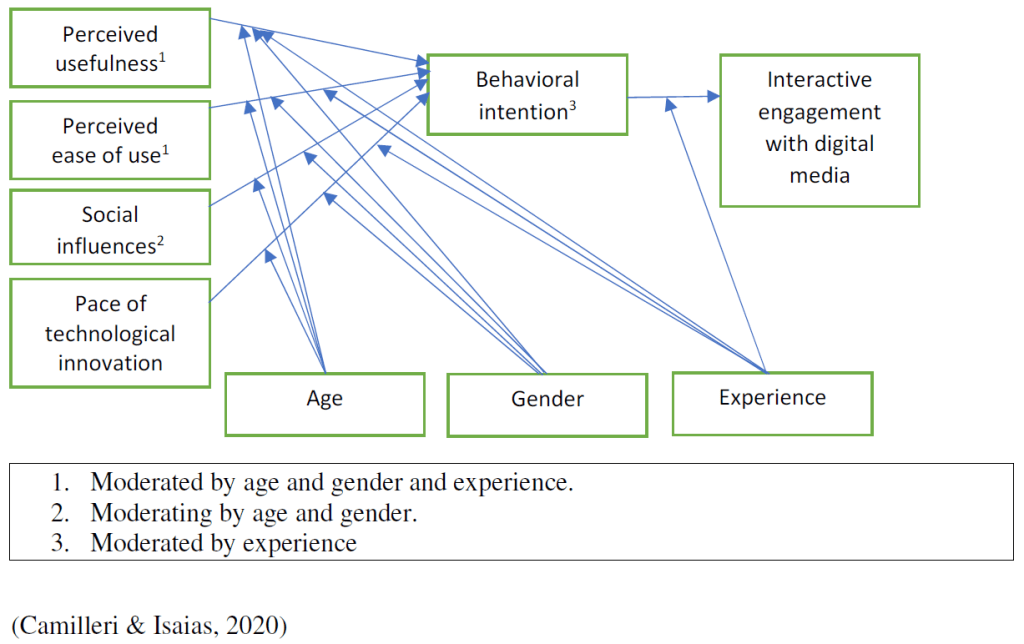
The study adapted the constructs from the technology acceptance model and from the theory of planned behavior. In sum, it hypothesizes that the individuals’ pace of technological innovation, perceived usefulness, ease of use and social influences are the antecedents of their behavioral intention to use the digital media for interactive engagement with online users. Moreover, it presumes that the demographic variables, including age, gender and experience mediate these relationships, as illustrated in Figure 1.
Figure 1. A research model on the users’ interactive engagement with digital media
References
Brouthers, K. D., Nakos, G. & Dimitratos, P. (2015). SME entrepreneurial orientation, international performance, and the moderating role of strategic alliances. Entrepreneurship Theory and Practice, 39(5), 1161-1187.
Camilleri, M. A. (2018a). The SMEs’ technology acceptance of digital media for stakeholder engagement. Journal of Small Business and Enterprise Development, 26(4), 504-521.
Camilleri, M. A. (2018b). The promotion of responsible tourism management through digital media. Tourism Planning & Development, 15(6), 653-671.
Camilleri, M. A. (2019a). Measuring the hoteliers’ interactive engagement through social media. In 14th European Conference on Innovation and Entrepreneurship (ECIE2019), University of Peloponnese, Kalamata, Greece.
Camilleri, M. A. (2019b). The online users’ perceptions toward electronic government services. Journal of Information, Communication and Ethics in Society, 18(2), 221-235.
Camilleri, M.A. (2020a). Strategic dialogic communication through digital media during COVID-19. In Camilleri, M.A. (Ed.), Strategic Corporate Communication in the Digital Age, Emerald, UK.
Capriotti, P., Zeler, I. & Camilleri, M.A. (2020). Corporate communication through social networks: The identification of key dimensions for dialogic communication. In Camilleri, M.A. (Ed.), Strategic Corporate Communication in the Digital Age, Emerald, UK.
Filieri, R. (2016). What makes an online consumer review trustworthy?. Annals of Tourism Research, 58, 46-64.
Hajarian, M., Camilleri, M.A.. Diaz, P & Aedo, I. (2020). A taxonomy of online marketing methods for corporate communication. In Camilleri, M.A. (Ed.), Strategic Corporate Communication in the Digital Age, Emerald, UK.
Harrigan, P. & Miles, M. (2014). From e-CRM to s-CRM. Critical factors underpinning the social CRM activities of SMEs. Small Enterprise Research, 21(1), 99-116.
Kaplan, A. M. & Haenlein, M. (2010). Users of the world, unite! The challenges and opportunities of Social Media. Business Horizons, 53(1), 59-68.
Lamberton, C. & Stephen, A. T. (2016). A thematic exploration of digital, social media, and mobile marketing: Research evolution from 2000 to 2015 and an agenda for future inquiry. Journal of Marketing, 80(6), 146-172.
Rather, R. A., & Camilleri, M. A. (2019). The effects of service quality and consumer-brand value congruity on hospitality brand loyalty. Anatolia, 30(4), 547-559.
Rios Marques, I., Casais, B. & Camilleri, M.A. (2020). The effect of macro celebrity and micro influencer endorsements on consumer-brand engagement on Instagram. In Camilleri, M.A. (Ed.), Strategic Corporate Communication in the Digital Age, Emerald, UK.
Schultz, F., Utz, S. & Göritz, A. (2011). Is the medium the message? Perceptions of and reactions to crisis communication via twitter, blogs and traditional media. Public Relations Review, 37(1), 20-27
Sin Tan, K., Choy Chong, S., Lin, B. & Cyril Eze, U. (2010). Internet-based ICT adoption among SMEs: Demographic versus benefits, barriers, and adoption intention. Journal of Enterprise Information Management, 23(1), 27-55.
Taiminen, H. M. & Karjaluoto, H. (2015). The usage of digital marketing channels in SMEs. Journal of Small Business and Enterprise Development, 22(4), 633-651.
This authoritative book features a broad spectrum of theoretical and empirical contributions on topics relating to corporate communications in the digital age. It is a premier reference source and a valuable teaching resource for course instructors of advanced, undergraduate and post graduate courses in marketing and communications. It comprises fourteen engaging and timely chapters that appeal to today’s academic researchers including doctoral candidates, postdoctoral researchers, early career academics, as well as seasoned researchers. All chapters include an abstract, an introduction, the main body with headings and subheadings, conclusions and research implications. They were written in a critical and discursive manner to entice the curiosity of their readers.
Chapter 1 provides a descriptive overview of different online technologies and presents the findings from a systematic review on corporate communication and digital media. Camilleri (2020) implies that institutions and organizations ought to be credible and trustworthy in their interactive, dialogic communications during day-to-day operations as well as in crisis situations, if they want to reinforce their legitimacy in society. Chapter 2 clarifies the importance of trust and belonging in individual and organizational relationships. Allen, Sven, Marwan and Arslan (2020) suggest that trust nurtures social interactions that can ultimately lead to significant improvements in corporate communication and other benefits for organizations. Chapter 3 identifies key dimensions for dialogic communication through social media. Capriotti, Zeler and Camilleri (2020) put forward a conceptual framework that clarifies how organizations can enhance their dialogic communications through interactive technologies. Chapter 4 explores the marketing communications managers’ interactive engagement with the digital media. Camilleri and Isaias (2020) suggest that the pace of technological innovation, perceived usefulness, ease of use of online technologies as well as social influences are significant antecedents for the businesses’ engagement with the digital media. Chapter 5 explains that the Balanced Scorecard’s (BSC) performance management tools can be used to support corporate communications practitioners in their stakeholder engagement. Oliveira, Martins, Camilleri and Jayantilal (2020) imply that practitioners can use BSC’s metrics to align their communication technologies, including big data analytics, with organizational strategy and performance management, in the digital era. Chapter 6 focuses on UK universities’ corporate communications through Twitter. Mogaji, Watat, Olaleye and Ukpabi (2020) find that British universities are increasingly using this medium to attract new students, to retain academic employees and to promote their activities and events. Chapter 7 investigates the use of mobile learning (m-learning) technologies for corporate training. Butler, Camilleri, Creed and Zutshi (2020) shed light on key contextual factors that can have an effect on the successful delivery of continuous professional development of employees through mobile technologies.
Chapter 8 evaluates the effects of influencer marketing on consumer-brand engagement on Instagram. Rios Marques, Casais and Camilleri (2020) identify two types of social media influencers. Chapter 9 explores in-store communications of large-scale retailers. Riboldazzi and Capriello (2020) use an omni-channel approach as they integrate traditional and digital media in their theoretical model for informative, in-store communications. Chapter 10 indicates that various corporations are utilizing different social media channels for different purposes. Troise and Camilleri (2020) contend that they are using them to promote their products or services and/or to convey commercial information to their stakeholders. Chapter 11 appraises the materiality of the corporations’ integrated disclosures of financial and non-financial performance. Rodríguez-Gutiérrez (2020) identifies the key determinants for the materiality of integrated reports.Chapter 12 describes various electronic marketing (emarketing) practices of micro, small and medium sized enterprises in India. Singh, Kumar and Kalia (2020) conclude that Indian owner-managers are not always engaging with their social media followers in a professional manner. Chapter 13 suggests that there is scope for small enterprises to use Web 2.0 technologies and associated social media applications for branding, advertising and corporate communication. Oni (2020) maintains that social media may be used as a marketing communications tool to attract customers and for internal communications with employees. Chapter 14 shed light on the online marketing tactics that are being used for corporate communication purposes. Hajarian, Camilleri, Diaz and Aedo (2020) outline different online channels including one-way and two-way communication technologies.
Endorsements
“Digital communications are increasingly central to the process of building trust, reputation and support. It’s as true for companies selling products as it is for politicians canvasing for votes. This book provides a framework for understanding and using online media and will be required reading for serious students of communication”.
Dr. Charles J. Fombrun, Former Professor at New York University, NYU-Stern School, Founder & Chairman Emeritus, Reputation Institute/The RepTrak Company.
“This book has addressed a current and relevant topic relating to an important aspect of digital transformation. Various chapters of this book provide valuable insights about a variety of issues relating to “Strategic Corporate Communication in the Digital Age”. The book will be a useful resource for both academics and practitioners engaged in marketing- and communications-related activities. I am delighted to endorse this valuable resource”.
Dr. Yogesh K. Dwivedi, Professor at the School of Management at Swansea University, UK and Editor-in-Chief of the International Journal of Information Management.
“This title covers a range of relevant issues and trends related to strategic corporate communication in an increasingly digital era. For example, not only does it address communication from a social media, balanced scorecard, and stakeholder engagement perspective, but it also integrates relevant contemporary insights related to SMEs and COVID-19. This is a must-read for any corporate communications professional or researcher”.
Dr. Linda Hollebeek, Associate Professor at Montpellier Business School, France and Tallinn University of Technology, Estonia.
“Corporate communication is changing rapidly, and digital media represent a tremendous opportunity for companies of all sizes to better achieve their communication goals. This book provides important insights into relevant trends and charts critical ways in which digital media can be used to their full potential”
Dr. Ulrike Gretzel, Director of Research at Netnografica and Senior Fellow at the Center for Public Relations, University of Southern California, USA.
“This new book by Professor Mark Camilleri promises again valuable insights in corporate communication in the digital era with a special focus on Corporate Social Responsibility. The book sets a new standard in our thinking of responsibilities in our digital connected world”.
Dr. Wim Elving, Professor at Hanze University of Applied Sciences, Groningen, The Netherlands.
References
Allen, K.A. Sven, G.T., Marwan, S. & Arslan, G. (2020). Trust and belonging in individual and organizational relationships. In Camilleri, M.A. (Ed.), Strategic Corporate Communication in the Digital Age, Emerald, UK.
Butler, A. Camilleri, M.A., Creed, A. & Zutshi, A. (2020). The use of mobile learning technologies for corporate training and development: A contextual framework. In Camilleri, M.A. (Ed.), Strategic Corporate Communication in the Digital Age, Emerald, UK.
Camilleri, M.A. (2020). Strategic dialogic communication through digital media during COVID-19. In Camilleri, M.A. (Ed.), Strategic Corporate Communication in the Digital Age, Emerald, UK.
Camilleri, M.A. & Isaias, P. (2020). The businesses’ interactive engagement through digital media. In Camilleri, M.A. (Ed.), Strategic Corporate Communication in the Digital Age, Emerald, UK.
Capriotti, P., Zeler, I. & Camilleri, M.A. (2020). Corporate communication through social networks: The identification of key dimensions for dialogic communication. In Camilleri, M.A. (Ed.), Strategic Corporate Communication in the Digital Age, Emerald, UK.
Hajarian, M., Camilleri, M.A.. Diaz, P & Aedo, I. (2020). A taxonomy of online marketing methods for corporate communication. In Camilleri, M.A. (Ed.), Strategic Corporate Communication in the Digital Age, Emerald, UK.
Mogaji, E., Watat, J.K., Olaleye, S.A. & Ukpabi, D. (2020). Recruit, retain and report: UK universities’ strategic communication with stakeholders on Twitter. In Camilleri, M.A. (Ed.), Strategic Corporate Communication in the Digital Age, Emerald, UK.
Oliveira, C., Martins, A., Camilleri, M.A. & Jayantilal, S. (2020). Using the balanced scorecard for strategic communication and performance management. In Camilleri, M.A. (Ed.), Strategic Corporate Communication in the Digital Age, Emerald, UK.
Oni, O. (2020). Small and medium sized enterprises’ engagement with social media for corporate communication. In Camilleri, M.A. (Ed.), Strategic Corporate Communication in the Digital Age, Emerald, UK.
Riboldazzi, S. & Capriello, A. (2020). Large-scale retailers, digital media and in-store communications. In Camilleri, M.A. (Ed.), Strategic Corporate Communication in the Digital Age, Emerald, UK.
Rios Marques, I., Casais, B. & Camilleri, M.A. (2020). The effect of macro celebrity and micro influencer endorsements on consumer-brand engagement on Instagram. In Camilleri, M.A. (Ed.), Strategic Corporate Communication in the Digital Age, Emerald, UK.
Rodríguez-Gutiérrez, P. (2020). Corporate communication and integrated reporting: the materiality determination process and stakeholder engagement in Spain. In Camilleri, M.A. (Ed.), Strategic Corporate Communication in the Digital Age, Emerald, UK.
Singh, T., Kumar, R. & Kalia, P. (2020). E-marketing practices of micro, small and medium sized enterprises. Evidence from India. In Camilleri, M.A. (Ed.), Strategic Corporate Communication in the Digital Age, Emerald, UK.
Troise, C. & Camilleri, M.A. (2020). The use of the digital media for marketing, CSR communication and stakeholder engagement. In Camilleri, M.A. (Ed.), Strategic Corporate Communication in the Digital Age, Emerald, UK.
Abstract submission deadline: 30th June 2020
Full chapters due: 31st December 2020
The Brundtland Report (WCED, 1987) defined sustainable development as; “development that meet the needs of the present without compromising the ability of future generations to meet their own needs” (p. 43). Its underlying assumption is that the world’s physical resources are not finite; therefore, they have to be managed responsibly to sustain future generations (Camilleri, 2018a; Camilleri, 2014). Subsequently, the United Nations (UN) Conference on Environment and Development has put forward Agenda 21 that dedicated a chapter that was focused on unsustainable patterns of production and consumption. This document recommended that the UN’s member states ought to intensify their efforts to reduce the use of scarce resources during production processes, whilst minimising the environmental impacts from the generation of waste and pollution (Camilleri, 2018a; Camilleri, 2014; Agenda 21, 1992).
In 2002, the UN Report of the World Summit on Sustainable Development also made reference to unsustainable patterns of production and consumption. The UN’s member states were urged to manage their natural resources in a sustainable manner and with lower negative environmental impacts; by promoting the conservation and sustainable use of biodiversity and ecosystems, whilst reducing waste (WSSD, 2002, p. 13). Moreover, in another resolution, entitled; “The future we want,” the General Assembly at the UN Conference on Sustainable Development has reaffirmed its commitment to implementing green economy policies in the context of sustainable development. The heads of state and government or their representatives have agreed to continue promoting the integrated and sustainable management of ecosystems, whilst facilitating their conservation, regeneration, and restoration of resources (UNCSD, 2012). Furthermore, during the UN’s General Assembly Resolution of September 25 2015 entitled “Transforming our world: the 2030 Agenda for Sustainable Development,” the world leaders have agreed to adopt the Sustainable Development Goals that replaced the previous millennium development goals that were established in the year 2000. Specifically, the Sustainable Development Goal 12 of the 2030 agenda, namely, “Sustainable Consumption and Production” explained that there is an opportunity for business and industry to reap economic gains through resource and energy efficiencies. It also raised awareness on the use of sustainable infrastructures and urged the UN member states to address air, water, and soil pollution to minimise their environmental impact (UNDP, 2015). Moreover, the Paris Climate Agreement (COP 21) and Resolutions 1/5 and 2/7 on chemicals and waste, and 2/8 on sustainable production and consumption, as adopted by the first and second sessions of the United Nations Environment Assembly (that was held in Nairobi, Kenya, on the June 27, 2014 and the May 27, 2016), are also considered as important policy instruments for many stakeholders, as they have paved the way for the transition towards the CE strategy.
These intergovernmental policy recommendations on sustainable consumption and production have led to increased regulatory pressures on business and industry towards controlled operations management and environmentally responsible practices.
Relevant theoretical underpinnings reported that the circular economy reduces the reliance on resource extraction and raw materials (Camilleri, 2018b; Camilleri, 2017; Cooper, 1999). Therefore, it restores any damage in resource acquisition by ensuring that little waste is generated throughout the production process and during the products’ life. Liu, Li, Zuo, Zhang, and Wang (2009) explained that the circular economy aims at minimising the generation of waste, as it involves environmental conservation. Similarly, Su, Heshmati, Geng, and Yu (2013) contended that the circular economy strategy involves efficiency‐oriented control systems at all stages of production, distribution, and consumption of materials. They made reference to energy efficiency and water conservation, land management, and soil protection, among other issues. Hence, the circular economy model can lead to resource and energy efficiencies as well as economic development.
In this light, the publisher is calling for theoretical and empirical contributions that are focused on the sustainable production and consumption of resources, materials and products. Therefore, the readers of this publication will be in a better position to understand the operations and strategies in manufacturing industries as well as in closed loop and product-service systems (Camilleri, 2018a). This special issue will include but is not limited to the following topics:
Alternative consumption patterns;
Assessment and Reporting;
Biomass;
Clean production;
Circular economy;
Circular economy business models;
Circular economy product designs;
Climate change;
Climate change policy and adaptation;
Closed loop systems;
Corporate social responsibility;
Corporate sustainability,
Eco-efficiency;
Eco-industrial parks;
Ecological management and natural capital;
Education for sustainability;
Emissions reduction;
Energy efficiency;
Energy policy;
Energy use and consumption;
Environmental assessment;
Environmental behavior;
Environmental economics;
Environmental management;
Environmental policy;
Environmental protection;
Environmental sustainability;
Extended producer responsibility;
Footprints and other assessment types;
Green/sustainable engineering;
Green/sustainable supply chains;
Industrial, agricultural and supply chains;
Industrial ecology;
Life cycle assessment;
Pollution reduction;
Product-service systems;
Recycling Resources;
Regional sustainability;
Renewable energy;
Renewable resource;
Resource and energy use;
Resource Efficiency;
Sustainable consumption;
Sustainable production;
Sustainable tourism;
Urban and regional sustainability;
Water conservation;
Waste management;
Waste minimization;
Submission Procedure
Academics and researchers are invited to submit a 300-word abstract before the 30th June 2020. Submissions should be sent to Mark.A.Camilleri@um.edu.mt. Authors will be notified about the editorial decision during July 2020. The accepted chapters should be submitted before the 31st December 2020. The length of the chapters should be around 7,000 words (including references, figures and tables). The references should be presented in APA style (Version 6). All submitted chapters will be critically reviewed on a double-blind review basis. All authors will be requested to serve as reviewers for this book. They will receive a notification of acceptance, rejection or suggested modifications –before the 25th February 2021.
Note: There are no submission or acceptance fees for the publication of the book chapters. All abstracts / proposals should be submitted via the editor’s email.
Editor
Prof. Dr. Mark Anthony Camilleri (Ph.D. Edinburgh)
Following the double-blind peer review process, the full chapters will be submitted to Emerald for final review. For additional information regarding the publisher, please visit https://www.emerald.com/insight/. This prospective publication will be released in 2021.
Camilleri, M. (2014). Advancing the sustainable tourism agenda through strategic CSR perspectives. Tourism Planning & Development, 11(1), 42-56.
Camilleri, M. A. (2017). Closing the Loop of the Circular Economy for Corporate Sustainability and Responsibility. In Corporate Sustainability, Social Responsibility and Environmental Management (pp. 175-190). Springer, Cham.
Camilleri, M. A. (2018a). The circular economy’s closed loop and product service systems for sustainable development: A review and appraisal. Sustainable Development, 27(3), 530-536.
Camilleri, M. A. (2018b). Closing the loop for resource efficiency, sustainable consumption and production: A critical review of the circular economy. International Journal of Sustainable Development.21(1-4), 1-17.
Cooper, T. (1999). Creating an economic infrastructure for sustainable product design. Journal of Sustainable Product Design, 8, 7– 17.
Liu, Q., Li, H. M., Zuo, X. L., Zhang, F. F., & Wang, L. (2009). A survey and analysis on public awareness and performance for promoting circular economy in China: A case study from Tianjin. Journal of Cleaner Production, 17, 265– 270. https://doi.org/10.1016/j.jclepro.2008.06.003
Su, B., Heshmati, A., Geng, Y., & Yu, X. (2013). A review of the circular economy in China: Moving from rhetoric to implementation. Journal of Cleaner Production, 42, 215– 227. https://doi.org/10.1016/j.jclepro.2012.11.020
WCED (1987). Our common future. In World commission on environment and development. Oxford, U.K: Oxford University press.
WSSD (2002). United Nations report of the world summit on sustainable development. Johannesburg, South Africa, 26 August‐ 4 September 2002. http://www.un‐documents.net/aconf199‐20.pdf.
I am co-editing a Special issue for Sustainability (IF: 2.592). Your contributions should be related to “The Sustainable Development of Smart Cities through Digital Innovation”
Deadline for manuscript submissions:31 October 2020.
Special Issue Information
The ‘smart city’ concept has been wrought from distinctive theoretical underpinnings. Initially, this term was used to describe those cities that utilized advanced computerized systems to provide a safe, secure, green, and efficient transportation services and utilities to meet the demands of their citizens (Caragliu, Del Bo & Nijkamp, 2011; Hall, Bowerman and Braverman, Taylor, Todosow and Von Wimmersperg, 2000). A thorough literature review suggests that several cities are already using disruptive technologies, including advanced, integrated materials, sensors, electronics, and networks, among others, which are interfaced with computerized systems to improve their economic, social and environmental sustainability (Camilleri, 2015, 2017; Deakin and Al Waer, 2011; Hall et al., 2000). These cities are increasingly relying on data-driven technologies, as they gather and analyze data from urban services including transportation and utilities (Ramaswami, Russell, Culligan, Sharma and Kumar, 2016; Gretzel, Sigala, Xiang and Koo, 2015). Their underlying objective is to improve the quality of life of their citizens (Ratten, 2017; Buhalis and Amaranggana, 2015). Hence, ‘smart cities’ have introduced technological innovations to address contingent issues like traffic congestion; air pollution; waste management; loss of biodiversity and natural habitat; energy generation, conservation and consumption; water leakages and security, among other matters (Camilleri, 2019; 2014; Ahvenniemi, Huovila, Pinto-Seppä and Airaksinen, 2017; Ratten and Dana, 2017; Ratten, 2017).
Ecologically-advanced local governments and municipalities are formulating long-term sustainable policies and strategies. Some of them are already capturing data through multisensor technologies via wireless communication networks in real time (Bibri, 2018; Bibri and Krogstie, 2017). Very often, they use the Internet’s infrastructure and a wide range of smart data-sensing devices, including radio frquency identification (RFID), near-field communication (NFC), global positioning systems (GPS), infrared sensors, accelerometers, and laser scanners (Bibri, 2018). A few cities have already started to benefit from the Internet of Things (IoT) technology and its sophisticated network that consists of sensor devices and physical objects including infrastructure and natural resources (Zanella, Bui, Castellani, Vangelista and Zorzi, 2014).
Several cities are crunching big data to better understand how to make their cities smarter, more efficient, and responsive to today’s realities (Mohanty, Choppali and Kougianos, 2016; Ramaswami et al., 2016). They gather and analyze a vast amount of data and intelligence on urban aspects, including transportation issues, citizen mobility, traffic management, accessibility and protection of cultural heritage and/or environmental domains, among other areas (Angelidou, Psaltoglou, Komninos, Kakderi, Tsarchopoulos and Panori, 2018; Ahvenniemi et al., 2017). The latest advances in technologies like big data analytics and decision-making algorithms can support local governments and muncipalities to implement the circular economy in smart cities (Camilleri, 2019). The data-driven technologies enable them them to reduce their externalities. They can monitor and control the negative emissions, waste, habitat destruction, extinction of wildlife, etc. Therefore, the digital innovations ought to be used to inform the relevant stakeholders in their strategic planning and development of urban environments (Camilleri, 2019; Allam & Newman, 2018; Yigitcanlar and Kamruzzaman, 2018; Angelidou et al. ,2018; Caragliu et al., 2011).
In this light, we are calling for theoretical and empirical contributions that are focused on the creation, diffusion, as well as on the utilization of technological innovations and information within the context of smart, sustainable cities. This Special Issue will include but is not limited to the following topics:
Advancing the circular economy agenda in smart cities;
Artificial intelligence and machine learning in smart cities;
Blockchain technologies in smart cities;
Green economy of smart cities;
Green infrastructure in smart cities;
Green living environments in smart cities;
Smart cities and the sustainable environment;
Smart cities and the use of data-driven technologies;
Smart cities and the use of the Internet of Things (IoT);
Sustainable energy of smart cities;
Sustainable financing for infrastructural development in smart cities;
Sustainable housing in smart cities;
Sustainable transportation in smart cities;
Sustainable tourism in smart cities;
Technological innovation and climate change for smart cities;
Technological innovation and the green economy of smart cities;
Technological innovation and the renewable energy in smart cities;
Technological innovation and urban resilience of smart cities;
Technological innovation for the infrastructural development of smart cities;
The accessibility and protection of the cultural heritage in smart cities;
The planning and design of smart cities;
The quality of life of the citizens and communities living in smart cities;
Urban innovation in smart cities;
Urban planning that integrates the smart city development with the greening of the environment;
Urban planning and data driven technologies of smart cities.
Department of Corporate Communication, University of Malta, Msida, MSD2080, Malta. Interests: sustainability; digital media; stakeholder engagement; corporate social responsibility; sustainable tourism
Prof. Dr. Vanessa RattenE-MailWebsite
Department of Entrepreneurship, Innovation and Marketing, La Trobe University – Melbourne, Australia Interests: innovation; technology; entrepreneurship
References:
Ahvenniemi, H., Huovila, A., Pinto-Seppä, I., & Airaksinen, M. (2017). What are the differences between sustainable and smart cities?. Cities, 60, 234-245.
Allam, Z., & Newman, P. (2018). Redefining the smart city: Culture, metabolism and governance. Smart Cities, 1(1), 4-25
Angelidou, M., Psaltoglou, A., Komninos, N., Kakderi, C., Tsarchopoulos, P., & Panori, A. (2018). Enhancing sustainable urban development through smart city applications. Journal of Science and Technology Policy Management, 9(2), 146-169.
Bibri, S. E., & Krogstie, J. (2017). Smart sustainable cities of the future: An extensive interdisciplinary literature review. Sustainable cities and society, 31, 183-212.
Bibri, S. E. (2018). The IoT for smart sustainable cities of the future: An analytical framework for sensor-based big data applications for environmental sustainability. Sustainable Cities and Society, 38, 230-253.
Buhalis, D., & Amaranggana, A. (2015). Smart tourism destinations enhancing tourism experience through personalisation of services. In Information and communication technologies in tourism 2015 (pp. 377-389). Springer, Cham.
Camilleri, M. (2014). Advancing the sustainable tourism agenda through strategic CSR perspectives. Tourism Planning & Development, 11(1), 42-56.
Camilleri, M. A. (2015). Environmental, social and governance disclosures in Europe. Sustainability Accounting, Management and Policy Journal, 6(2), 224-242.
Camilleri, M. A. (2017). Corporate sustainability and responsibility: creating value for business, society and the environment. Asian Journal of Sustainability and Social Responsibility, 2(1), 59-74.
Camilleri, M. A. (2019). The circular economy’s closed loop and product service systems for sustainable development: A review and appraisal. Sustainable Development, 27(3), 530-536.
Caragliu, A., Del Bo, C., & Nijkamp, P. (2011). Smart cities in Europe. Journal of urban technology, 18(2), 65-82.
Deakin, M., & Al Waer, H. (2011). From intelligent to smart cities. Intelligent Buildings International, 3(3), 140-152.
Gretzel, U., Sigala, M., Xiang, Z., & Koo, C. (2015). Smart tourism: foundations and developments. Electronic Markets, 25(3), 179-188.
Hall, R. E., Bowerman, B., Braverman, J., Taylor, J., Todosow, H., & Von Wimmersperg, U. (2000). The vision of a smart city (No. BNL-67902; 04042). Brookhaven National Lab., Upton, NY (US).
Mohanty, S. P., Choppali, U., & Kougianos, E. (2016). Everything you wanted to know about smart cities: The internet of things is the backbone. IEEE Consumer Electronics Magazine, 5(3), 60-70.
Ramaswami, A., Russell, A. G., Culligan, P. J., Sharma, K. R., & Kumar, E. (2016). Meta-principles for developing smart, sustainable, and healthy cities. Science, 352(6288), 940-943.
Ratten, V., & Dana, L. P. (2017). Sustainable entrepreneurship, family farms and the dairy industry. International Journal of Social Ecology and Sustainable Development (IJSESD), 8(3), 114-129.
Ratten, V. (2017). Entrepreneurship, innovation and smart cities. Routledge: Oxford, UK.
Yigitcanlar, T., & Kamruzzaman, M. (2018). Does smart city policy lead to sustainability of cities? Land Use Policy, 73, 49-58.
Zanella, A., Bui, N., Castellani, A., Vangelista, L., & Zorzi, M. (2014). Internet of things for smart cities. IEEE Internet of Things journal, 1(1), 22-32.
Manuscript Submission Information
Manuscripts should be submitted online at www.mdpi.com by registering and logging in to this website. Once you are registered, click here to go to the submission form. Manuscripts can be submitted until the deadline. All papers will be peer-reviewed. Accepted papers will be published continuously in the journal (as soon as accepted) and will be listed together on the special issue website. Research articles, review articles as well as short communications are invited. For planned papers, a title and short abstract (about 100 words) can be sent to the Editorial Office for announcement on this website.
Submitted manuscripts should not have been published previously, nor be under consideration for publication elsewhere (except conference proceedings papers). All manuscripts are thoroughly refereed through a single-blind peer-review process. A guide for authors and other relevant information for submission of manuscripts is available on the Instructions for Authors page. Sustainability is an international peer-reviewed open access semimonthly journal published by MDPI.
What is Strategic Corporate Social Responsibility?
Organisations engage in Strategic Corporate Social Responsibility (Strategic CSR) when they integrate responsible behaviours in their corporate practices (Camilleri, 2018; Porter & Kramer, 2011). Therefore, Strategic CSR is often evidenced by the businesses’ engagement with key stakeholders, including customers, employees, shareholders, regulatory authorities and communities as their non-financial activities can have an effect on society and the natural environment (Camilleri, 2017a). The ultimate goal of strategic CSR is to create both economic and social value (Carroll & Shabana, 2010; Falck & Heblich, 2007).
Introduction
The businesses’ CSR practices may result in a sustained competitive advantage if they are willing to forge strong relationships with their stakeholders (Camilleri, 2015a; Freeman, & McVea, 2001). Therefore, businesses ought to communicate with employees, customers, suppliers, regulatory stakeholders as well as with their surrounding community (EU, 2016; Bhattacharya, Korschun & Sen, 2009). Positive stakeholder relationships can lead to an improved organizational performance, in the long run (Camilleri, 2015a).
The most successful businesses are increasingly promoting the right conditions of employment for their employees, within their supply chains (Camilleri, 2017b). They are also instrumental in improving the lives of their suppliers (Camilleri, 2017c; Porter & Kramer, 2011). They do so as they would like to enhance the quality and attributes of their products or services; which are ultimately delivered to customers and consumers. Hence, their long-term investments on strategic CSR activities are likely to yield financial returns for them. At the same time they will add value to society (McWilliams et al., 2006; Falck & Heblich, 2007). Therefore, the strategic CSR involves the promotion of socially and environmentally responsible practices they are re-aligned with the businesses’ profit motives (Camilleri, 2017b,c).
Key Theoretical Underpinnings
The Strategic CSR perspective resonates well with the agency theory. In the past, scholars argued that the companies’ only responsibility was to maximise their owners’ and shareholders’ wealth (Levitt, 1958; Friedman, 1970). Hence, companies were often encouraged to undertake CSR strategies which can bring value to their businesses and to disregard those activities which are fruitless. However, at times, the fulfilment of philanthropic responsibilities can also benefit the bottom line (Lantos, 2001).
Although, it could be difficult to quantify the returns of responsible behaviours, relevant research has shown that those companies that practiced social and environmental responsibility did well by doing good (Falck & Heblich, 2007, Porter & Kramer, 2011).Some of the contributions on this topic suggest that corporate philanthropy should be deeply rooted in the firms’ competences and linked to their business environment (Camilleri, 2015; Porter & Kramer, 2002; Godfrey, 2005). Many authors often referred to the CSR’s core domains (economic, legal and ethical responsibilities) that were compatible and consistent with the relentless call for the business case of CSR (Camilleri, 2015b; Carroll & Shabana, 2010, Vogel, 2005).
Many commentators argued that the strategic CSR practices may result in a new wave of social benefits as well as gains for the businesses themselves (Fombrun et al., 2000; Porter & Kramer, 2011) rather than merely acting on well-intentioned impulses or by reacting to outside pressures (Van Marrewijk, 2003). Lozano (2015) indicated that the business case is the most important driver for CSR engagement. Thus, proper incentives may encourage managers ‘to do well by doing good’ (Falck & Heblich, 2007). If it is a company’s goal to survive and prosper, it can do nothing better than to take a long-term view and understand that if it treats society well, society will return the favour. Companies could direct their discretionary investments to areas (and cost centres) that are relevant to them (Gupta & Sharma, 2009). The reconciliation of shareholder and other stakeholders addresses the perpetual relationship between business and society, as companies are expected to balance the conflicting stakeholder interests for long term sustainability (Orlitzky et al., 2011; Camilleri, 2017c; Camilleri 2019).
Conclusion Many companies are increasingly recognising the business case for CSR as they allocate adequate and sufficient resources to financial and non-financial activities that will ultimately benefit their stakeholders. Their motivation behind their engagement in strategic CSR practices is to increase their profits and to create shareholder value. At the same time, they strengthen their competitive advantage through stakeholder management.
References
Bhattacharya CB, Korschun D, Sen S (2009). Strengthening stakeholder–company relationships through mutually beneficial corporate social responsibility initiatives. J Bus Ethics 85(2):257–272.
Camilleri, M.A. (2015a). Valuing Stakeholder Engagement and Sustainability Reporting. Corporate Reputation Review, 18 (3), 210-222.
Camilleri, M.A. (2015b) The Business Case for Corporate Social Responsibility. In Menzel Baker, S. & Mason, M.(Eds.) Marketing & Public Policy as a Force for Social Change Conference. (Washington D.C., 4th June). Proceedings, pp. 8-14, American Marketing Association.
Camilleri M.A. (2017a) Corporate sustainability, social responsibility and environmental management: an introduction to theory and practice with case studies. Springer, Cham, Switzerland. Camilleri, M.A. (2017b). Corporate Citizenship and Social Responsibility Policies in the United States of America. Sustainability Accounting, Management and Policy Journal. 8 (1), 77-93.
Camilleri, M.A. (2017c). The Rationale for Responsible Supply Chain Management and Stakeholder Engagement. Journal of Global Responsibility. 8 (1), 111-126.
Camilleri, M.A. (2018). The SMEs’ Technology Acceptance of Digital Media for Stakeholder Engagement. Journal of Small Business and Enterprise Development. 26(4), 504-521.
Camilleri, M.A. (2019). Measuring the corporate managers’ attitudes toward ISO’s social responsibility standard. Total Quality Management & Business Excellence. 30(14), 1549-1561.
Carroll AB, Shabana KM (2010). The business case for corporate social responsibility: a review of concepts, research and practice. Int J Manag Rev 12(1):85–105.
Falck O, Heblich S (2007). Corporate social responsibility: doing well by doing good. Business Horizons 50(3):247–254.
Freeman, R. E., & McVea, J. (2001). A stakeholder approach to strategic management. The Blackwell handbook of strategic management, 189-207.
Friedman M (1970). The social responsibility of business is to increase its profits. New York Times Magazine 13:32–33.
Godfrey PC (2005). The relationship between corporate philanthropy and shareholder wealth: a risk management perspective. Acad Manag Rev 30(4):777–798.
Gupta S, Sharma N (2009). CSR-A business opportunity. Indian Journal of Industrial Relations:396–401.
Lantos GP (2001). The boundaries of strategic corporate social responsibility. J Consum Mark 18(7):595–632.
Levitt T (1958). The dangers of social-responsibility. Harv Bus Rev 36(5):41–50.
Lozano R (2015). A holistic perspective on corporate sustainability drivers. Corp Soc Responsib Environ Manag 22(1): 32–44.
Orlitzky M, Siegel DS, Waldman DA (2011). Strategic corporate social responsibility and environmental sustainability. Business & society 50(1):6–27.



 Substantia Mea
You must be logged in to post a comment.